
The advice you hear most often about boxed red is that it's a compromise. Fine for a party, fine for the second glass on a Tuesday, never the bottle you'd choose. The same people will tell you the opposite in the next breath, that a box keeps wine fresh for weeks after opening, so it's always the sensible buy.
Both statements miss what decides quality. Packaging doesn't make a red good or bad. Freshness, oxygen and turnover do, and those three things vary far more between individual boxes than they ever do between box and bottle.
I judge a red wine box the way a buyer judges any stock: what's in it, when it was packed, how it's been stored, and whether you'll finish it before it fades. Get those right and the format wins on cost. Get them wrong and you've bought four litres of disappointment.
What Boxed Red Wine Is and Why It Is Not Automatically Cheap
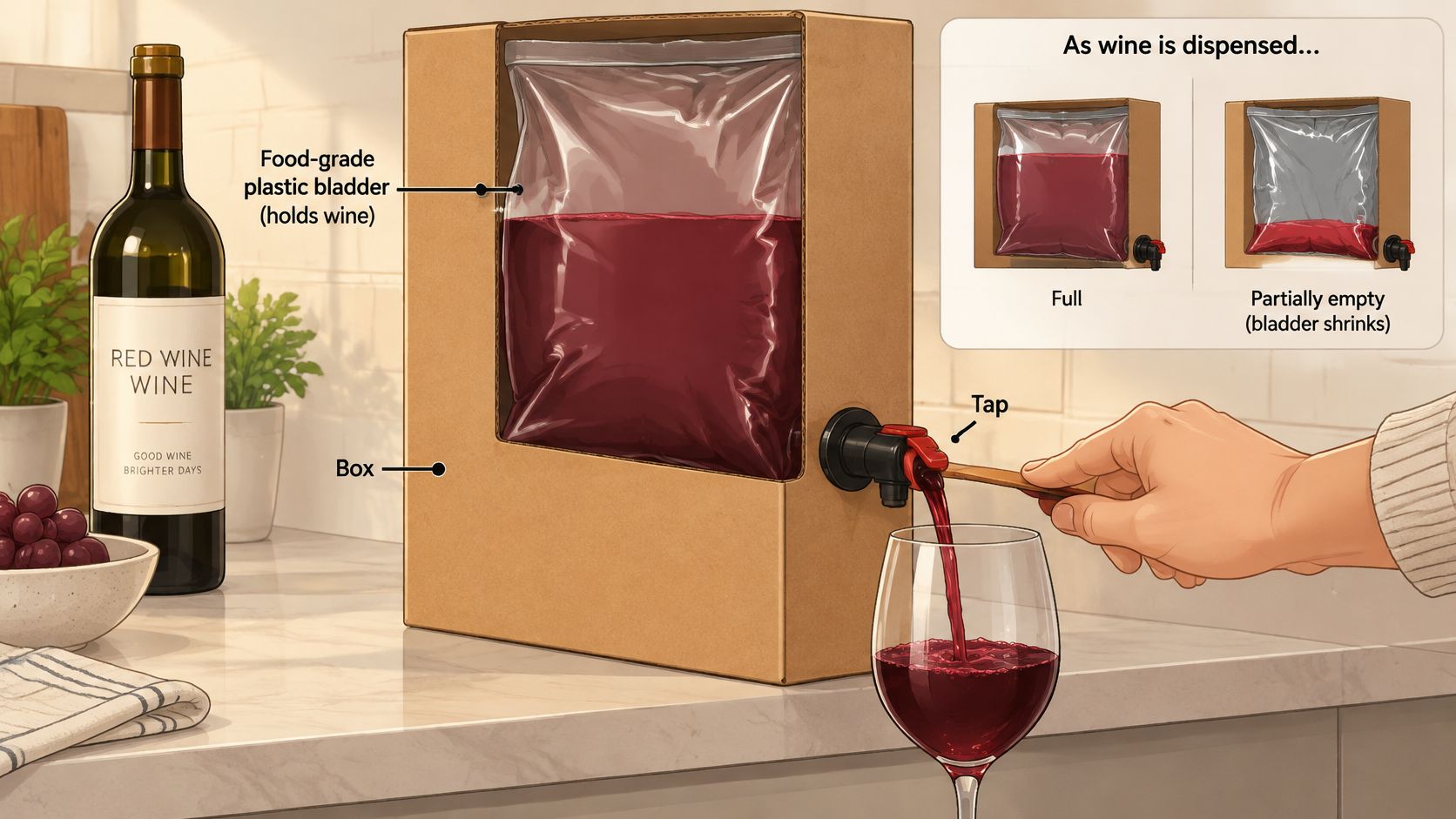
A red wine box holds wine in a food-grade plastic bladder sealed inside a cardboard carton, dispensed through a tap at the base. The closest everyday comparison is a squeezed fruit juice pouch: as wine leaves, the bag collapses behind it, so no pocket of air forms above the surface. That one mechanical detail explains most of what the format does well.
Four parts do the work. The outer carton carries the label and protects what's inside. The inner bag is a laminated plastic liner, and its barrier quality sets how long the wine stays fresh. The tap dispenses the wine and is the most common point of failure. The seal around the fitment keeps oxygen out until the first pour.
Names all mean the same thing. Cask, bag-in-box, boxed wine and soft pack describe one family of packaging. Sizes run from 2 litres to 4 litres, and 2 litres is the most common on Australian shelves.
Where the format came from
Boxed wine is a South Australian invention, not a European idea repackaged. In 1965 winemaker Thomas Angove patented a one-gallon polyethylene bladder enclosed in a cardboard box, as the ABC's history of Australian cask wine records. Three steps took it from curiosity to supermarket fixture:
- 1965, the bladder. Angove's patent solved a packaging problem, not a winemaking one.
- The 1970s, the tap. A functional tap made it practical to pour a glass without opening a bottle, and the format became convenient rather than merely cheap.
- The 1980s and 1990s, the volume. Cask wine reportedly reached about half of Australian wine sales, concentrated at the value end and in larger 2 to 4 litre packs.
The speed of that change shows in the litres. Research from the University of Adelaide's Wine Economics Research Centre cited in the same report records Australian wine sold in plastic bags inside boxes rising from 33 million litres in 1978 to 152 million litres in 1984, while bottled red and white sales fell by about a quarter, from 73 million litres to 55 million litres.
What the history doesn't tell you: those figures describe a fight over price and convenience, not a verdict on quality. A box was cheaper to fill, ship and pour, and that's why it won shelf space.
None of this makes the wine inside cheap. The carton, bag and tap cost cents. What you're paying for is the liquid, and a producer who puts good Shiraz in a box is still selling you good Shiraz.
Boxed Red Against Bottled Red at a Glance
| Factor | Boxed red | Bottled red |
|---|---|---|
| Typical pack size | 2 L to 4 L, with 2 L the most typical | 750 mL standard |
| Bottle equivalents | About 2.7 bottles in a 2 L box, about 5.3 in a 4 L box | 1 bottle |
| Cost per litre | Usually lower at the value end | Usually higher for similar quality |
| Oxygen exposure once opened | Low, because the bag collapses as wine is poured | Higher, because air fills the space left in the bottle |
| Packaging and transport weight | Lightweight, lower transport load | Heavy glass, higher transport load |
| Best use | Everyday drinking and entertaining | Gifting, cellaring and prestige wines |
Three forces explain every row. Oxygen once opened is the first: a bottle's headspace fills with air the moment you pour, while a collapsing bag leaves no headspace to fill. Pack size is the second, and it's where most shoppers get caught. A 2 litre box holds roughly 2.7 standard 750 mL bottles, and a 4 litre pack holds about 5.3, so the sticker price tells you almost nothing. Cost per litre is the only comparison worth making. Weight is the third: glass is heavy and fragile, and a filled carton carries less mass per litre and survives freight better.
The broader market backs the format's durability. A Wine Australia life-cycle assessment drawing on Australian Bureau of Statistics and industry production data estimated that Australian still wine sold domestically in 2020–21 totalled 393 million litres, of which about 68% went into conventional 750 mL glass and about 32% into casks, bag-in-box or soft packs at a nominal 2 litre size (Wine Australia market insights). That's roughly 126 million litres in flexible packaging.
Red has a real stake in that number. Red still wine accounted for 32% of retail off-trade still-wine sales by volume in the year ended September 2023, against 46% for white, per the same report. The long trend has nonetheless favoured glass: total cask sales fell 30% between 2004 and 2014 while bottle sales rose by almost 40%.
The rule of thumb: compare cost per litre, then ask how many weeks the box will sit open on your bench. A cheap litre you tip down the sink is the most expensive wine in the shop.
Testing the Real Cost and Sustainability Trade-offs
Spend $30 on four litres, drink two and pour two away, and the good deal becomes $15 a litre for wine you never tasted. That is the turnover test: a box earns its place when the household empties it while the fruit is still bright. A couple drinking a glass each on weekends needs a smaller format than six people finishing a tap over a fortnight.
The green case needs the same discipline, because it is usually sold as a slogan. The submission to the Australian Parliament puts packaging and transport among the winery emissions worth attacking, names lightweight bottles, casks, PET, cans and recycled glass as the available interventions, and cites an Australian sustainable-packaging review finding that 1 litre in a cask or bag-in-box can cut emissions by up to 45% against a heavier 500 gram glass bottle, with the result turning on transport and end-of-life assumptions (submission to the Australian Parliament).
Treat that as a conditional number. Newer recycle-ready packs describe the bag, tap and carton as recyclable, which is the version worth hunting for, but the claim only travels as far as your kerbside rules and the distance the wine shipped.
Four checks before you commit
- Read the material labels on the pack. A recyclable claim is only meaningful when it names which components qualify, and the tap and inner bag are usually the problem parts.
- Call your council before you buy the second box. Kerbside acceptance for soft plastics and taps differs by council area, and a bag that goes to landfill drags the whole comparison back.
- Count the freight distance. The lighter pack wins more decisively the further the wine travels, so a boxed red from a nearby region can beat a bottle flown across the country.
- Compare against the bottle it replaces. A lighter bottle narrows the gap sharply; a heavy prestige bottle widens it.
The same principle governs any durable container: the benefit arrives with repeated use rather than with the purchase, a point HYDAWAY on bottle sustainability makes for bottles. For wine, the box earns that advantage by displacing several bottles in the same month.
For the production side of the ledger, our breakdown of the carbon footprint of wine and what's improving covers viticulture, winery energy and freight in more detail.
A boxed red wins on footprint when the pack is recyclable where you live, the wine travels a short distance, and you drink it. Break one condition and the claim collapses.
How Long a Box Lasts Before and After Opening
Sulfur dioxide is what keeps a red tasting fresh. Oxygen that reaches the wine consumes it, and once the protection is gone the fruit fades and the wine starts to smell of stewed plums, or worse, of sherry. Freshness is a countdown measured in sulfite remaining, not in romantic notions about the wine opening up.
Before the tap turns, oxygen reaches the wine through the liner itself. The Australian Wine Research Institute reports that bag-in-box liners generally permit more oxygen transmission than bottle closures, giving a typical shelf life of around 9 to 12 months, while 6 to 9 months is a realistic outcome when packaging and supply-chain controls are well managed (AWRI alternative packaging review).
| Stage | Typical window | What changes |
|---|---|---|
| Unopened, well-managed box | 6 to 9 months from packing | Fresh fruit fades slowly as oxygen enters |
| Unopened, older or poorly managed stock | Shorter than the well-managed window | Stewed, cooked or oxidised notes appear early |
| Opened box, tap sealed, stored cool | Several weeks, confirm against brand guidance | Gradual loss of freshness and fruit |
| Opened bottle, for comparison | Typically a few days, refrigerated | Rapid loss of fruit and colour |
Reading the timeline
The gap between those first two rows is the whole argument for buying from a shop that moves stock. A box packed eight months ago and stored at 28 degrees is a different wine from one packed six weeks ago and kept at 16. Same label, same wine, two different experiences.
The opened window is the format's genuine advantage. Once tapped, a box holds its line for several weeks rather than several days, because the collapsing bag limits the surface area in contact with air. Treat that as general guidance and check each brand's own recommendation, since liner quality varies widely between producers.
The rules that change the outcome
- Check the pack date, not just a best-before. A dated box tells you what you're buying; an undated one asks you to trust the retailer.
- Buy where stock turns over. A dusty box at the back of a warm shelf has been ageing in the worst possible conditions.
- Finish it inside the window. Buy the 2 litre when you're the only drinker, and the 4 litre only when the household will get through it.
- Store it cool, dark and upright. Heat accelerates every reaction you're trying to slow, and a box left beside an oven is on a fast track to stewed fruit.
Edge cases undo more wine than bad winemaking does. A warm pantry, a sunny benchtop and a car boot in February will all shorten every window in that table, sometimes by weeks. If you're keeping opened bottles in play as well, our guide to how long opened red wine lasts sets out the bottle-side timeline.
Which Red Styles Suit a Box and Which Don't
The most persistent myth about boxed red is that the format itself lowers quality. It doesn't. Suitability turns on freshness, oxygen management, turnover and wine style, and a tired bottle of bargain Shiraz is a worse drink than a well-handled box of the same wine.
Buyer sentiment has moved on from the old assumption. Wine Australia reports that 50% of surveyed Australians considered bag-in-box sustainable in 2025, up from 44% in 2023, and that packaging innovation is being driven by convenience and sustainability, with pouches and cartons often lighter than glass (Wine Australia market bulletin).
| Style | Box suitability | Why |
|---|---|---|
| Shiraz (McLaren Vale style) | Excellent | Ripe fruit and savoury notes hold up for everyday drinking |
| Cabernet Sauvignon | Good for early drinking | Softer young wines suit a box, while structured reserves do not |
| Merlot | Excellent | Soft, approachable fruit suits casual pouring |
| Grenache blends | Very good | Juicy, light-to-medium reds work well as value packs |
| Pinot Noir | Mixed | Delicate aromatics fade quickly, so buy the freshest box |
| Age-worthy Cabernet and reserve Shiraz | Poor | The format limits ageing, so choose a bottle |
Shiraz is the natural fit, and in McLaren Vale it's the obvious place to start. Ripe fruit, a savoury edge and enough body to hold together in the glass mean a good example stays enjoyable across the several weeks a box remains open. Cabernet Sauvignon works while it's young and fruit-driven; the firmly structured reserve wines that need a decade do not.
The delicate end is where the format struggles. Grenache blends and lighter styles can work well as value packs, but Pinot Noir loses its aromatics faster than anything else in the box, so freshness of stock matters more than the label. Match the wine to the way you drink: a glass at a time, most nights, with the occasional dinner where the bottle gets finished.
The test that settles it
If the wine's appeal depends on years of evolution, it belongs in a bottle. That covers cellar-worthy Cabernet, single vineyard reserve Shiraz and anything you're buying as a gift with a price tag worth presenting.
If the appeal is what the wine does tonight, in a glass, alongside dinner, a box will serve it better than a bottle that's been open since Tuesday. For a wider look at how the styles differ, our guide to red wine types covers the grape-by-grape detail.
Choosing, Buying and Serving a Box
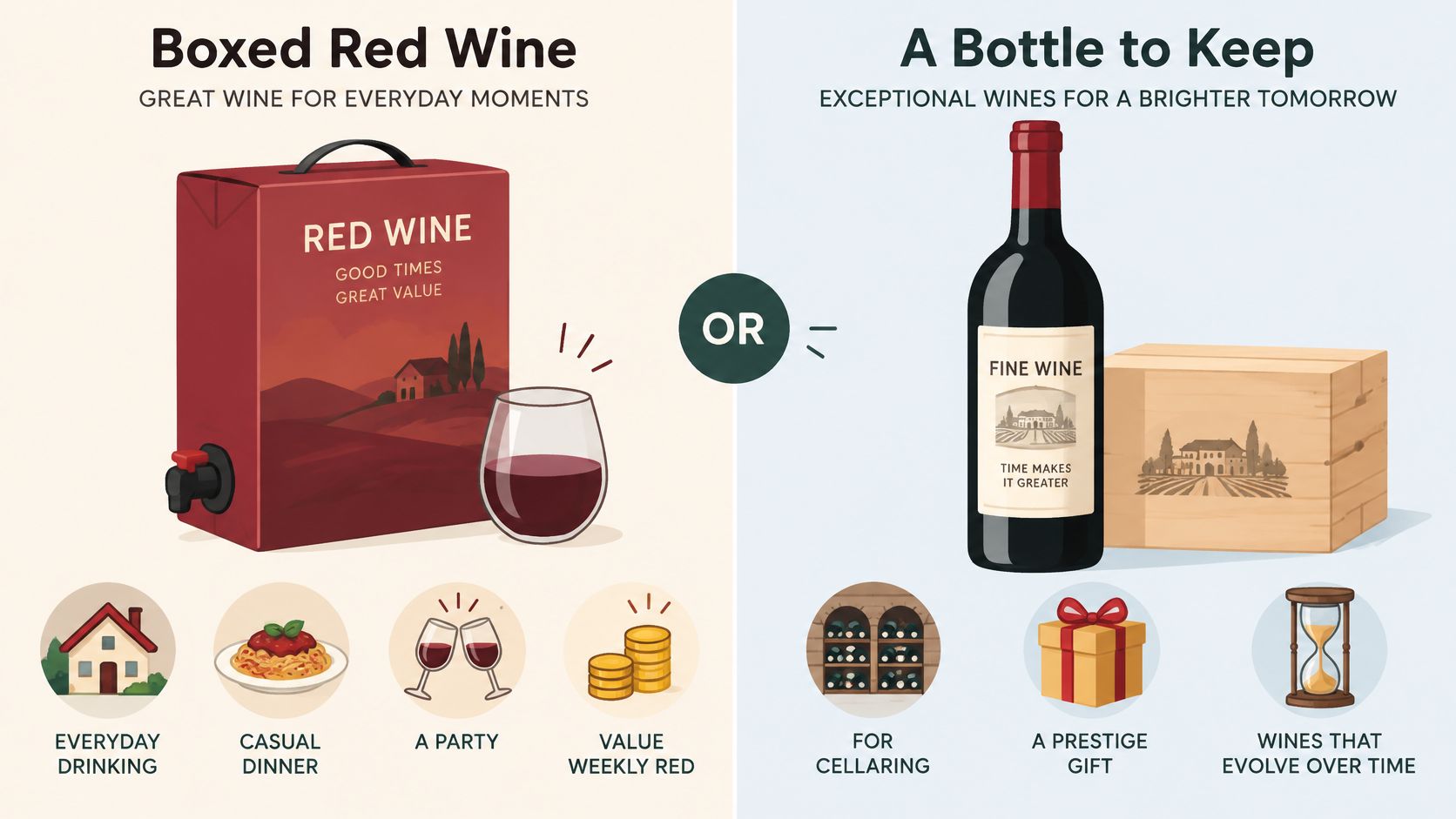
The verdict by situation is simple. Choose a box for the Tuesday night red, the casual dinner, the party and the value weekly pour you'll get through in a fortnight. Choose a bottle for cellaring, for a gift that has to land, and for any wine whose whole appeal is what it becomes in five years.
The buying checklist
- Find the packing or vintage date. Prefer the most recent one on the shelf, and treat an undated box as a warning rather than a bargain.
- Look for a pack date rather than a best-before alone. A pack date tells you when the clock started; a best-before hides it.
- Pick a style from the suitable list. Shiraz, Merlot and Grenache blends are the safest choices, with Cabernet for early drinking.
- Buy a size you'll finish inside the opened window. For one or two drinkers that usually means 2 litres, not 4.
- Check the box for punctures and a leaking tap. Press the carton gently and look for damp corners, because a compromised bag oxidises from day one.
- Compare cost per litre across the range. The 4 litre looks like the value buy until you work out what half of it will cost you in wasted wine.
Serving it properly
Chill fuller reds lightly, to roughly 14 to 16 degrees Celsius, and let lighter styles sit at cool room temperature for 15 minutes before pouring. Warmer than that and the alcohol dominates the fruit.
Pour through the tap and close it firmly after every glass. A tap left half open drips, aerates and ruins the wine over a week.
Store the box upright in a cool, dark spot away from heaters and sunny windows. Standing upright keeps the tap clear of sediment and the wine away from the fitment, which is where oxygen gets its best chance to sneak in.
Here's a short visual comparison if you're weighing up your first box against a bottle.
Slips that ruin a good box
A tap left open is the most common and most avoidable. Next is the box parked on a warm benchtop beside a kettle, then the four litre pack bought by a household that drinks one glass a night.
Our returns policy is straightforward, and worth knowing before you tap anything: opened bottles, broken seals, bulk wine, port and 200 ml gin and liqueur bottles can't be exchanged. Check the pack date and the tap before you leave the shop, rather than discovering a problem on Friday night.
Pick one style, buy one box, and test it against this checklist this week. Note the pack date, note the day you finish it, and you'll know your own turnover rate well enough to buy the right size next time.
McLaren Vale Cellars stocks the reds that suit a box alongside the reds that reward a bottle, from McLaren Vale Shiraz and Grenache blends through to Cabernet Sauvignon and Merlot, with half and half packs and build-your-own boxes if you'd rather test a few styles before committing to a dozen. Every order over $100 ships free Australia-wide, and the Taste Guarantee means a bottle that doesn't land is worth a conversation rather than a shrug. Visit McLaren Vale Cellars and start with one style, one box and one bottle, then taste them side by side this week.
Comments (0)
There are no comments for this article. Be the first one to leave a message!