
You're standing in front of a wall of bottles, phone in hand, trying to decide if tonight calls for something crisp with seafood or something fuller for a slow-cooked dinner. The labels mention regions, vintages, oak and alcohol, but none of them plainly says what the wine will taste like. That's normal. Wine basics for beginners starts by shrinking that wall down to a few questions you can answer at a glance.
Why Wine Feels Confusing and Where to Start
You're in the shop comparing a $20 Shiraz with a $25 Sauvignon Blanc, and you've got no reliable way to predict which one you'll enjoy. Price doesn't answer that. Four details on every bottle do.
- Colour: Red, white, rosé or sparkling tells you the broad family.
- Grape variety: Shiraz, Chardonnay and others hint at flavour and weight.
- Where it was grown: Region shapes ripeness and freshness.
- Style: Dry or sweet, light or full-bodied, still or sparkling.
You don't need to memorise the world's wines. Nine grape varieties and a handful of styles cover most bottles on an Australian shelf. Australia grows major volumes of both red and white grapes, which is why you'll see such a broad mix rather than one dominant colour, as shown in Wine Australia's 2024 vintage report on national grape production.
This guide holds one region constant so you can learn one variable at a time. McLaren Vale in South Australia covers a 433-square-kilometre geographical indication with 7,438 hectares of vineyards, according to Wine Australia's regional record for McLaren Vale. It's large enough for real variety, small enough to compare fairly. You'll work through grapes, styles, serving, tasting, labels and storage, then finish with a practical three-bottle test.
Grape Varieties and What They Taste Like
The grape variety is your strongest clue. It predicts flavour, body and acidity far better than vague words like smooth, because each variety ripens differently and carries its own aroma pattern.
One naming trap catches almost everyone. Shiraz is called Syrah in many other countries. It's the same grape, so don't treat them as two separate discoveries on imported labels.
Common Grape Varieties at a Glance
| Variety | Colour | Typical flavours | Body | Food match |
|---|---|---|---|---|
| Shiraz (Syrah) | Red | Blackberry, plum, black pepper | Full | Grilled steak, lamb shanks |
| Cabernet Sauvignon | Red | Blackcurrant, cedar, firm tannin | Full | Beef, aged cheddar |
| Grenache | Red | Raspberry, red cherry, spice | Light to medium | Roast lamb, tomato-based dishes |
| Pinot Noir | Red | Cherry, strawberry, earthy notes | Light to medium | Salmon, roast chicken, mushrooms |
| Merlot | Red | Plum, cherry, soft tannin | Medium | Roast pork, pasta with tomato sauce |
| Sauvignon Blanc | White | Passionfruit, lime, herbal notes | Light | Seafood, goat's cheese |
| Chardonnay | White | Stone fruit and citrus, oaked styles show vanilla and toast | Light to full | Roast chicken, creamy pasta |
| Riesling | White | Lime, green apple, petrol notes with age | Light | Spicy Asian dishes, pork |
| Pinot Grigio | White | Pear, green apple, lemon | Light | Salads, light seafood |
White and red are both mainstream choices on Australian shelves, so colour is a starting point, not a verdict. A light red can feel fresher than a rich white. That's why variety plus body matters more than colour alone.
A Variety Predicts a Range, Not One Taste
Chardonnay proves the point. It can taste fresh and citrus-driven when it's picked earlier and kept away from heavy oak, or richer and toastier when a winemaker uses oak and riper fruit. You're not looking for one fixed flavour. You're looking for where a bottle sits inside that range.
Use Shiraz as your worked example. Blackberry and pepper, plus full body, tell you the wine will feel weighty and warming. That weight stands up to grilled steak because fat and char soften tannin and match intensity. A delicate white would disappear beside the same dish.
Practical rule: Rich, savoury food suits a full-bodied red. Light, fresh food suits a light white or light red.
Body is the sense of weight on your tongue, and it's worth learning separately from flavour. If you want more detail, this guide to wine body, weight and texture breaks down why one wine feels skim-light and another feels almost creamy.
Don't try to learn all nine at once. Pick two varieties from the table for your next purchase, ideally one light and one full. Taste them with similar food, note which weight you prefer, and you've already narrowed future shelves considerably.
Wine Styles From Sparkling to Fortified
Style comes from four dials that work independently of grape. Once you separate them, unfamiliar labels get easier to read.
- Sweetness: Dry through to sweet, based on remaining sugar.
- Body: Light through to full, based mainly on alcohol, ripeness and texture.
- Bubbles: Still, lightly sparkling or fully sparkling.
- Fortification: Spirit added, or not.
Body works like milk. Skim is light, standard milk is medium, full cream is rich. Wine follows the same feeling, even when flavours differ completely.
The diagram below maps those dials across familiar glasses.
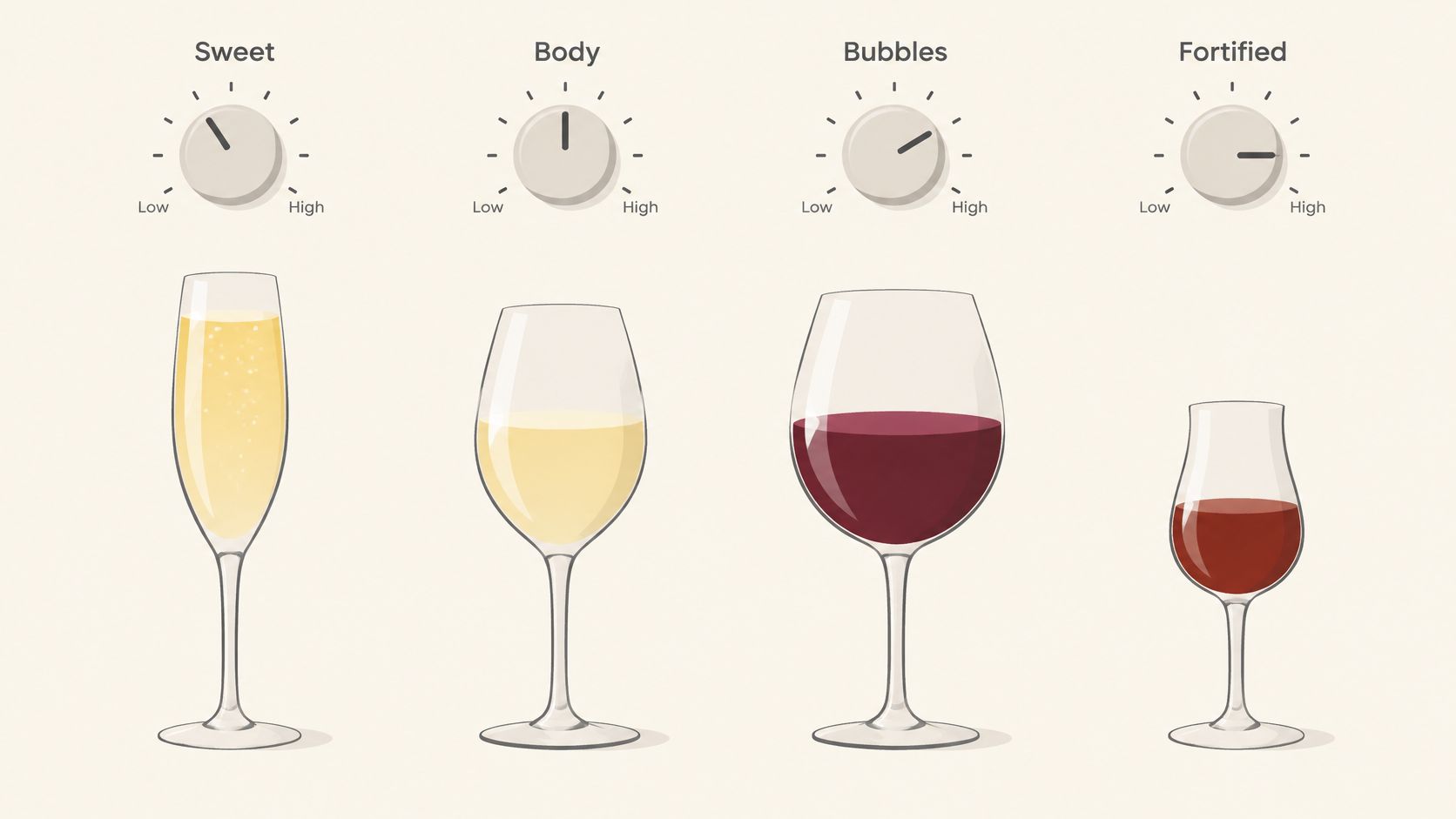
Still whites include Sauvignon Blanc and Chardonnay, usually light to medium and served chilled. Reds run from light Pinot Noir to big Shiraz, with tannin adding grip. Rosé comes from red grapes given only brief skin contact, so it picks up pink colour without much tannin, and most Australian examples are dry.
Sparkling wines include Champagne, Prosecco and Australian Blanc de Blancs. Bubbles lift aroma and make acidity feel brighter, which is why sparkling suits salty starters. Fortified wines such as port sit higher in alcohol because spirit is added, a category explored in this complete guide to fortified wines, their types and tasting notes. Dessert wines, such as late-harvest Riesling, keep noticeable sweetness for fruit desserts.
If a wine tastes sweet but the label says dry, you're probably sensing ripe fruit and fuller body, not added sugar. Try one style from each dial before you buy a full case of anything.
Serving Temperature and Glassware
Temperature changes what you taste before glassware gets a chance. Warm wine makes alcohol feel prominent and fruit seem flat. Wine that's too cold hides aroma and makes red tannin feel hard and drying.
Wine Australia's educator guidance recommends about 15°C for red wine and 8 to 10°C for sparkling, and it notes that sparkling served too warm can foam aggressively or surge from the bottle, as set out in Wine Australia's sparkling wines educator guide. That's practical, not fussy. Cold keeps bubbles controlled and acidity crisp.
Serving Temperature and Glass by Wine Type
| Wine type | Serve at | Glass |
|---|---|---|
| Sparkling (Prosecco, Blanc de Blancs) | 8–10°C | Flute or tulip-shaped white glass |
| Light white and rosé | 8–10°C | Narrower white glass |
| Full-bodied white (oaked Chardonnay) | 10–12°C | Wider white glass |
| Light red (Pinot Noir, Grenache) | About 15°C | Medium tulip glass |
| Full-bodied red (McLaren Vale Shiraz) | 15–18°C | Large tulip glass |
| Port (fortified) | 16–18°C | Small glass |
An Australian room is often 20 to 22°C, so room temperature red is usually too warm. Put the bottle in the fridge briefly, or keep it in a cool room, until it feels cool to touch. For full-bodied McLaren Vale reds, 15 to 18°C keeps fruit fresh without muting aroma.
Why Glass Shape Helps
A tulip-shaped glass narrows at the rim, so aromas gather instead of escaping. Reds get a wider bowl because they release more aroma and benefit from air. Whites and sparkling suit narrower glasses that preserve freshness and bubbles. A thin rim matters too, since wine reaches your palate cleanly instead of tumbling over thick glass.
Chill whites in the fridge for around two hours, or use an ice bucket for 20 to 30 minutes if you're short on time.
Fill the glass only about a third full. You'll have room to swirl, the wine won't warm as quickly in a large pour, and you can top up with a cooler splash from the bottle.
How to Taste Wine Step by Step
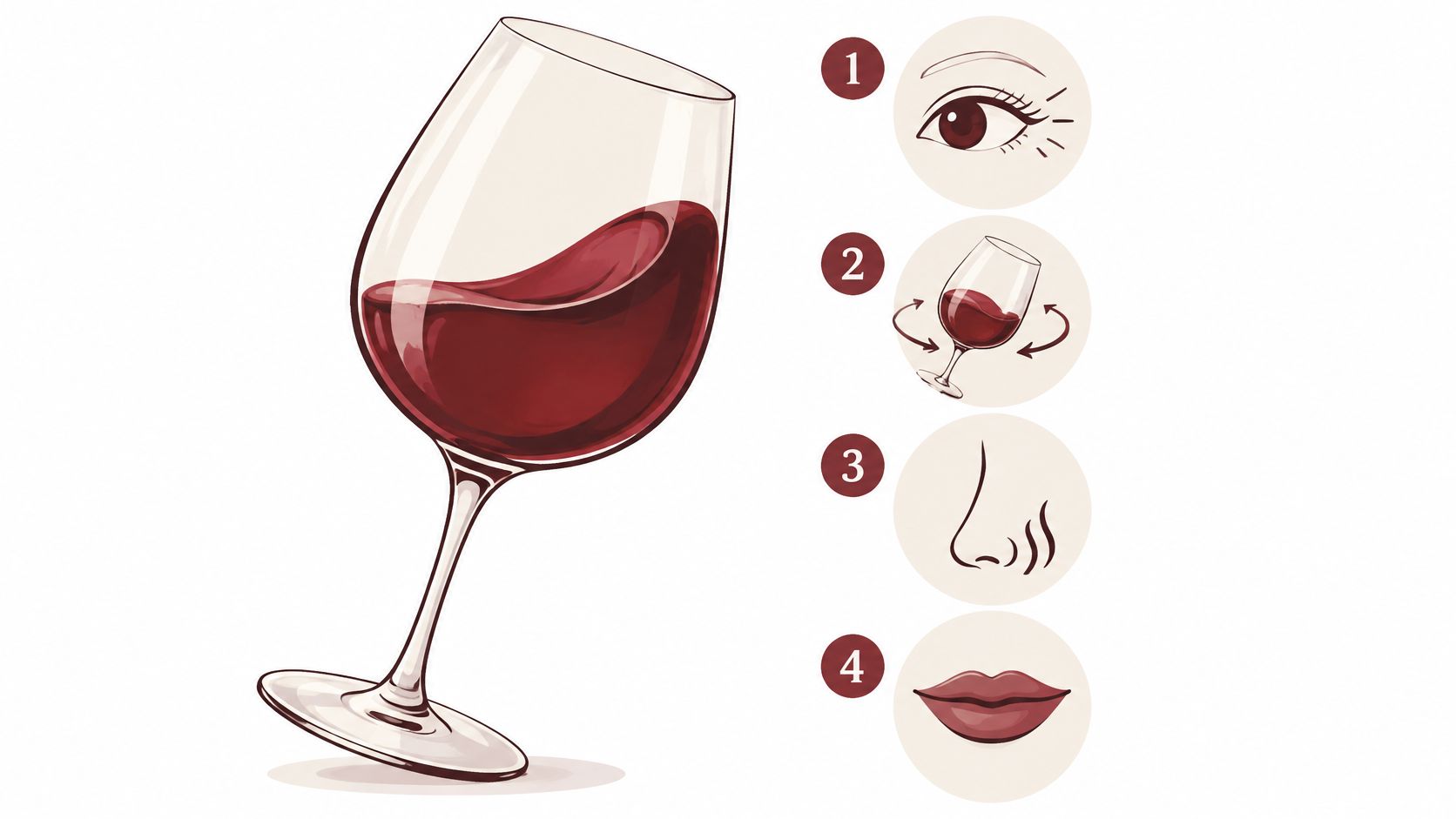
Tasting isn't a test with hidden correct answers. It's a short routine that slows you down enough to notice differences you'd otherwise swallow past.
The illustration below shows the basic sequence before you start.
The Six Step Routine
- Look: Tilt the glass against a white background and note colour and depth. Young reds often look purple-ruby, aged reds turn brick-tinged, and whites range from pale straw to gold.
- Swirl: Keep the base on the table and rotate for a few seconds. Swirling coats the glass and releases aroma.
- Smell: Take a short sniff, then a longer one. Name two or three things only, such as fruit, herb, spice or oak, because a short list is easier to compare later.
- Sip: Take a small mouthful and move it across your tongue. Different areas pick up sweetness, acidity and texture more clearly when the wine doesn't sit in one spot.
- Judge five elements: Check sweetness, acidity as the mouth-watering feeling, tannin as the drying grip in reds, alcohol as warmth at the back of your throat, and finish as how long flavour lingers after swallowing.
- Note and compare: Write one line per wine and rate it out of five. A brief note beats a perfect description you'll never revisit.
Watching the routine once can make the movements feel less awkward.
Common Slips That Muddle Your Palate
Don't push your nose deep into the glass and inhale hard, since alcohol can overwhelm subtler aromas. Avoid tasting straight after mint toothpaste or strong coffee, because both distort acidity and bitterness. Keep a session to three to four samples, or fatigue will make every wine taste similar.
Your first goal is noticing difference. Is one wine sharper, heavier or longer in finish than another? If you can answer that, you're tasting properly.
Reading Labels and Drinking Within Limits
Start with ABV, short for alcohol by volume. It's the label number that lets you compare strength directly, and it also affects taste. Higher alcohol adds warmth and weight, so a fuller Shiraz will usually feel rounder than a lighter one made at lower strength.
Two glasses can look identical and deliver different amounts of alcohol if one wine is 12% and the other is 15%. Glass size doesn't settle the question. ABV and pour size do.
The Australian Standard Drink
In Australia, a standard drink contains 10 grams of pure ethanol, whether it comes from wine, beer or spirits. You can estimate a bottle with this formula. Litres × ABV (%) × 0.789 gives standard drinks.
So a 750 mL wine at 13.5% ABV contains approximately 8.0 standard drinks, and a 150 mL pour contains about 1.35, using the calculation method described in Food Standards Australia New Zealand's standard drinks comparison document. Australian labels must also state the approximate number of standard drinks for beverages above 0.5% ABV, which gives you a check without doing maths in the shop. For worked bottle examples, see this guide to standard drinks in a bottle of wine.
Lower Alcohol Is an Occasion Choice
Reduced-alcohol wine isn't alcohol-free wine. The label's ABV tells you which you've picked up, so read it rather than relying on front-label language about lightness. Lower strength usually means lighter body and sometimes a different balance of sweetness, which can change food matches.
Interest is broad rather than binary. More than 20% of consumers are purchasing or interested in wines with lower alcohol, calories, carbohydrates or sugar, and over 90% of shoppers buying no-alcohol drinks also purchase alcoholic beverages, according to Wine Australia's market bulletin on US wine opinions research and moderation trends. That pattern points to planning by occasion, not a simple good-or-bad verdict.
Full-strength McLaren Vale red with dinner on Saturday, a lighter option on a weeknight, a smaller pour when you're driving early, and water between glasses all belong in the same sensible toolkit.
Choose the format before you open the bottle. You'll enjoy the wine more when the pour size and strength already fit the evening.
Buy and Store Your First Three Bottles
Buy contrast, not quantity. Your three-bottle test is one light white such as Sauvignon Blanc, one red such as McLaren Vale Shiraz or Pinot Noir, and one sparkling wine. That spread covers freshness, weight and bubbles in a single comparison.
A mixed sample pack helps because you won't be stuck with a dozen of a style you dislike. McLaren Vale Cellars sells curated sample packs alongside dozen and half-case bundles, so those three styles can arrive in one order. Taste them over one evening using the routine above, with plain crackers and water nearby.
Store unopened bottles in a cool, dark place around 12 to 15°C, away from ovens and sunny windows. Heat and light age wine quickly. Lay corked bottles on their side so the cork stays moist and seals properly.
How Long Wine Keeps Once Opened
| Wine type | Once opened | Storage |
|---|---|---|
| Sparkling | 1–3 days | Re-stoppered and refrigerated |
| Light white and rosé | 3–5 days | Corked and refrigerated |
| Full-bodied red | 3–5 days | Corked in a cool, dark place |
| Port (fortified) | About 4 weeks | Corked in a cool, dark place |
Write a one-line note for each bottle, rate it out of five, and buy more of the style you rated highest. That's how taste becomes useful knowledge.
Start your three-bottle test with a light white, a McLaren Vale red and a sparkling from McLaren Vale Cellars, where curated sample packs and mixed bundles let you compare styles without committing to a dozen. Taste them side by side, keep your one-line notes, and order more of the bottle you rated highest.
Comments (0)
There are no comments for this article. Be the first one to leave a message!