
On average, a standard 750ml bottle of wine contains between 7 and 8 standard drinks. This figure shifts depending on the wine's alcohol by volume (ABV)—a punchy McLaren Vale Shiraz will naturally have more standard drinks than a lighter white wine.
What Is a Standard Drink in Australia?
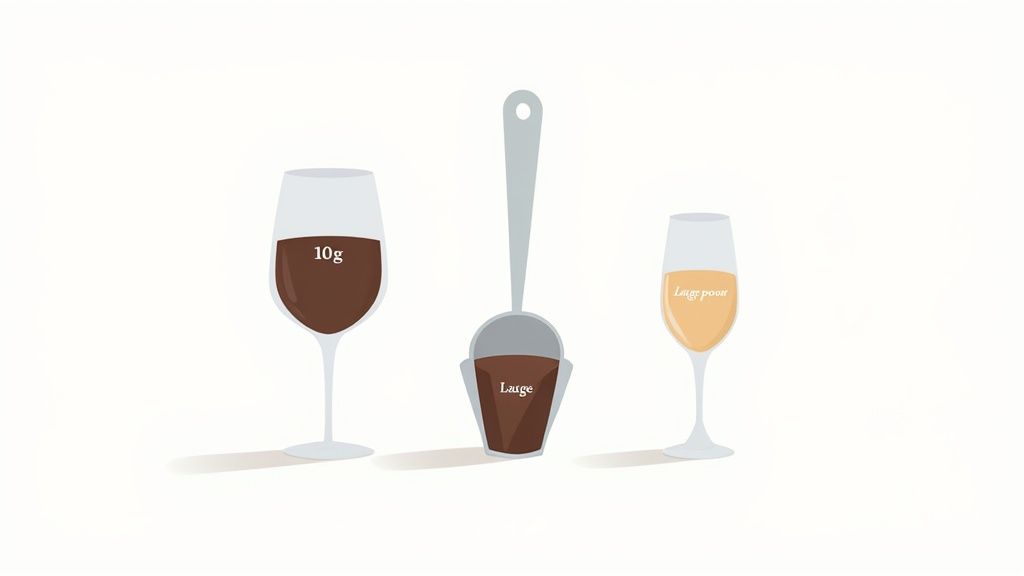
Ever poured what looks like a single glass of wine, only to find out it’s technically more than one "drink"? The key is understanding what a standard drink actually is here in Australia. It’s not about the size of your glass or how high you fill it; it's a fixed measure of pure alcohol.
Think of it like a shot of espresso. You can pour that single shot into a tiny cup for a potent short black or into a huge mug with frothed milk for a weaker latte. The amount of coffee—the active ingredient—is exactly the same in both, even though the total volume of the drink is completely different. That's the principle behind a standard drink.
The Official Measurement
In Australia, one standard drink is officially any beverage containing 10 grams of pure alcohol. This simple, universal measurement is the only reliable way to track your alcohol intake, regardless of whether you're drinking beer, wine, or spirits.
It’s why a small pour of a high-ABV Shiraz can easily contain more pure alcohol than a much larger glass of a crisp, lower-ABV Sauvignon Blanc.
A standard drink always contains 10 grams of pure alcohol. This is the single most important detail for figuring out how many drinks are in a bottle and helps you make informed choices.
This national standard takes all the guesswork out of it. For example, a common 750 mL bottle of wine with 13.5% ABV contains roughly 8.0 standard drinks, a fact you'll see reflected on labels as per Wine Australia's labelling guidelines. By focusing on the grams of alcohol rather than just the liquid volume in your glass, you can accurately track what you're drinking and enjoy it responsibly.
The Simple Formula to Calculate Standard Drinks
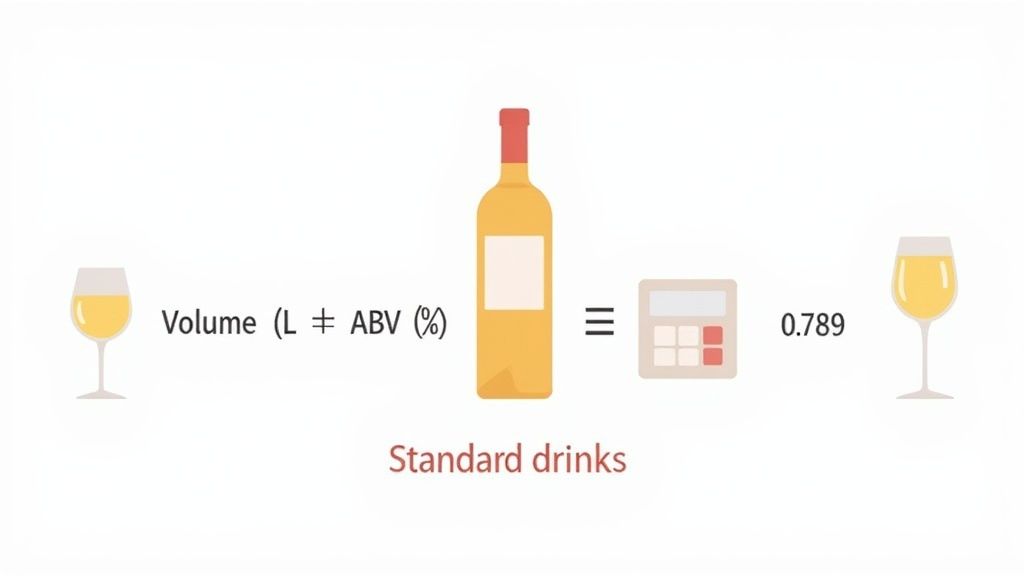
Working out the standard drinks in a bottle of wine doesn't require a maths degree. Once you get your head around the official Australian formula, you can figure it out for any bottle you pick up. It's a surprisingly handy skill for making informed choices about what you're drinking.
The whole calculation is pretty straightforward. All you need are three bits of info: the bottle's volume, its alcohol percentage, and one special conversion number.
Breaking Down the Equation
The formula used right across Australia to lock in the standard drinks count is:
Volume of liquid (in litres) x Alcohol by Volume (%) x 0.789 = Number of standard drinks
At first glance, this might look a bit technical, but each part is actually quite simple. Let’s pull it apart.
- Volume (Litres): This is just the size of the bottle. A standard wine bottle is 0.75 litres (750ml), a half-bottle is 0.375 litres (375ml), and a magnum holds 1.5 litres.
- Alcohol by Volume (ABV %): You'll find this percentage on every label. It tells you exactly how much of the liquid is pure alcohol. So, a wine labelled 14% ABV is made up of 14% pure alcohol.
- The Magic Number (0.789): This quirky number is the specific gravity of ethanol (pure alcohol). Its job is to convert the volume of alcohol into its weight in grams, making sure everything lines up with that "10 grams of alcohol" rule for a single standard drink.
Think of the 0.789 constant as a translator. It takes the liquid measurement of alcohol (millilitres) and turns it into the weight measurement (grams) that officially defines a standard drink. It's the key to making the whole calculation accurate.
By multiplying these three numbers, you'll get the precise number of standard drinks in a bottle of wine. This is the exact formula used to generate the number you see printed on the label, putting the power in your hands to check it yourself or calculate it for any drink.
Putting the Formula to Work With Popular Wines
Theory is one thing, but let's get practical. The best way to really get a feel for this is to apply the formula to the actual bottles you’ll find in your wine rack or at the local bottle-o.
For these examples, we’ll use a wine with 13.5% ABV. It’s a pretty common strength for many popular Aussie reds and whites, making it a great real-world benchmark for our calculations.
The Standard 750ml Bottle
This is the classic bottle size you'll see everywhere. First, we just need to convert the volume from millilitres into litres, so 750ml becomes 0.75L.
- Calculation: 0.75 (L) x 13.5 (ABV) x 0.789 = 8.0 standard drinks
There you have it. A standard 750ml bottle of wine at this strength contains exactly 8.0 standard drinks. This is a super handy number to keep in the back of your mind as a quick reference.
The Smaller 375ml 'Half Bottle'
Perfect for a quiet mid-week dinner or when you just fancy a couple of glasses. The half bottle is, as the name suggests, half the volume of a standard one (375ml = 0.375L).
- Calculation: 0.375 (L) x 13.5 (ABV) x 0.789 = 4.0 standard drinks
No surprises here – a half bottle has precisely half the standard drinks of its bigger sibling. Knowing this makes portion control much simpler and helps you keep track of your intake. Of course, how you pour it matters, which is why it's also worth knowing how many glasses of wine are in a bottle for different situations.
The Celebratory 1.5L 'Magnum' Bottle
Magnums are double the fun and double the size of a standard bottle (1.5L), making them a fantastic centrepiece for parties and bigger get-togethers. They definitely make a statement, but it’s important to be aware of just how much wine you're dealing with.
- Calculation: 1.5 (L) x 13.5 (ABV) x 0.789 = 16.0 standard drinks
A magnum holds a whopping 16 standard drinks. That's a critical bit of info when you're planning an event, as it helps you make sure there's enough to go around while also encouraging everyone to enjoy themselves responsibly.
How Wine Style Changes the Standard Drink Count
The alcohol percentage on a wine label is far from a one-size-fits-all number. It’s deeply connected to a wine's style and where its grapes were grown, which means your choice of bottle can make a big difference to your alcohol intake.
A wine’s final alcohol level comes down to how much sugar was in the grapes at harvest. Grapes from warmer climates, like our home turf in South Australia’s McLaren Vale, ripen more fully and develop higher sugar levels. During fermentation, that sugar turns into alcohol, resulting in wines that are typically richer, bolder, and higher in booze.
Comparing a Bold Red with a Crisp White
Let's look at how this plays out in a standard 750ml bottle. We’ll pit a classic warm-climate Shiraz against a zesty Sauvignon Blanc, which often comes from cooler spots.
-
McLaren Vale Shiraz (High ABV): A bold, powerful Shiraz from this neck of the woods can easily hit 14.5% ABV.
- Calculation: 0.75 (L) x 14.5 (ABV) x 0.789 = 8.6 standard drinks
-
Sauvignon Blanc (Lower ABV): A crisp, lighter-bodied Sauvignon Blanc usually sits around 12.5% ABV.
- Calculation: 0.75 (L) x 12.5 (ABV) x 0.789 = 7.4 standard drinks
The difference is striking. Simply by choosing the Shiraz over the Sauvignon Blanc, you've added more than a full standard drink to the bottle. It’s a perfect example of why just ‘counting bottles’ isn't an accurate way to track what you're drinking.
This principle doesn't just apply to reds versus whites, of course. The overall mysteries of wine alcohol content are a fascinating mix of grape variety, climate, and the winemaker's touch.
Comparing Standard Drinks Across Different Wine Styles
To really bring this home, here’s a quick comparison of how standard drinks stack up across a few popular styles in a 750ml bottle.
| Wine Style | Typical ABV (%) | Calculated Standard Drinks |
|---|---|---|
| Sparkling Wine (Brut) | 12.0% | 7.1 |
| Sauvignon Blanc | 12.5% | 7.4 |
| Cabernet Sauvignon | 13.5% | 8.0 |
| McLaren Vale Shiraz | 14.5% | 8.6 |
| Fortified Wine (Port) | 18.0% | 10.7 |
As you can see, a bottle of fortified wine packs in over three more standard drinks than a bottle of bubbly. Being aware of these differences helps you make more informed choices, ensuring you're never caught by surprise by a wine's hidden strength.
Find the Answer Instantly on the Wine Label
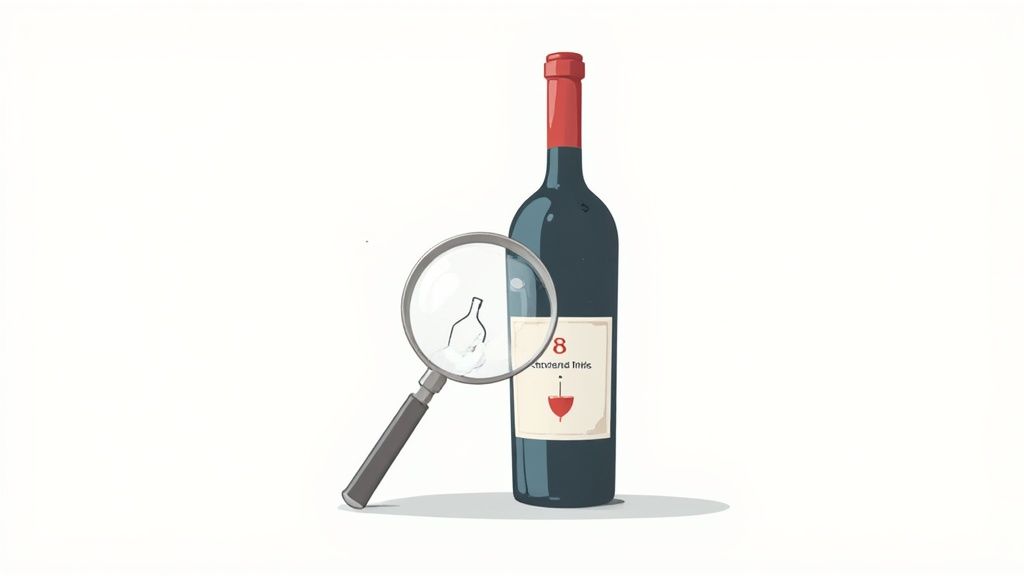
While it’s great to know the maths behind it all, there’s a much faster way to figure out the standard drinks in a bottle of wine. Thanks to Australian food safety laws, this vital piece of information is printed right on every single label.
This legal requirement means you can get an accurate count in seconds flat, no calculator needed. It's the simplest way to make an informed choice, whether you’re browsing the aisles at the bottle-o or pulling a wine from your collection at home.
Where to Look on the Label
You'll almost always find the standard drinks info on the back label. It's typically located near the alcohol by volume (ABV) percentage and other mandatory details.
To make it even easier, the number is usually displayed inside a simple icon. Keep an eye out for a silhouette of a wine bottle or a wine glass with a number either inside it or right next to it. That figure is the total number of standard drinks in that specific bottle.
For example, you might see an icon of a wine bottle with the number “8.6” printed clearly beside it. This tells you instantly that the entire bottle contains 8.6 standard drinks.
Learning to spot this little icon is a simple but incredibly useful skill for any wine lover. For a deeper dive into decoding what all the other symbols and terms on a bottle mean, check out our guide to understanding Australian wine labels. It'll make you a far more confident and knowledgeable wine buyer.
Understanding Australia's Responsible Drinking Guidelines
Knowing how many standard drinks are in your bottle of wine isn't just trivia—it's one of the most powerful tools you have for looking after your health. This knowledge connects directly to Australia’s national drinking guidelines, which are all about helping us enjoy a drink while minimising long-term risks.
Think of these guidelines as a simple, clear framework. Sticking within these limits means you can keep enjoying your favourite wines as part of a balanced lifestyle, all while keeping potential health impacts low.
The Official Australian Guidelines
To reduce the risk of harm from alcohol-related disease or injury, the National Health and Medical Research Council (NHMRC) has set out two key recommendations for healthy adults. These aren't random numbers; they're based on extensive research into how alcohol affects the body over time.
For healthy Australian adults, the advice is to drink no more than 10 standard drinks per week and no more than 4 standard drinks on any one day.
Following these limits is one of the best ways to significantly reduce your lifetime risk of alcohol-related harm. You can find more detail on how these guidelines were developed over at the Alcohol and Drug Foundation.
If you’re looking for some practical tips on managing your intake during celebrations, it can be really helpful to check out different drinking tactics for social events. At the end of the day, understanding these official recommendations empowers you to make conscious choices, whether you’re unwinding with a glass at home or celebrating with friends.
Your Wine Questions, Answered
To wrap things up, let's tackle some of the most common questions we hear about wine and standard drinks. These quick answers should clear up any lingering confusion and help you pour with confidence.
Is a Restaurant Glass of Wine One Standard Drink?
Almost never. It’s one of the biggest myths out there. A typical restaurant pour in Australia is 150 ml.
If that wine is a fairly standard 13.5% ABV, that single glass contains around 1.6 standard drinks—a fair bit more than one. A true standard drink of that same wine would only be 100 ml. This is exactly why a quick check of the bottle’s label is always your best bet.
Does the Standard Drink Count Change as Wine Ages?
Nope. The alcohol content is locked in the moment the wine is bottled.
While a wine's flavours and aromas will evolve beautifully over time in the cellar, the amount of alcohol is stable. That means the standard drink number printed on the label is accurate for the entire life of the wine, whether you open it tonight or in ten years.
Why Do Countries Define a Standard Drink Differently?
Great question. It’s because the definition is a public health guideline, not a universal scientific unit. It’s all about local advice. Australia sets the bar at 10 grams of pure alcohol, but our neighbours do things differently.
For instance, the UK's unit is just 8 grams, while a 'standard drink' in the USA contains a hefty 14 grams. This is why it's so important to rely on the Australian definition and the info on local labels when you're keeping track of your intake here.
At McLaren Vale Cellars, we believe that understanding your wine makes every glass more enjoyable. Explore our curated selection of premium McLaren Vale wines and find your next favourite today. https://www.mclarenvalecellars.com


Comments (0)
There are no comments for this article. Be the first one to leave a message!