
You're in a bottle shop, or scrolling an online range, and three Shiraz bottles are staring back at you. One has a gold sticker. One has “95 points” on the shelf talker. One has no badge at all, but the back label sounds promising. Shoppers often pause right there and wonder the same thing. Which one is the better buy?
That confusion is normal. Australian wine awards can look like a secret code made for judges, critics and collectors, not for the person trying to pick a good bottle for Friday night dinner or a case for a family gathering.
The good news is that the system isn't as mysterious as it first appears. Once you know who gives awards, how judging works, and what different medals really signal, those shiny stickers become useful. They stop being decoration and start acting like shopping clues.
That matters even more in a region like McLaren Vale, where there's depth as well as fame. You'll find recognised Shiraz, standout Grenache, and wines that overdeliver for the money. If you know how to read the award language, you can buy with far more confidence and far less guesswork.
Your Guide to Navigating Australian Wine Awards
A medal sticker often creates more questions than answers. Is a bronze worth noticing? Is a regional trophy meaningful? Is a critic's score more reliable than a wine show gold medal? Most shoppers don't need a lecture on wine bureaucracy. They need a practical way to make a better choice.
I think of wine awards the way I think of restaurant recommendations. If one local tells you a place is good, that's useful. If several independent diners praise it, that's stronger. If a respected guide lists it, that tells you something else again. Wine works in a similar way. Different awards tell you different things.
For everyday buying, the key is simple. Awards are best used as guides, not commandments. They help narrow the field, especially when you're choosing between unfamiliar producers or trying a style you don't normally buy.
Practical rule: Use an award to reduce risk, not to switch off your own taste.
That's where many people get tangled. They assume a medal answers every question. It doesn't. A medal doesn't tell you whether you prefer plush Shiraz or brighter, peppery Shiraz. It doesn't tell you whether you want a cellar-worthy bottle or something soft and easy tonight.
What it can do is tell you that trained tasters found quality, typicity, balance or value in that wine. In plain English, it tells you the bottle deserves serious consideration.
A useful shopping mindset looks like this:
- Ask what kind of award it is. A regional trophy, a major show medal and a critic score aren't the same signal.
- Check whether the award suits your purpose. Buying a gift is different from buying a weeknight red.
- Use the medal as a filter. Then match the wine to your budget, food and taste.
Once you start reading awards this way, Australian wine shelves become easier to explore. Instead of seeing a blur of stickers and scores, you start seeing a map.
The Major Players in Australian Wine Awards
Australian wine awards don't come from one single authority. They come from several lanes of judging, each with its own role. If you keep those lanes separate in your mind, the overall situation becomes much easier to grasp.

Wine shows and regional competitions
Traditional wine shows are the classic Australian system. Wines are entered into classes, tasted blind and assessed against style and quality expectations. These shows can be regional, state-based or national in reputation.
Regional shows matter more than many shoppers realise. They often spot excellence that reflects local conditions and local strengths. A strong result there can be very informative because the judges are tasting wines in a regional context, not as random bottles from everywhere.
A good example comes from McLaren Vale. At the 2025 MGA Insurance Group McLaren Vale Wine Show results, the Thistledown 2024 Sands of Time Single Vineyard Blewitt Springs Grenache was named Best Wine of Show. That matters because it highlights a specific site and a style that challenges the simple idea that McLaren Vale is only about big warm-climate reds.
Critic-led awards and point systems
Then you have critic-led systems. These are usually associated with an individual reviewer or a publication rather than a show circuit. In Australia, the Halliday Wine Companion sits prominently in this category.
These scores influence buying because they feel direct and easy to compare. A shopper sees 95 points and assumes quality. Often that's fair, but it helps to remember that a points system reflects a critic's tasting framework rather than a show's class-based judging process.
Here's a simple explanation for it:
| Award type | What it often tells you | Best use for shoppers |
|---|---|---|
| Regional wine show | How a wine performs within its local context | Finding authentic regional strengths |
| Major show medal | Broad technical quality and style execution | Comparing similar wines |
| Critic score | One reviewer or publication's assessment | Narrowing a shortlist quickly |
International competitions
International awards add another layer. They tell you how Australian wines are being judged on a broader stage, often against wines from many countries and styles.
That's useful for consumers because it can reveal two things at once. First, a wine's quality travels. Second, Australian wines can win at price points that aren't reserved for collectors.
If you remember only one point from this section, make it this. Not all awards mean the same thing, but each can be useful if you know what question it answers.
How Wine Judging and Medals Actually Work
Most wine judging is less theatrical than people imagine. It's disciplined, comparative and usually blind. Judges assess what's in the glass without leaning on the producer's reputation, the packaging or the price tag.

Blind tasting in plain English
Blind tasting means judges don't know which producer made the wine while they assess it. That matters because labels carry baggage. Famous names can impress before the cork is even pulled. Blind tasting strips that away and asks a stricter question. Is this wine good on its own merits?
Judges typically taste wines in classes. That might mean similar varieties, styles or vintages grouped together. Comparing like with like is important. A lean, crisp white and a full-bodied red aren't competing in the same lane.
Shoppers sometimes assume judging is about finding the most powerful wine in the room. It isn't. Judges look for balance, varietal character, cleanliness, harmony and how well the wine expresses its style.
A strong medal wine doesn't need to be loud. It needs to be convincing.
Medals, trophies and points
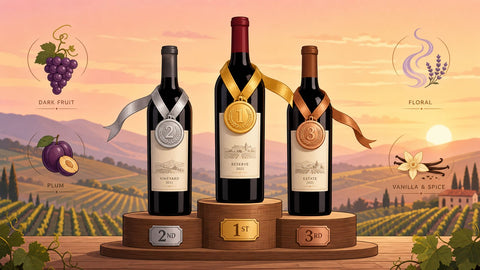
The medal ladder is easier to understand when compared to school results. Bronze says the wine performed well. Silver says it performed very well. Gold says it stood out strongly among its peers. A trophy is the class leader. Best in Show is the bottle that keeps rising after several comparison rounds.
Critic scores work differently. They convert a tasting judgment into a number, usually on a scale that feels precise. That precision can be helpful, but it can also mislead. Many shoppers treat a one-point difference like a dramatic gap when it often isn't.
If you'd like a deeper look at where scores help and where they don't, this guide on what wine scores can and can't tell you is worth reading.
What judges are really rewarding
A medal usually signals one or more of these qualities:
- Balance. Fruit, acidity, tannin, oak and alcohol sit together well.
- Typicity. The wine tastes like a good example of its grape or style.
- Purity. Flavours are clean and faults aren't distracting.
- Distinction. The wine has something memorable, not just technical correctness.
This short video gives useful context on tasting and judging culture in wine.
One reason medals confuse shoppers is that they look absolute. In reality, they're comparative. A wine hasn't just been called “good” in isolation. It has usually been measured against others in a structured setting. That doesn't make the result infallible, but it does make it more informative than a flashy shelf sticker with no context.
The Annual Australian Wine Awards Calendar
Wine awards in Australia follow a rhythm. You don't need a diary full of judging dates to make sense of it, but it helps to know the general seasonal flow because medal stickers and published scores tend to appear in waves.
When results tend to surface
Many wine show results appear in the second half of the year. That's often when you start seeing fresh medal stickers on bottles and award announcements pushed through retailer newsletters, winery websites and media coverage.
The Halliday Wine Companion awards have their own annual moment. The award winners are unveiled each year in August, which makes that period especially relevant for drinkers who follow critic recognition and updated scores.
This timing explains why a bottle can suddenly seem to appear everywhere at once. It may not be a new wine to the producer, but it's new to the public conversation because the judging cycle has just landed.
How that helps you shop
If you're buying for Christmas, summer entertaining or gifts, this calendar matters. Retailers often start highlighting new award winners as the warmer months approach. That's when many shoppers first notice the sticker, but the result may have been earned in a judging cycle that happened earlier.
A simple way to use the calendar is this:
- Watch late-year retail displays. That's when recent show results often become visible on shelves.
- Pay attention in August. Halliday announcements can reshape what wines get attention.
- Check the vintage and release timing. A fresh medal is most useful when it matches the bottle in your hand.
Think of the awards calendar as seasonal context. It won't tell you what to drink tonight, but it will help you understand why certain wines suddenly move into the spotlight.
What a Medal Sticker on a Bottle Really Means
A medal sticker is a clue, not a verdict. It tells you the wine impressed somebody in a formal setting, but the true value comes from asking a few extra questions before you buy.

Start with three questions
When you see a sticker, check these first:
- Which show or critic gave it. A medal from a respected show carries a different kind of weight from a niche competition you've never heard of.
- Which vintage it refers to. An award belongs to a specific wine, not automatically to every year that winery makes it.
- What kind of recognition it was. Gold, trophy, best in show and points all signal different things.
That last point trips people up. A gold medal and a 95-point review can both suggest quality, but they come from different judging cultures. One emerged from a comparative show system. The other came through a critic's scoring lens.
Price and prestige don't always move together
Many drinkers assume the expensive bottle with a medal must be the serious one, and the cheap bottle with a medal must be a marketing trick. That's too simplistic.
The better way to read value is relative. A modestly priced wine with meaningful recognition can be one of the smartest buys in the shop because it has already cleared a quality hurdle without asking luxury money.
That's why one of the most interesting recent stories in Australian wine awards wasn't about a rare collector label. It was about value. The ABC report on Australian success at the Decanter World Wine Awards noted that half of Decanter's Best in Show winners in 2023 were affordable South Australian wines, and it specifically highlighted a $22 wine in that conversation. For shoppers, that's a powerful reminder that awards can point to value as well as prestige.
Shopping shortcut: If a modestly priced wine has credible recognition, don't dismiss it. It may be the bottle punching above its weight.
What a sticker can't tell you
A medal can't tell you whether the wine suits your palate. That's the part people often forget. Judges may reward a taut, savoury Grenache for its precision, while you may be looking for something plush and generous.
It also can't tell you whether the bottle is right for the moment. A trophy-winning red might be brilliant with a slow-cooked lamb shoulder and feel far too serious for a casual Tuesday pizza night.
Here's a useful filter:
| If you want | A medal helps by | What you still need to decide |
|---|---|---|
| Reliable quality | Reducing the chance of a faulty or weak buy | Whether the style suits you |
| Better value | Flagging wines that overperform for the money | Whether the flavour profile appeals |
| A gift | Signalling credibility and recognition | Whether the recipient likes that variety |
Medals matter most when you read them in context. The sticker gets your attention. The ultimate decision comes from matching that recognition to price, vintage, style and occasion.
Finding Award-Winning Gems at McLaren Vale Cellars
If you're shopping for McLaren Vale wine, awards become especially useful when you know what the region does best and where the standout exceptions sit. McLaren Vale has a strong public identity, but the awards conversation shows that the region's strengths aren't one-note.

Start with Shiraz, but don't stop there
If you want the safest starting point, begin with McLaren Vale Shiraz. The region has built a serious reputation for it, and recent recognition reinforces why.
According to this feature on McLaren Vale in the Halliday and Decanter awards conversation, McLaren Vale wineries secured seven scores of 95 points or above in the 2026 Halliday Wine Companion Awards, with the region dominating the shortlist. The same report notes that Shiraz drives much of that award-winning performance, with typical harvest sugar levels of 24–25 Brix in McLaren Vale helping deliver the dense phenolic structure that expert panels often reward. For a shopper, that translates into a practical takeaway. When you buy McLaren Vale Shiraz, you're buying into a regional strength that judges repeatedly recognise.
That doesn't mean every bottle will taste the same. Some lean toward dark fruit and richness. Others bring more spice, savoury edges or floral lift. The award tells you there's quality. The producer style tells you what kind of quality.
Use awards to hunt for the region's surprises
The more interesting buys often come just beyond the headline category. McLaren Vale is famous for Shiraz, but award results can steer you toward wines that challenge your assumptions about the region.
A smart shopper's shortlist might include:
- Single-vineyard Grenache. Especially when regional judging highlights a specific site rather than a generic house style.
- Sub-regional bottlings. Names like Blewitt Springs often matter because site expression can shape freshness, texture and perfume.
- Producers with repeated recognition. Consistency is useful if you're building a mixed case rather than buying one bottle.
The Halliday-related reporting also points to sub-regional precision and vineyard management as part of what lifts wines into top company, including recognition around single-vineyard Grenache and more site-conscious winemaking in places such as Blewitt Springs. That's valuable consumer information because it encourages a better question than “What's the best McLaren Vale wine?” The better question is “Which McLaren Vale style or site fits what I like?”
A practical way to browse
When you shop online, don't just search “award-winning” and stop there. Layer your decision.
Try this order:
- Pick the variety first. Shiraz if you want a benchmark. Grenache if you want fragrance and finesse.
- Check for recognised producers or highlighted vintages. Awards help narrow the field.
- Read the tasting note for style clues. Look for words like savoury, plush, bright, spicy or structured.
- Compare bottles within a price band. Awards prove most useful for finding better value in this range.
Awards work best when paired with style awareness. A high-scoring bottle that suits your taste is a win. A high-scoring bottle in a style you don't enjoy is just an expensive lesson.
If you want a useful companion piece while browsing, this guide to award-winning McLaren Vale wines and must-try selections helps connect recognition with actual bottle choices.
The broader lesson is simple. Awards can point you to trusted names, but they're even more helpful when they help you discover bottles you might have skipped. In McLaren Vale, that can mean a celebrated Shiraz, or it can mean a Grenache from a specific site that changes how you think about the region.
Using Awards to Shop for Wine with Confidence
Wine awards Australia wide can feel noisy until you know how to use them. Then they become practical. They help you sort through a crowded shelf, lower the chance of a dud purchase and spot wines that offer more than their price suggests.
The most useful mindset is balanced. Trust the signal, but don't surrender your own taste. A medal is evidence of quality. It isn't a guarantee that the wine suits your dinner, your budget or your palate.
When you're choosing, keep the checklist short:
- Look at who gave the award
- Check that the award matches the vintage
- Think about style, not just status
- Use value medals and strong regional results to explore
That last point matters. Some of the best bottles you'll buy won't be the most expensive or the most famous. They'll be the wines where recognition, style and price line up neatly for what you need.
If you're buying online and want a broader framework for making smart choices, this guide on how to buy wine online in Australia adds another layer of practical help.
Awards are a map. Not a gospel, not a shortcut to instant expertise, but a very handy map. Used well, they help you drink better, spend smarter and discover bottles you might otherwise miss.
If you're ready to put that knowledge to work, explore the curated range at McLaren Vale Cellars. You'll find benchmark regional styles, value-packed mixed options, and plenty of bottles that make wine awards easier to use in the practical world of buying, opening and enjoying wine.
Comments (0)
There are no comments for this article. Be the first one to leave a message!