
The standard answer to the question "why does wine taste bitter" is tannin, and it's the answer most drinkers get from the back label, from the tasting room and from the first page of search results. It's also the reason a lot of people misdiagnose their own glass. Tannin is real, and it does create a firm, drying edge in red wine. But bitterness in a bottle you opened at home is often something else wearing the same label: a red poured at 24°C, a wine that spent a summer in a hot garage, a bottle carrying smoke from a bad fire season, or a cellar fault that leaves a medicinal taste rather than a drying one.
None of that lets tannin off the hook. It's still the most common structural cause of a hard finish in red wine, and if you're drinking a young Shiraz from a warm, dry year, phenolics are the sensible first suspect. The problem is the order of checking. Most advice jumps straight to the grape and the winery, when the cheap, reversible variables sit much closer to home: how the bottle was stored, how it was served, and what the nose says before the liquid ever reaches your tongue.
This guide works through that order patiently. It covers what phenolics are and why they bite, how acidity and alcohol change what your palate reports, which winemaking decisions push a wine toward the green and hard end, and how to separate a fault from a style. By the end you'll have a check you can run in about thirty seconds, at the table, with nothing but a glass and a bit of attention.
The Main Causes of Bitter Wine at a Glance
Bitterness in wine usually comes from phenolic compounds drawn out of grape skins, seeds and stems, but balance, winemaking, serving temperature and spoilage decide whether you notice it.
The table below is the quick diagnostic. Read it left to right: where the cause originates, what it feels like in your mouth, and whether you can do anything about it once the bottle is open. Two rows end with "return the bottle", and those are the ones most drinkers never consider.
| Cause | Where It Comes From | What It Tastes Like | Can It Be Fixed |
|---|---|---|---|
| Tannins (phenolics) | Grape skins, seeds and stems | Drying, firm bitterness on the tongue and finish | Partly, with time or food |
| Seed and stem phenolics | Long maceration or green stems | Green, harsh, hard-edged bitterness | Rarely, choose a different style |
| Low acidity and high pH | Ripeness and vintage conditions | Flat, with bitterness more noticeable | Partly, pair with acidic food |
| Under-ripe or over-extracted fruit | Picking and extraction choices | Thin, sharp bitterness with little fruit | Partly, decant or serve cooler |
| Serving too warm | Storage in a warm room | Alcohol heat that amplifies bitterness | Yes, chill briefly before pouring |
| Smoke taint | Bushfire or prescribed-burn smoke exposure | Ashy, burnt or medicinal, drying | No, return the bottle |
| Brettanomyces | Microbial spoilage in the cellar | Medicinal, barnyard, lingering aftertaste | No, return the bottle |
Three sensations drinkers confuse
Bitterness is a taste. You register it on the tongue and toward the back of the palate, and it reads as a flavour rather than a texture.
Astringency is a feeling, not a taste. It's the tightening across the cheeks and gums that comes from tannins binding your saliva proteins. A wine can be powerfully astringent and barely bitter at all.
Heat is the burn of alcohol, felt at the back of the throat and sometimes in the chest. Serve a 14.5% red too warm and the heat climbs, which makes every bitter note behind it seem louder than it is.
Before you blame the grape, run three quick checks, in this order.
- Temperature: touch the bottle. If it feels warm to the hand, it's over room temperature and the alcohol is doing damage.
- Storage history: a bottle that sat in a hot car or a sunlit shelf for a week will taste flatter and firmer than the same wine from a cool cellar.
- The nose: smoky, ashy, medicinal or barnyard aromas point somewhere entirely different from tannin, and no amount of decanting will fix them.
How Tannins Create the Bitter Edge
A strongly brewed cup of tea offers a useful clue to wine's bitter edge. As the leaves steep, the water draws out compounds that make the tea darker, sharper and more drying. Nothing extra has gone into the cup. Longer contact has changed what comes out of the leaves. In red wine, grape skins, seeds and stems play a similar role during fermentation and maceration.
Those extracted compounds belong to a broad family called phenolics. Tannins are part of that family, and they help explain why a wine can feel grippy as well as taste bitter. The Australian Wine Research Institute describes tannins as phenolics capable of binding to and precipitating proteins. In plain language, they can latch onto proteins and draw them out of solution.
Your saliva contains those proteins. When tannins bind to them, your mouth loses some of its lubricated feel, leaving that familiar tightening across the gums and cheeks. The tea comparison helps here too: the sharp flavour and the dry feeling arrive together, but they are different parts of the experience.
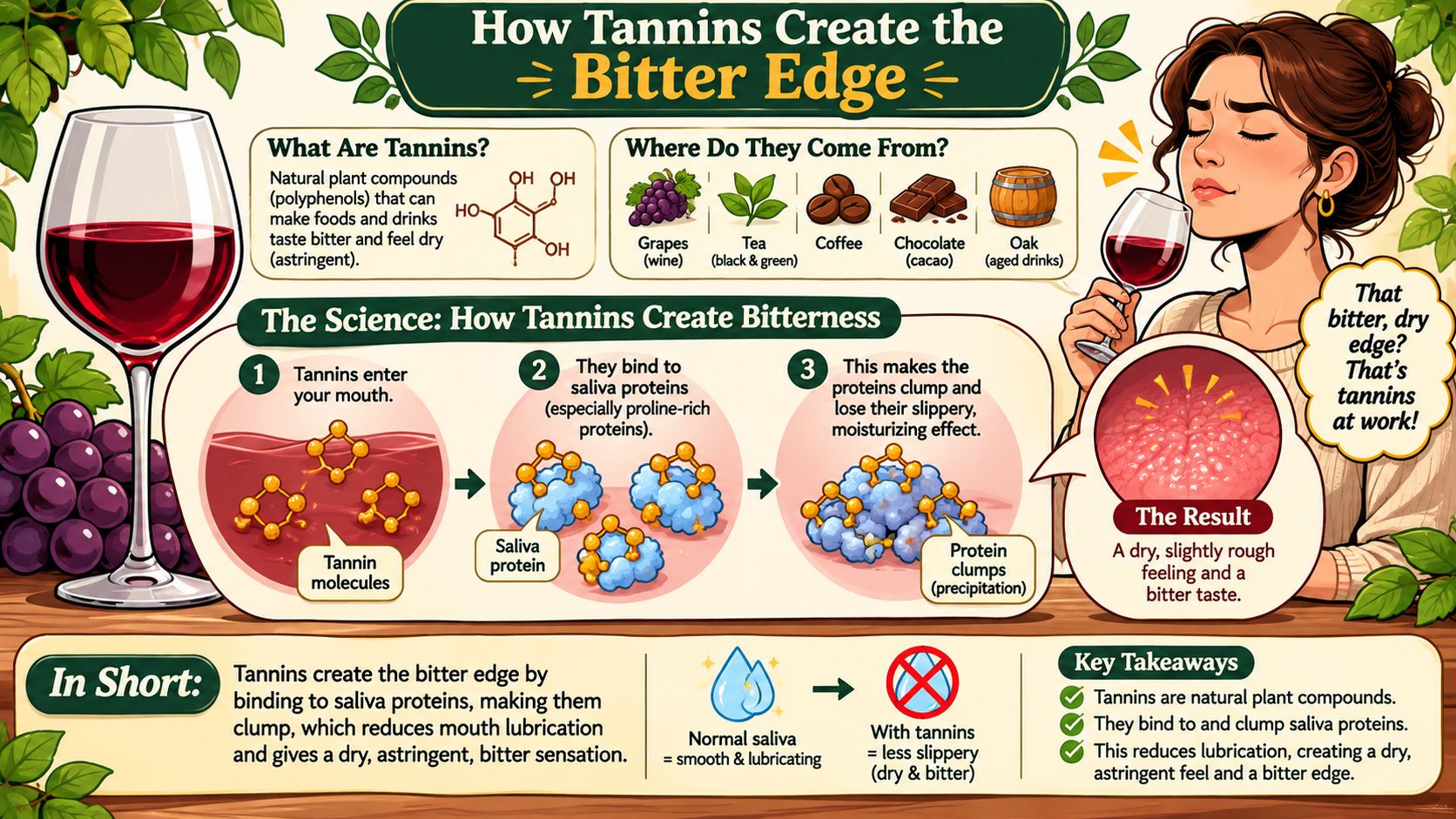
Bitterness and astringency are two different signals
The protein-binding process explains astringency. Bitterness involves compounds acting on taste receptors. Calling both sensations “bitter tannins” hides that distinction and can send you looking for the wrong explanation.
The distinction worth memorising: bitterness is something you taste on the tongue. Astringency is something you feel on the gums. A wine can be firmly astringent with almost no bitterness at all.
The amount of tannin is only part of the picture. Phenolics are a family of compounds, rather than a single ingredient with a fixed flavour. Their composition helps shape the balance between bitter taste and drying texture, so a wine's overall tannin level cannot describe the whole experience.
That is why two McLaren Vale Shiraz can feel different even when both seem firmly tannic. Grape maturity, extraction and ageing influence how tannins develop and how the finished wine feels. One may have a noticeable bitter edge; another may mainly leave a firm grip. Our guide to how tannins shape wine structure and mouthfeel explains that structural role in more detail.
Use your next sip to separate the signals. Hold the wine briefly, swallow, then notice what remains: a bitter flavour, a tightening sensation, or both. Describe those separately before blaming tannin for everything unpleasant in the glass. A smoky or medicinal impression, or an alcohol burn, needs a different explanation from the drying effect of tannins binding to saliva.
Why Acidity, pH and Alcohol Change the Taste
Seasoning is the closest kitchen comparison. A soup with too little salt tastes flat. Add the right amount, and it tastes rounder, sweeter and more like itself. The salt did not add those flavours. It changed what the palate noticed. Wine works in a similar way. Acidity, pH, alcohol and residual sugar shape how strongly any phenolic bitterness registers.
pH often does more than drinkers expect. In general terms, particular phenolics can taste more bitter when acidity is lower and the wine's pH is higher. Think of acidity as the squeeze of lemon that keeps a dish bright. When that lift fades, a bitter edge has less fruit and freshness to sit behind. Alcohol adds another layer. It brings warmth, and in some wines that warmth can make bitterness feel more pronounced.
If you prefer to see the mechanism rather than read it, this short explainer covers how acidity and bitterness interact on the palate.
What the balance study found
Broader composition matters too. Measures such as pH, titratable acidity, residual sugar and alcohol can help explain why perceived bitterness varies between wines, sometimes more than total phenolic content alone. Read that in plain terms. How the wine is built changes how bitter it tastes.
Alcohol is the loudest part of that build. It gives a wine heat, weight and a sense of ripeness. Yet it never acts alone. Its effect depends on the phenolics and acidity around it, which is why a wine with similar alcohol can taste round in one glass and hard in another. Alcohol is more like volume on a stereo. The same track sounds different when the bass and treble settings change.
There is a useful caution here. Some phenolic compounds do not follow the simple rule that more phenolics mean more bitterness. Caftaric acid and grape-reaction product, two phenolics discussed in relation to Australian white wines, are examples. That helps explain why casual advice about “high phenolics” can mislead. The type of compound matters, along with the wine's overall balance.
For the numbers behind the pH scale, our explainer on wine acidity and pH levels goes deeper. The same structure also matters beyond the immediate glass. If you are buying to lay down rather than to drink this month, aging potential data for collectors is a sensible companion, because sharpness in a young white can be part of what holds it together over time.
The takeaway is blunt. A Sauvignon Blanc and a South Australian red can both taste bitter for different chemical reasons. Treat the sensation as a clue, then look at acidity, pH, alcohol and phenolics together before blaming one ingredient.
Winemaking Choices That Raise Bitterness
Say a grower in a cool year picks Cabernet ten days before the seeds turn nut-brown and woody. The fruit looks fine. Sugar is close to target. But green seeds carry harsh, hard-edged phenolics, and anything those seeds touch during fermentation will carry that character into the bottle. The wine isn't faulty. It's built from fruit that wasn't quite ready, and the winemaker's choices either soften that or amplify it.
Grape-derived phenolics, particularly flavan-3-ols and certain tannin structures, activate bitter taste perception while simultaneously creating astringency through interactions with salivary proteins, as the Australian Wine Research Institute sets out. The volume of tannin isn't the deciding factor. Extended post-fermentation maceration is, because it keeps wine in contact with skins, seeds and stems for longer, and formal sensory studies frequently found greater bitterness in those wines, with seed-derived compounds such as catechin considered a likely contributor. One study cited by AWRI found that 73–79% of tannins in Cabernet Sauvignon and Merlot wines made with 30-day macerations came from seeds.
That single figure explains a lot of what drinkers describe as "too much tannin". The problem isn't quantity. It's origin.
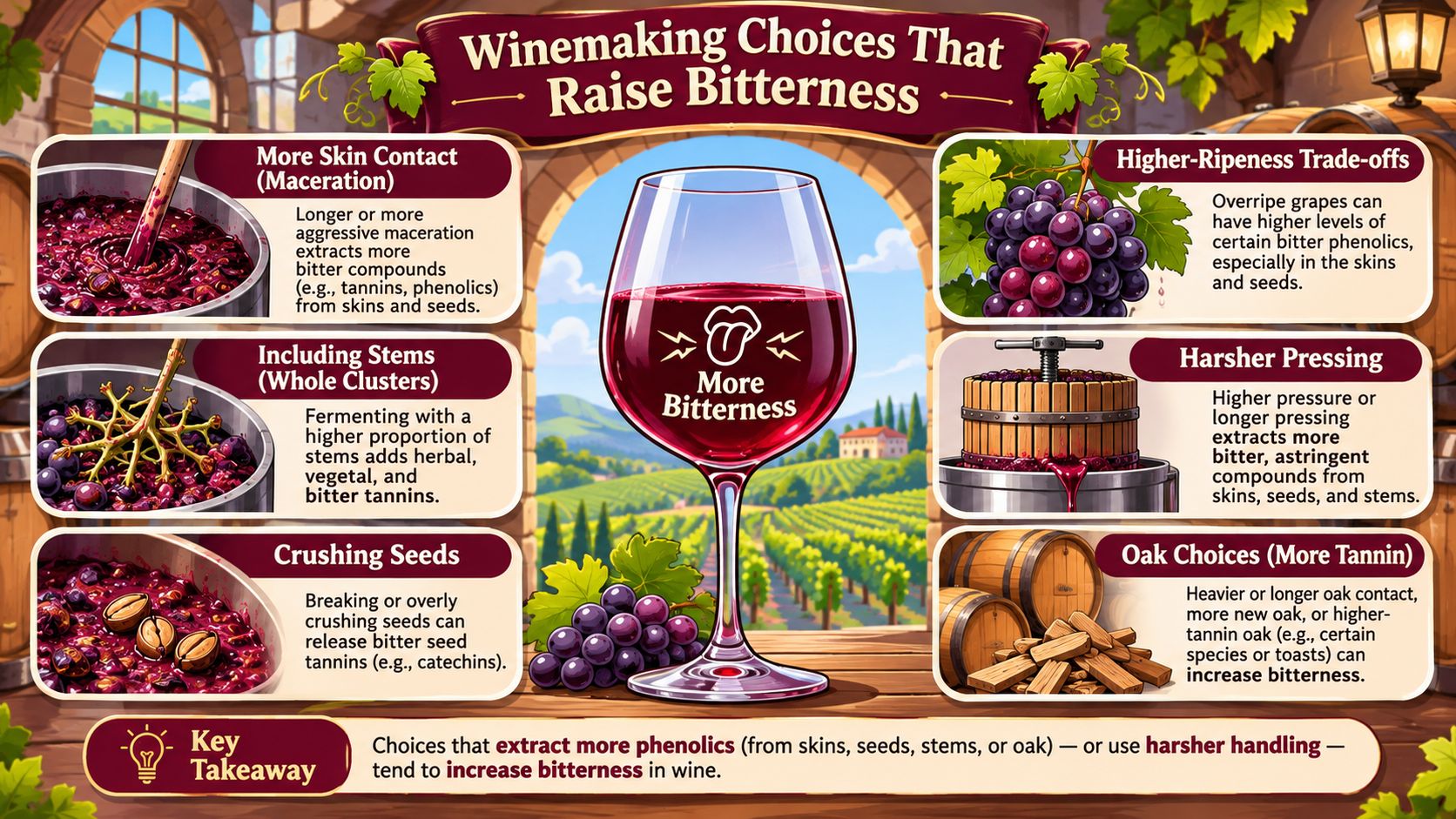
Whole-bunch fermentation adds another source. Stems bring stalky, herbal phenolics, and while the technique can produce beautiful savoury lift in the right hands, green stems deliver a bitterness that feels leafy and hard rather than fruity. Crushing and vigorous pumping over during fermentation pull more out of the solids. Oak barrels contribute their own tannins, which is why a heavily oaked red can taste firm even when the fruit was gentle.
Maturation then does slow repair work. Oxygen exposure and time progressively reshape tannin structure, softening some roughness without removing the underlying phenolic character. A wine that felt aggressive at eighteen months can feel resolved at five years, but it hasn't lost its tannin. It has rearranged it.
Reading a label for bitterness risk
- Extended maceration: expect a firmer, more structured wine, especially in a cool year.
- Whole bunch: a marker of stem inclusion, which can read stalky in under-ripe vintages and savoury in ripe ones.
- Vintage notes: a cool, late-ripening season usually means greener seeds and harder phenolics than a warm one.
- Oak regime: new oak adds tannin on top of grape tannin, so a heavily oaked young red will feel firmer than an unoaked one.
Bitterness that feels green, hard or stalky usually points to immature or seed- and stem-derived phenolics rather than excessive tannin. That's a style question as much as a quality question, and it's the reason choosing a different wine style often works better than persisting with a bottle that isn't to your taste.
Serving Temperature and Food That Soften Bitterness
Temperature acts like a volume knob on sensation. Turn it up, and fruit aromas become more visible, but alcohol warmth can crowd the glass and make bitter notes feel sharper. Turn it down, and the wine can feel tighter, with tannin reading as more drying because the aroma seems quieter. The useful trick is to treat serving temperature as a small adjustment, not a cure.
| Wine Style | Why It Matters |
|---|---|
| Full-bodied red | Serve at 16 to 18°C. Warmth lifts fruit; above 18°C alcohol heat and bitterness stand out |
| Light-bodied red | Serve at 13 to 16°C. Cooler service keeps firm tannins from dominating |
| Rosé | Serve at 7 to 10°C. Fresh acidity balances phenolic edges |
| White | Serve at 7 to 12°C. Cool enough to keep acidity crisp, not so cold that aroma disappears |
| Sparkling | Serve at 6 to 8°C. Cold service keeps acidity lively and bitterness subdued |
Three adjustments worth trying
- Check the bottle against the table. A thermometer is overkill. If a red feels warm to the touch in a heated room, it sits above the range where fruit stays tidy, and a short rest away from heat helps more than swirling harder.
- Chill a warm red for 15 to 20 minutes in the fridge. Not the freezer. You want to remove heat, not numb the wine, and fifteen minutes is usually enough to bring a red back toward its working range.
- Decant a young, firm red for 30 minutes. This helps some wines open up and settle. It won't remove phenolic bitterness, and it can't reverse a microbial fault, so treat it as a comfort measure rather than a cure.
Food changes the same sensation from another direction. Think of tannin as a sponge that grabs at proteins in your saliva. Protein-rich dishes such as grilled steak or lamb give tannin another target, so the drying feel softens. Acid-rich dishes work differently. They restore a sense of freshness, which can make a bitter edge seem less isolated, like adding seasoning to a dish that tasted flat.
Why restaurant wine tastes smoother: a bitter red served with rich food often seems rounder by the second glass. That's pairing working, not evidence that the bottle at home is flawed.
If you're buying sparkling for a celebration rather than a dinner, browse champagne hampers for brides and you'll notice how often bubbles are the bottle in the room at exactly the moment nobody is checking the temperature.
Smoke Taint, Brettanomyces and the Second-Bottle Test
Bitter is often the wrong word for what is in the glass. Two faults get called bitterness more than any other, and both survive decanting, chilling and a generous plate of food. If you have described a wine as bitter while someone else at the table drank it happily, there is a fair chance you were picking up something other than phenolics.
When the bitterness is smoke
Wine Australia and the Australian Wine Research Institute describe smoke-affected wines as having smoky, burnt, ashy or medicinal characters. Studies of smoke-affected Australian reds show that heavy exposure can mute the fruit and leave a drying, ashy finish that lingers well past the point where tannin would have faded. That matches what drinkers report. The fruit seems to vanish, and what stays behind reads as bitter even though the sensation is closer to the smell of a cold fireplace than to anything happening on the tongue.
This is a vintage and vineyard question, not a regional one. A smoke-affected season says nothing about McLaren Vale Shiraz as a category. It says something about particular blocks in a particular year, so the sensible move is to ask about the vintage rather than write off the grape. Detection is improving as well. Wine Australia lists a 2026 QUT project funded at $455,847 to develop a portable sensor for smoke-related compounds in grapes, which would let growers and winemakers test fruit before it becomes wine rather than after.
The practical cue sits in your nose. Ask where the sensation lives: on the tongue itself, or retronasally after you swallow. Ask whether it feels drying or burnt, and whether the fruit seems muted. Drying plus muted fruit points toward smoke. Bitter on the tongue with the fruit still intact points toward phenolics.
When it's Brettanomyces
Brettanomyces is a yeast that converts hydroxycinnamic acids into 4-ethylphenol and 4-ethylguaiacol, the compounds behind horsey, barnyard, smoky and band-aid aromas that can reshape a wine's whole profile. It behaves like a heavy-handed seasoning in a kitchen. Even a small amount changes everything it touches, and no amount of airing will take it back out.
A 2026 study examined 26 Australian winery isolates of Brettanomyces bruxellensis and found substantial variation in sulphur dioxide tolerance between them, reported in the Australian Journal of Grape and Wine Research. That undercuts the comfortable assumption that a sound sulphur addition automatically prevents the problem. Tolerance varies by isolate, so cellar conditions and microbial management carry real weight.
For a drinker, the useful part is simpler. A wine with Brett can read as bitter when the problem is a persistent medicinal, smoky or savoury aftertaste that outstays its welcome. Decanting may soften the impression and food will mask the character, but neither removes a microbial fault. If you want a broader checklist for sorting a faulty bottle from a challenging style, our guide to identifying common wine faults in Australian bottles walks through the main culprits.
Tannin, acid or fault
Tannin dries the mouth. Acidity makes it water. A fault stays in the finish, and it stays there after the wine is gone.
Run that sentence against your glass and most of the confusion clears. Astringency eases within a minute or two of swallowing. Acidity makes you salivate. A medicinal or barnyard note sits at the back of the throat and refuses to leave.
The second-bottle test
When you suspect a fault rather than a style, don't decide on one glass. Work through this sequence.
- Taste the bottle at the recommended serving temperature for its style. Warmth exaggerates everything, so rule temperature out before you rule anything else in.
- Note whether the bitterness sits on your tongue or lingers as an aroma in the finish. Tongue placement suggests phenolics. A retronasal linger suggests a compound fault.
- Decide whether the drying feel is tannin-like or burnt, ashy or medicinal. Tannin feels like grip. Smoke and Brett feel like an aftertaste with a smell attached.
- Check whether the fruit seems muted or gone. Young tannic reds still show fruit underneath the structure. Faulted wines often don't.
- Open a second bottle from the same case or batch, ideally after the first has rested a day at room temperature. A bottle that improves overnight was likely suffering from bottle shock or reduction rather than a permanent fault.
Then apply the decision rule. If the second bottle tastes clean, the first was likely faulty and should go back to the seller. If it tastes the same, the bitterness is the wine's style, and the answer is food, temperature or a different bottle next time rather than a refund.
That second outcome is more common than people expect, and it isn't a failure on anyone's part. Palates vary, styles vary, and a wine that suits one drinker's taste won't suit another's. If a wine you bought from us doesn't land the way you hoped, we'll help you find one that does, and you're welcome to call us on 0409 605 605 to talk through what you usually enjoy. Faults are worth identifying, and so is the simpler truth that a hard, green-edged McLaren Vale red from a cool year is doing exactly what its vintage told it to do.
Bitterness stops being a mystery once you know what you're tasting, and it gets simpler still when someone who knows the region helps you choose. McLaren Vale Cellars stocks red, white, rosé and sparkling styles from South Australia, including the structured McLaren Vale Shiraz that teaches the tannin lesson faster than any explanation can. If a bottle isn't to your taste, we'll help you find one that is, so visit McLaren Vale Cellars and start with a sample pack or a dozen of something suited to how you like to drink.


Comments (0)
There are no comments for this article. Be the first one to leave a message!