
Friday dinner is ready, the bottle has been chosen, and the corkscrew suddenly feels like the most important tool in the kitchen. The worm enters at an angle, the cork shifts, and everyone at the table watches as a simple pour becomes a small test of nerve.
Knowing how to open wine with a corkscrew removes that pressure. Australia's move towards screw caps means many everyday bottles no longer need an opener, but cork-sealed wines still matter for premium releases, older vintages, fortified wines and imported bottles. Australian producers trialled screw caps in the 1970s, returned to them strongly in the late 1990s and early 2000s, and the change reshaped wine service culture. The Sydney Morning Herald's account of Australia's screw-cap revolution describes how screw caps became widely used from 2000, while ABC reported that about 98% of Australian wine is now produced under screw cap.
That leaves a narrower but important role for the corkscrew. The right technique protects the cork, keeps fragments out of the wine and lets you serve the bottle without drama.

Opening Wine Without the Stress
Friday service can change quickly when a cork-sealed bottle arrives at the table. Set it upright on a stable surface, clear space for your elbow, and inspect the closure before the worm touches it. A young red usually suits a standard waiter's corkscrew. An older bottle needs slower handling because its cork may be fragile.
Australia's shift to screw caps has reduced how often many drinkers use an opener, yet cork remains common in premium and aged selections. Australian consumers remove approximately 120 million corks from wine bottles each year, according to Wine Industry Sustainability Australia's cork-recycling nomination. That volume makes careful technique practical, not ceremonial. Poor alignment produces broken corks, fragments and untidy bottle necks.
Practical rule: Treat the cork as part of the bottle's condition, not as an obstacle to overpower.
A corkscrew depends on alignment and mechanical advantage. Hold the bottle steady, place the worm centrally, and pull along a controlled line. Excess force can tilt the worm, tear the cork or create a loud pop.
What to check before opening
- Closure type: Confirm that the bottle has a cork. Do not force an opener onto a screw cap or synthetic stopper.
- Cork condition: Look for crumbling, staining or a cork that has sunk into the neck. A fragile cork may require a two-prong opener.
- Bottle position: Keep the bottle upright, especially when sediment may have collected in an aged wine.
- Serving space: Position the bottle so the lever can rest securely on the lip without contacting glassware.
The first Australian winery to bottle all its wines under screw cap was Taylors Wines in 2004, according to The history of cork and screw-cap use in Australian wine. That history explains why Australian service now requires familiarity with both closures. Practise the cork technique on an affordable bottle before opening an aged release, and check the cork's condition before choosing the opener.
Mastering the Waiters Corkscrew
The waiter's corkscrew is the practical starting point for most cork-sealed bottles. It combines a small knife, a hinged lever and a worm in one compact tool. Its advantage is control, but only when the worm enters straight and the lever bears against the bottle lip.
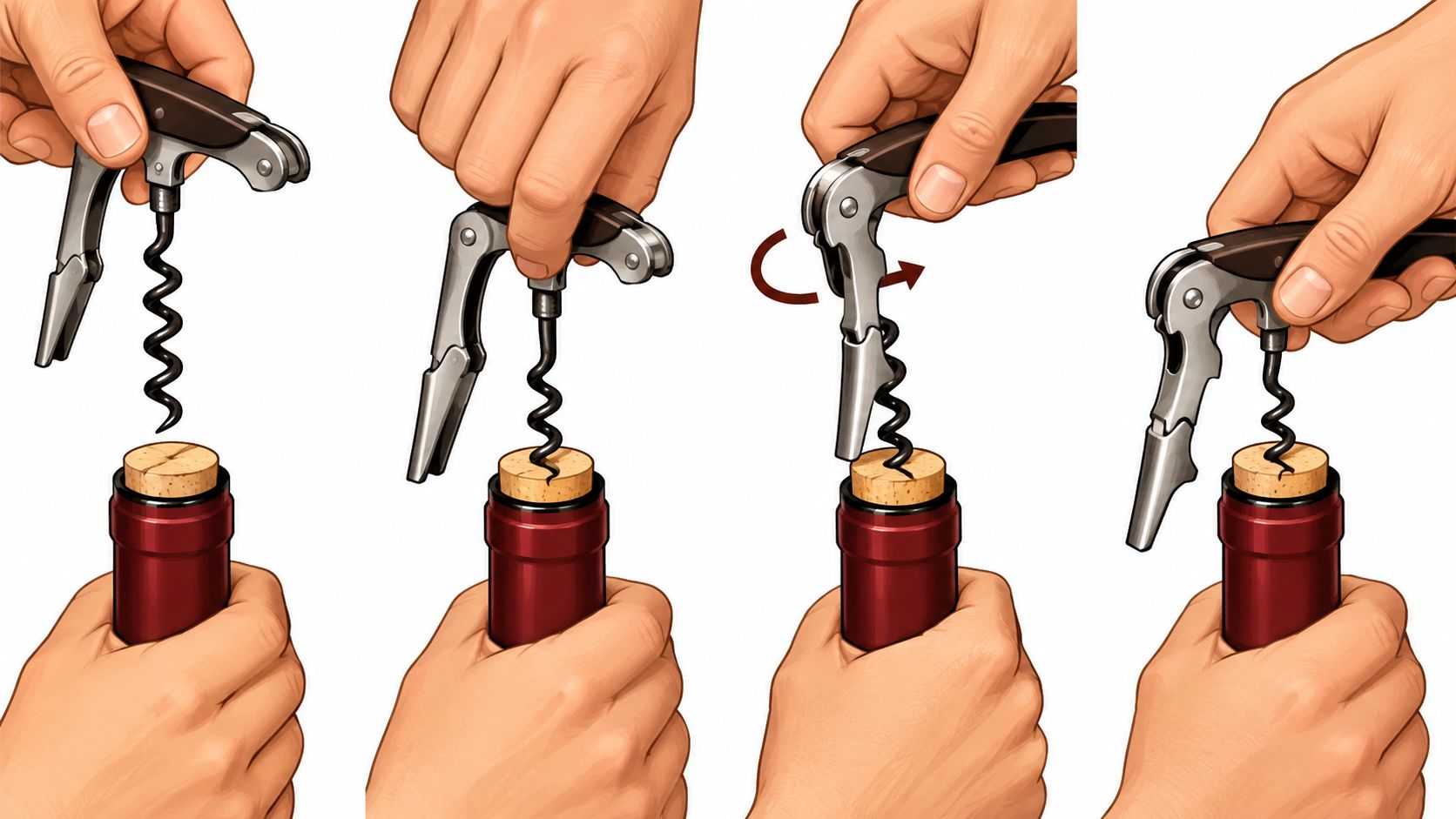
Follow the bottle-opening sequence
- Cut below the lip. Use the small blade to score the capsule cleanly around the neck, then remove the top section. Cutting below the lip keeps the blade away from the wine and gives the lever a clear contact point.
- Wipe the neck. A clean cloth removes foil fragments, dust and residue before the bottle is opened.
- Find the centre. Place the worm tip in the exact centre of the cork. This is the most important alignment step because an off-centre entry makes the cork twist as you pull.
- Turn steadily. Drive the worm down with controlled clockwise turns until nearly all of the screw is embedded. Leave enough room to avoid pushing the tip through the bottom of the cork.
- Use the first hinge. Set the shorter lever against the bottle lip and lift gently. Keep the pull vertical rather than swinging the handle sideways.
- Change the angle if needed. Once the cork rises, move to the second hinge and continue the same smooth motion.
- Finish by hand. When only a small portion remains in the neck, ease the cork out gently with your fingers.
Australian guidance for aged wine recommends a straight, smooth extraction because long cellaring can leave corks brittle or compressed. This guide to opening aged wines also reinforces the value of embedding the worm far enough to support the cork without tearing it.
The common mistake is twisting the bottle or pulling the handle towards your body. Both actions introduce sideways force. If the cork begins to lean, stop, reset the lever and continue with smaller movements.
For a visual demonstration, watch the technique here:
The choice between cork and screw cap also affects the handling experience and the type of opening routine you need. This comparison of cork and screw-cap closures provides useful background before you decide which tool belongs in your wine drawer.
Choosing the Right Opener for Your Bottle
A waiter's corkscrew is versatile, but it isn't automatically the right choice for every cork. Bottle age and cork condition should guide the tool, especially when the wine is valuable, fragile or likely to contain sediment.
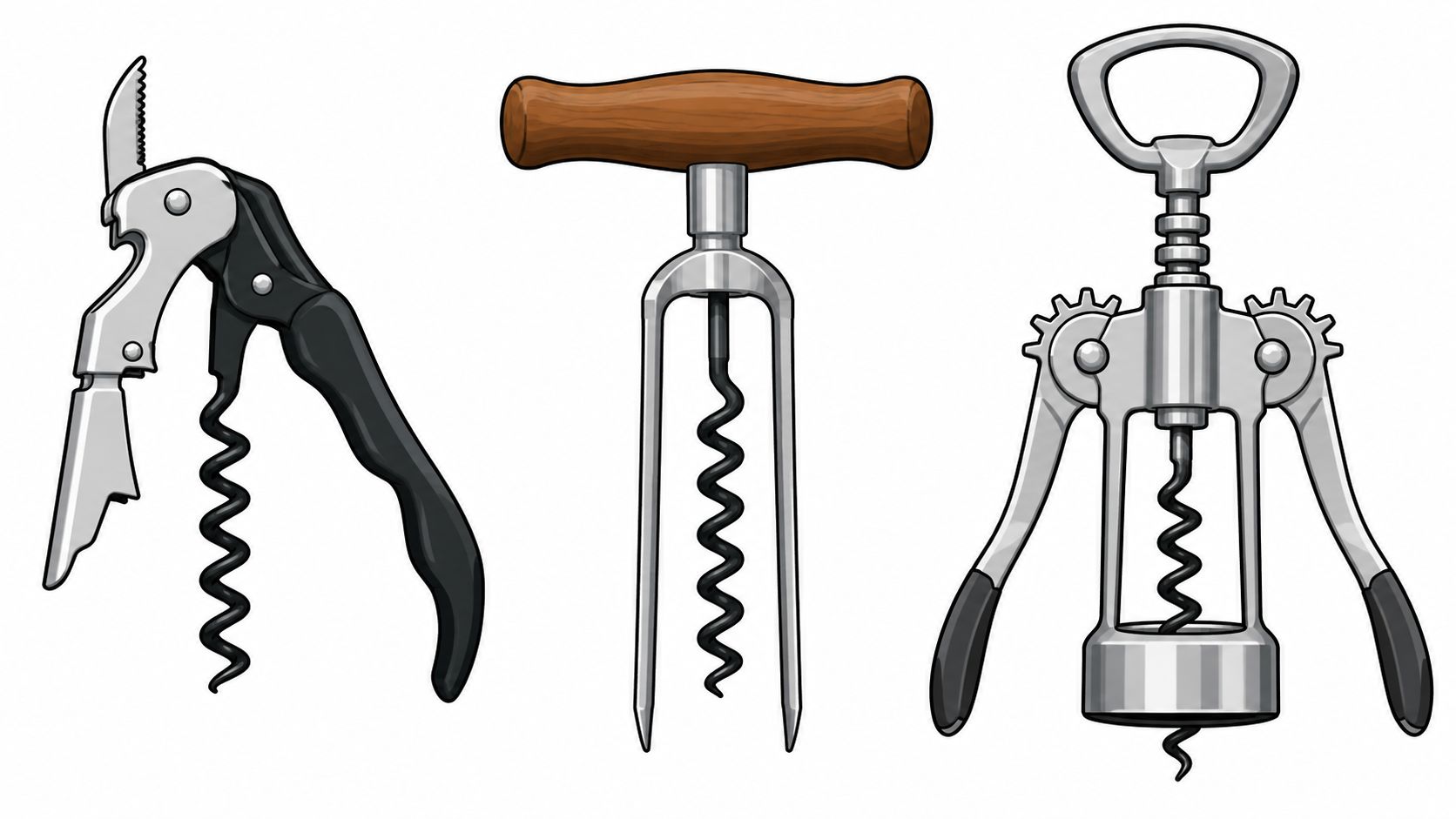
Match the tool to the closure
| Opener | Best use | Main trade-off |
|---|---|---|
| Waiter's corkscrew | Everyday cork-sealed bottles and table service | Compact and controlled, but it requires accurate worm placement |
| Winged corkscrew | Repeated openings and home entertaining | Simple leverage, though the tool can encourage uneven pressure if it isn't centred |
| Two-prong opener | Older bottles with corks that need support | Preserves cork integrity, but it takes more practice |
| Ah-So opener | Very fragile or decades-old corks | Slides alongside the cork rather than drilling through it, but it won't suit every firm closure |
A winged corkscrew suits a busy dinner where several bottles need opening. Place the worm in the centre, turn it down and press both wings evenly. The handles do much of the lifting, making the tool approachable for new users. Its weakness appears when the worm enters crooked. The wings may rise unevenly, and the cork can twist rather than lift cleanly.
The two-prong opener, often called an Ah-So, takes a different approach. Slide the longer prong between the cork and the neck, then work the shorter prong down the opposite side. Once both prongs sit alongside the cork, twist and lift gradually. This can preserve a delicate cork that would crumble under a conventional worm.
A slower opener is often the faster choice when the alternative is fishing cork pieces out of an aged bottle.
The Ah-So is especially useful for old, fragile corks, but it demands patience and a stable grip. Don't jab the prongs down aggressively. If the cork feels compressed or soft, ease the opener in with a gentle rocking motion.
A T-handle corkscrew can provide direct pulling strength, but it offers less built-in mechanical advantage than a waiter's model. It's workable for sound corks and straightforward settings, while this guide to essential wine accessories can help you choose complementary tools for serving and storage.
Troubleshooting Common Opening Problems
Most opening failures have a mechanical cause. The worm is off-centre, the cork is fragile, the lever is resting poorly or the pull is too fast. Identifying that cause lets you fix the problem without turning a small setback into a damaged bottle.
When the cork breaks
Stop pulling as soon as the cork snaps. Remove the loose upper piece, then inspect the section still inside the neck. If it's stable, place the worm into the remaining cork slightly off the original hole and turn it down carefully. Pull vertically with short movements.
If the remaining cork is too soft to support the worm, use a two-prong opener if available. An Ah-So can grip the sides of a fragile cork without drilling through the centre, which reduces further crumbling.
- A clean break: Reinsert the worm into the lower section and apply slow pressure.
- A leaning cork: Don't twist the bottle. Reset the worm so it sits more centrally.
- A collapsed cork: Use prongs or remove the remnants carefully, then strain the wine through a clean fine mesh if fragments have entered it.
- A wet or stained cork: Handle it gently because moisture may have weakened its structure.
When the opener makes too much noise
A loud scrape, crack or sudden pop usually means the tool is moving sideways or too quickly. Keep the bottle on the table, brace it with your non-dominant hand and let the hinge do the lifting. The lever should rest on the bottle lip, not on the capsule or a loose foil edge.
The worm also matters. A blunt, bent or heavily worn screw can struggle to grip the cork and encourage extra force. Replace damaged tools rather than compensating with stronger pulling.
When fragments fall into the wine
Cork residue often comes from shallow worm placement, a cork that has dried or deteriorated, or repeated twisting during extraction. Don't shake the bottle to remove fragments. Pour slowly through a clean strainer or decant the wine, keeping the neck steady so the debris stays behind.
Australian wine guidance for aged bottles places particular emphasis on a centred worm and a smooth, straight pull. That approach addresses the root problem rather than merely cleaning up after breakage.
Recovery principle: Slow down first. More force rarely improves a misaligned opening.
Safety Tips and Best Practices for Every Pour
Good wine service protects more than the drink. It keeps fingers away from blades and levers, prevents bottles from slipping and reduces the chance that glass, foil or cork ends up near the pour.
Hold the bottle securely at its base or around the lower body, never by the neck while applying twisting force. Keep your free hand clear of the hinge path, and close the knife before passing a waiter's corkscrew to someone else. If the bottle is wet, dry it before opening rather than trying to stabilise it with a towel wrapped around the neck.
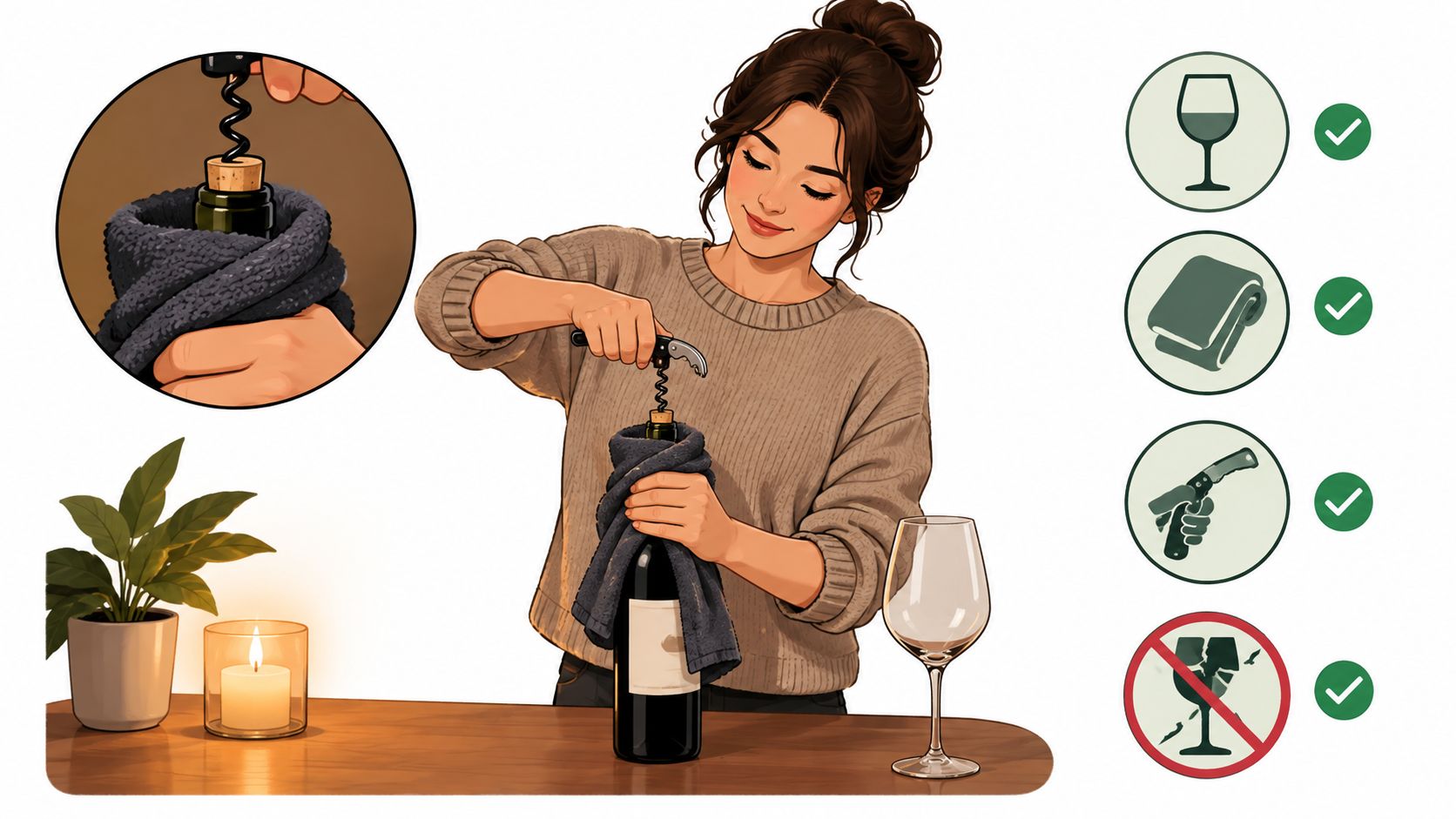
Keep the process controlled
A calm opening has a simple rhythm: inspect, cut, wipe, centre, turn and lift. Don't hold the bottle against your chest or use a countertop edge as an improvised lever. Those shortcuts reduce control and can damage the bottle or opener.
Use a clean cloth to wipe the neck after removing the capsule and again after extracting the cork. For aged wine, keep the bottle upright during opening and pour slowly so any sediment remains settled. If the cork shows signs of failure, decanting through a suitable strainer is preferable to allowing fragments into every glass.
Store the tool properly
Dry the worm and blade after cleaning. Store the corkscrew closed in a drawer or dedicated accessory case, where the blade won't catch clothing or hands and the worm won't collect kitchen residue. Check the hinge before opening an important bottle. A loose hinge or bent worm is a reason to change tools, not a challenge to overcome.
A few habits prevent most avoidable errors:
- Stabilise first: Put the bottle on a firm, uncluttered surface.
- Protect your hands: Keep fingers behind the lever and away from the knife.
- Respect fragile corks: Choose a two-prong opener when the cork looks compromised.
- Inspect the pour: Check the first glass for cork particles before serving everyone.
- Avoid rushing: Quiet, steady extraction gives you more control than a forceful pull.
For more serving habits that can affect the bottle and the experience, this guide to common wine mistakes is a useful companion.
The best opener is the one that matches the closure and the condition of the cork. Build confidence with a waiter's corkscrew on sound bottles, keep an alternative for aged releases and treat every extraction as a controlled movement rather than a strength test.
McLaren Vale Cellars offers premium South Australian wines, curated sample packs, mixed bundles and guidance through its tasting and Wine 101 resources, making it easier to choose bottles that suit your cellar and serving plans. Visit McLaren Vale Cellars to explore cork-sealed selections and prepare your next bottle with the right opener close at hand.


Comments (0)
There are no comments for this article. Be the first one to leave a message!