
Australia is the world's sixth-largest sparkling-wine market, valued at approximately US$1.2 billion, and local sparkling wines accounted for 45% of that value while imports represented 55%, according to Wine Australia's market bulletin. A big slice of what Australians drink is made here, and much of it is priced for a weeknight rather than a formal toast.
Cheap bubbly wine earns its place. A low shelf price usually predicts a simpler style, built to taste fresh and be finished soon, rather than a faulty bottle.
The better test is cost per glass you pour and finish. Shelf price works like the ticket price on a night out: it tells you the entry fee, not whether anyone stayed for dessert. A cheaper bottle can still cost more per drink if much of it is tipped away, so compare the glasses guests finish, not what the label asks at the shelf.
Price Bands and What Each One Gets You
Wine Australia estimated domestic sparkling-wine sales at 72 million litres in 2023–24, 7% of total Australian wine sales. Inside retail, the money is clustering in reachable bottles. The A$20 to A$29.99 segment represented 16% of sparkling-white volume and grew 24% over the two years to 2024. Prosecco, often sold as a value stand-in for traditional-method wine, held 26% share and increased sales by 37% over the same period.
That growth is a buying clue. Shoppers are paying a bit more than the bottom shelf, and they're choosing styles that taste of fruit rather than of long cellar time.
| Price per bottle (AUD) | Typical styles | What you get | Watch for |
|---|---|---|---|
| Under A$10 | Carbonated or fast tank-fermented white and rosé | Light, fresh, often sweeter | Short shelf life and sweetness that varies widely |
| A$10 to A$19.99 | Tank-fermented Australian sparkling and simpler Prosecco | Cleaner fruit, medium bubbles, a drier option if the label says Brut | Sweetness hiding behind a “dry” sounding name |
| A$20 to A$29.99 | Prosecco, sparkling rosé and entry Australian sparkling | Deeper fruit and steadier texture | Fastest-growing band, so stock turns over |
| A$30 and above | Traditional-method sparkling white and rosé | Finer bead, more weight, bread and nut notes | Paying for labour you may not taste if you mix the wine |
What each band tastes like in the glass
Under A$10 you mostly get a light, cold, fruity drink. Bubbles are often larger and fade in the glass. Sweetness can swing from off-dry to plainly sweet, which is fine in a spritz and tiring on its own.
From A$10 to A$19.99 the fruit gets cleaner. Think pear, green apple and a simple citrus edge. Texture is still straightforward. This is mixer and picnic territory, and it can be a weeknight glass if you like it a touch sweet.
A$20 to A$29.99 is where Prosecco, sparkling rosé and entry Australian sparkling usually sit. Fruit is riper, the bead lasts longer, and bottle-to-bottle quality is steadier because these lines sell quickly.
At A$30 and above you're often paying for a traditional-method wine. Finer bubbles, a little almond or brioche, and more weight. That extra cost earns its keep when people sip the wine slowly. It is wasted in a jug of orange juice.
Practical rule: For an everyday bottle, A$15 to A$25 is where most drinkers find reliable quality. Go under A$10 only for mixers, a big casual crowd, or people who prefer a sweeter style.
A A$20 to A$29.99 Prosecco, Australian sparkling or sparkling rosé can stand in for a so-called cheap Champagne at a toast, with salty snacks, or as the first pour of the night. Choose a Champagne-style traditional-method bottle when the wine is the point of the glass, not the mixer.
How Production Method Shapes Taste and Cost
Think of the tank method as a batch bake and the traditional method as slow sourdough. Both are bread. The time, the labour and the texture are not the same, and that gap is why two “sparkling” bottles can sit A$20 apart.
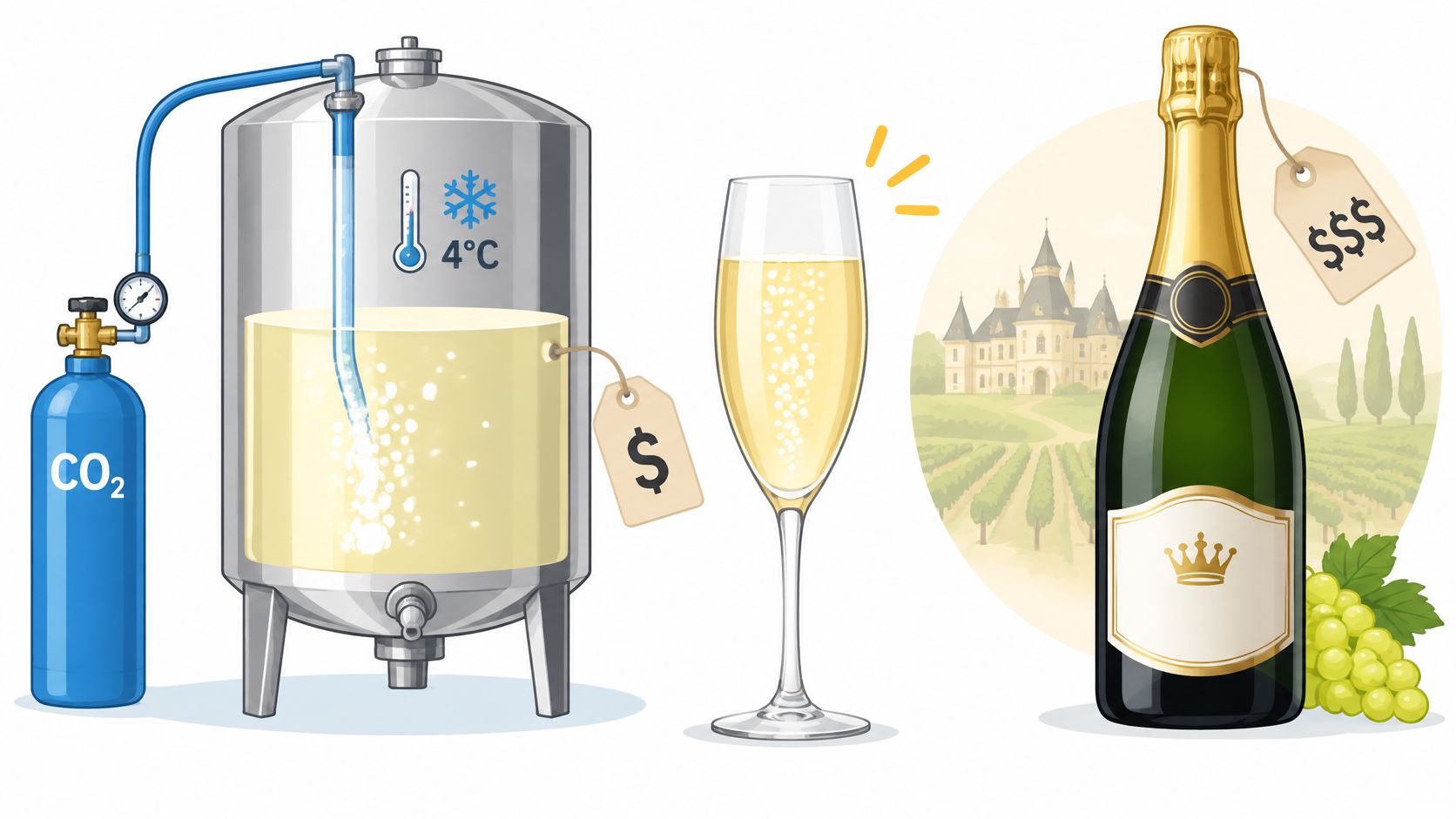
Wine Australia's sparkling educator guide treats production method as a cost-and-style driver, not a quality verdict.
Carbonation is the least expensive process. Carbon dioxide is injected into chilled base wine. You get a sharp prickle that disappears quickly, which is why these bottles suit a party punch more than a long sit-down.
The Charmat or tank method runs the second fermentation in a pressurised tank, then the wine is pressure-filtered and bottled. Less bottle-by-bottle handling means a lower price. Fresh fruit stays in front, and the bubbles feel softer. Most Prosecco is made this way on purpose.
Traditional method gives each bottle its own second fermentation. The tirage liqueur typically carries 19 to 26 g/L of sugar, secondary fermentation takes roughly four to six weeks, and cellar work continues after that. You pay for riddling, disgorging and time on lees. In return you get a finer bead and those bread, nut and brioche notes.
Cheap is a style choice
Tank-fermented and carbonated wines are engineered for fresh fruit, straightforward aromas and drinking now. They aren't defective traditional-method wines that failed a test. If you want brioche, don't buy a tank wine and feel cheated. If you want pear and a cold glass before dinner, don't pay for years in a cellar.
Read the back label for tank fermented, traditional method or carbonated. The word “sparkling” on the front tells you almost nothing about texture or value.
Our guide to good sparkling wine walks through how those label words show up on Australian bottles, so you can match the method to the night you're planning.
Reading Sweetness Labels on Cheap Bubbly
The word that trips people up is Extra Dry. On a cheap Prosecco it does not mean “drier than Brut”. It means the opposite of what the English suggests.
| Label term | Residual sugar (g/L) | How it tastes |
|---|---|---|
| Brut Nature | 0 to 3 | Bone dry and sharp |
| Extra Brut | 0 to 6 | Very dry and savoury |
| Brut | 0 to 12 | Dry with crisp fruit; most versatile |
| Extra Dry | 12 to 17 | Noticeably sweeter and fruit-forward |
| Dry | 17 to 32 | Soft and sweet |
| Demi-sec | 32 to 50 | Very sweet |
Brut, up to 12 g/L, is the versatile everyday pick. Fruit shows, but the glass still finishes clean. If you want a dry drink and the front label shouts Extra Dry, put it back unless you like a softer, fruitier pour. Demi-sec belongs with dessert, not with oysters.
Why some sweet bottles taste flat
Sugar needs acidity to stay lively. Crisp acid makes even a modest tank wine feel bright, like lemon over ripe pear. When acid is low and sugar is high, the same wine tastes syrupy and the finish sits on your tongue. That is a balance problem, not proof that inexpensive bubbly is always poor.
Tank-fermented bottles tend toward green apple, pear and citrus. Traditional-method bottles, once you spend more, lean toward stone fruit, almond and brioche. Don't mark a A$16 Prosecco down because it lacks toast. Toast was never the job.
A three-part taste check
- Watch the bead. Pour into a tall glass. Fine bubbles that keep rising for several minutes are a better sign than a furious fizz that dies in two.
- Smell before you judge sweetness. You want fresh fruit. Stale, cooked or cardboard notes mean the bottle has sat too long or too warm, and no amount of chill will fix that.
- Sip for lift. Acidity should tickle the sides of your tongue, and the finish should clear rather than coat. If it tastes like cordial, it will tire guests by the second glass.
A A$12 bottle that fails this check is worse value than an A$18 bottle that passes. You're not paying A$6 extra for prestige. You're paying so the second glass still tastes like the first.
Pairing Budget Bubbles With Food and Occasions
Match the sweetness you already like to the food's salt, spice or sugar. Don't restage the whole label chart at the table.
Brut and Brut Nature cut through fried chicken, hot chips, prawns, oysters and buttered popcorn. Salt plus bubbles is the easiest win on a small budget.
Extra Dry has enough sugar to cool chilli and soy. It sits happily with spicy takeaway, baked ham and a fruit platter. Treat it as the friendly bottle when tastes in the room differ.
Dry and Demi-sec belong with fruit tarts, blue cheese and anything glazed. Pour them at the end, not as the arrival drink, or the meal will taste dull beside them.
Sparkling rosé handles barbecue, salami and charcuterie because a little red-fruit weight stands up to char and fat. Sparkling red, whether Lambrusco or an Australian sparkling Shiraz, is the pizza and grilled-meat bottle. Chill it. Warm sparkling red tastes jammy and clumsy.
One decision per occasion
A quiet Friday needs one reliable Brut and nothing else. A birthday with mixed guests works better as two bottles, one Brut and one Extra Dry, so the dry drinkers and the sweet drinkers both finish what you opened.
Brunch and mimosas can take a cheaper Brut. Orange juice covers a plain aroma, so don't spend on brioche you won't taste. Our notes on food pairings for red, white and sparkling are handy if you're setting several courses, and if you're writing a longer drinks list, plan your wine menu with TopFoodApp before you lock in quantities.
A wedding toast needs a style you'd happily drink with no speech attached. Buy that, chill it to about 6 to 8°C, and pour into a flute or any tall glass so the bead lasts past the first sip.
Cost per Serve, Not Shelf Price
A standard 750 mL bottle pours five glasses of 150 mL. Divide the bottle price by five. That is the cost per glass before anyone leaves a puddle in the bottom.
| Purchase | Price per bottle (AUD) | Cost per 150 mL glass (AUD) |
|---|---|---|
| Single bottle at A$15 | 15.00 | 3.00 |
| Dozen at A$18 per bottle | 18.00 | 3.60 |
| 6-pack at A$20 per bottle | 20.00 | 4.00 |
| 6-pack at A$22.50 per bottle | 22.50 | 4.50 |
| Single bottle at A$25 | 25.00 | 5.00 |
On our shelves, a Sparkling Pinot Noir Rosé six-pack is A$120, which is A$20 a bottle, so A$4 a glass if you finish it. Curtis Heritage Sparkling Blanc de Blanc is priced from A$30, and a six-pack brings it to A$22.50 a bottle, or A$4.50 a glass. The single A$15 bottle looks thriftiest at A$3, but only on paper.
If you prefer a smaller measure, divide by 7.5 for cost per 100 mL. The A$15 bottle is A$2 per 100 mL. The A$22.50 bottle is A$3. Same ranking, smaller numbers, same trap.
When the cheap bottle costs more
National Liquor News notes that the A$6 to A$9.99 wine segment declined by 9%, while shoppers put more weight on value and pack size. A lower ticket is not the same thing as a lower entertaining bill.
Say you open a A$10 bottle and half of it goes flat or gets tipped out because it was too sweet. You served about two and a half glasses. Cost per glass drunk is A$4, the same as the A$20 rosé that people finished. Add a second rejected bottle and the “bargain” has funded the mid-range wine twice.
Use this sum before you click a dozen into the cart:
Bottle price ÷ 5, then add the cost of any wine you expect to pour away.
A half-case or a larger pack lowers the per-bottle figure only when that style suits the food and the people. For a hosted night, fold drinks into the same budget as the food. A plain guide to budgeting for cocktail party catering shows why the per-head drinks line matters as much as the canapés. Smaller gatherings make this sharper, because one wrong bottle is a quarter of the night, not a rounding error.
Buying Bulk, Sample Packs and Timed Offers
Bulk is a discount on a decision you've already made. It is an expensive way to discover you don't like the wine.
- Compare the per-bottle figure, not the carton total. A dozen at A$180 is A$15 a bottle. A six-pack at A$120 is A$20. The bigger number on the carton can still be the cheaper drink.
- Use a mixed pack to test two or three styles. One Brut, one Extra Dry and one rosé in the same order tells you more than three identical bottles you might regret.
- Treat a sample pack as tuition. It is the lowest-cost way to learn your sweetness preference before you commit to twelve.
- Buy the style you've already tasted when a promotion lands. Holiday and end-of-year cuts are useful on a known bottle. They are a gamble on a name you've never opened.
- Store cool, dark and on its side or upright, and drink within about a year unless the back label invites longer keeping. Heat and a sunny kitchen bench age cheap bubbly into flat, cooked fruit.
- Read the returns line and the freight line together. We can't exchange opened bottles or broken seals. Free delivery Australia-wide on orders over A$100 can make a half-case cheaper than two singles plus postage, and it can also tempt you to add a bottle you don't want just to clear the threshold.
Our piece on buying wine in bulk sets out when a carton saves money and when it just fills a cupboard. If the per-bottle saving survives shipping, and you've already liked the wine once, the carton is the rational buy. If you haven't tasted it, the saving is imaginary.
Pick One Test Bottle Before Buying in Bulk
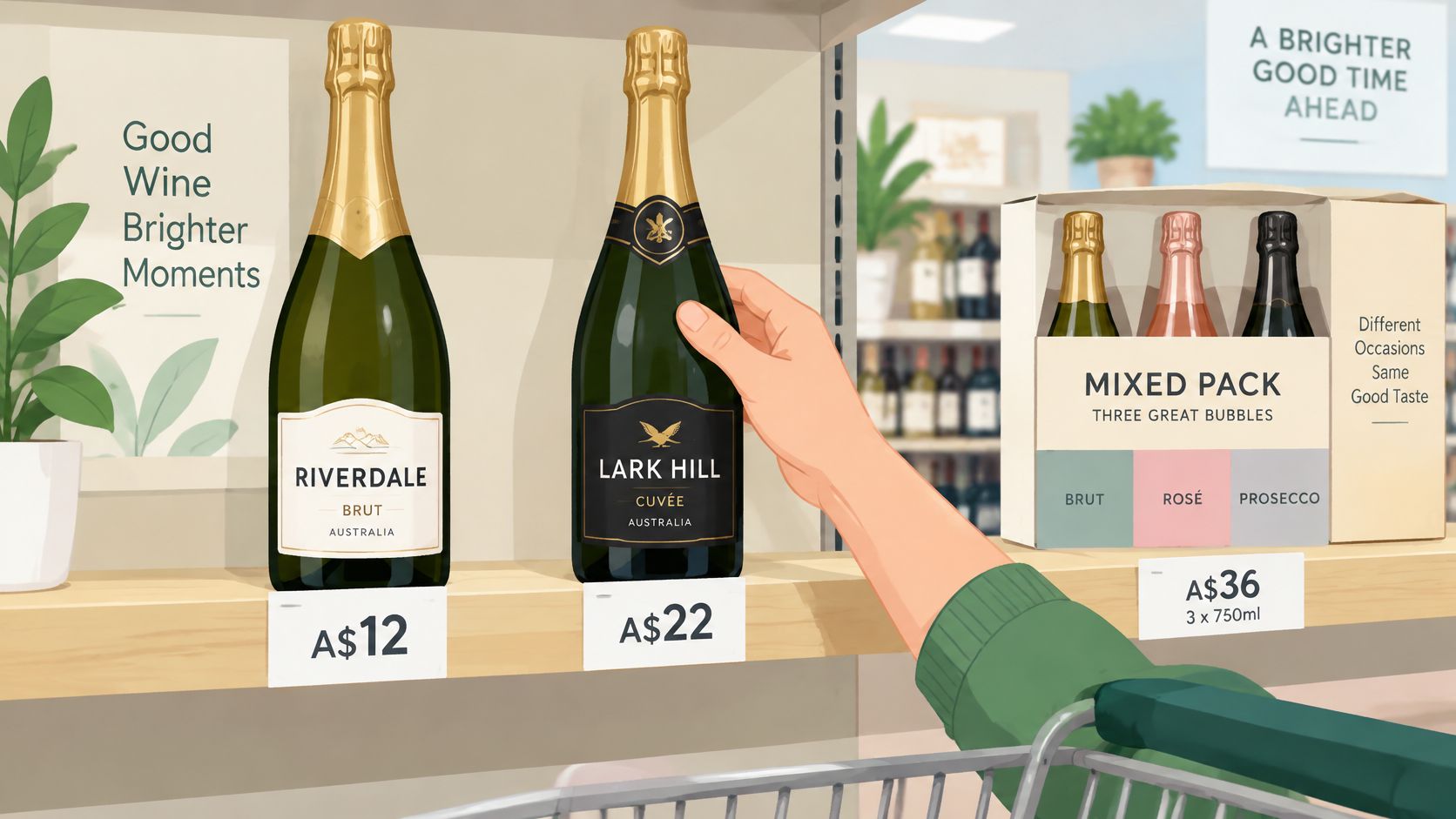
Buy one bottle near A$12 (inside A$10 to A$19.99) and one near A$22 (inside A$20 to A$29.99). If a mixed pack is on offer, add that rather than guessing a third style. You can build your own mix, learn which bottles you finish, and only then buy that mix in bulk.
Taste them side by side. Watch the bead, smell for fresh fruit rather than stale notes, and check whether the finish is clean and the sweetness matches what you like. Write the winner on the receipt. Memory after two glasses is a poor cellar plan.
A short tasting walk-through helps if you're unsure what “clean finish” feels like:
Buy a dozen only after two separate tastings agree on the same style. Then do the sum: bottle price divided by five, plus whatever you poured out. If neither bottle passes, wait. Another style will turn up. Loading the car with a wine you already know you won't finish is the expensive version of cheap.
Cheap bubbly wine earns its keep when it's dry enough for your taste, served cold, and gone before it goes flat.
McLaren Vale Cellars stocks Australian sparkling by the bottle, the six-pack and the dozen, including Blanc de Blanc and sparkling rosé you can test before you commit to a carton. Sample packs and build-your-own mixes let you check sweetness and style first, and orders over A$100 ship free Australia-wide. Visit McLaren Vale Cellars and pick one test bottle from each price band before you buy in bulk.
Comments (0)
There are no comments for this article. Be the first one to leave a message!