
Aged cheddar and aged semi-hard cheeses such as pecorino or Manchego are the safest matches for Cabernet Sauvignon because their fat and salt soften tannin, while fresh cheeses are the least reliable. But if hard cheese always works with red wine, why can Parmesan make one Cabernet taste harsher while a creamy cheese makes it feel smoother?
The missing detail is texture, not just cheese type. A successful Cabernet Sauvignon cheese pairing also depends on how grippy the wine feels, how strongly the cheese tastes, and which you taste first. You don't need a complicated cheese board to understand the difference, just a familiar cheese, a glass of Cabernet and a deliberate comparison.
Firm Aged Cheeses Are the Safest Start
Start with mature cheddar or an aged semi-hard cheese, rather than the strongest cheese at the deli counter. Say you're choosing between Australian cloth-bound cheddar, aged Manchego and fresh ricotta. The cheddar is the easiest baseline, Manchego offers a useful comparison, and ricotta is better saved for another occasion.
Cheddar is a familiar starting point for Australian shoppers. The USDA's Australian dairy industry report identifies cheddar as the country's leading cheese category, accounting for roughly half of the market. That familiarity helps: you can concentrate on what changes in the wine rather than trying to understand an unfamiliar cheese at the same time.
What to look for at the cheese counter
Choose by how the cheese feels and tastes, not by age alone.
- Fat: Look for a rich mouthfeel rather than a chalky, lean impression.
- Salt: Choose a savoury cheese, but don't assume the saltiest option will be best.
- Maturity: Seek developed nutty flavour that remains noticeable after a sip of full-bodied red.
Aged Gouda, Manchego and pecorino can all fit that description, although individual examples differ considerably. Ask for a taste where possible. A cheese that feels supple and rich may be more helpful than one that's exceptionally dry and crumbly.
Shopping rule: Buy a cheese you enjoy eating on its own. Pairing shouldn't require you to tolerate an unpleasant bite.
Young, mild cheese is a less dependable starting point. Fresh ricotta and fresh goat's curd may disappear behind Cabernet's flavour, leaving you more aware of the wine's grip than of the cheese.
For tonight's simplest experiment, choose mature cheddar and a mid-weight McLaren Vale Cabernet. Taste each separately, then together, without adding chutney or strongly flavoured crackers.
Cabernet Sauvignon Pairing Chart by Cheese Type
| Cheese style | Example cheeses | Effect on Cabernet | Verdict |
|---|---|---|---|
| Aged cheddar | Mature Australian or English cheddar, cloth-bound cheddar | Rich texture cushions grip; savoury flavour complements oak | Best match |
| Aged semi-hard sheep's milk | Aged pecorino, aged Manchego | Richness and salt balance structure; nutty flavour persists | Best match |
| Ossau-Iraty | Mature Basque sheep's milk cheese | Rounder texture balances tannin | Best match |
| Aged Gouda | Mature Dutch-style Gouda | Rich texture and caramel-like flavour suit a fruit-driven wine | Good match |
| Earthy soft-ripened | Ripe Camembert, mature Brie | Creaminess reduces grip; earthy flavour suits savoury Cabernet | Good match when fully ripe |
| Parmigiano-Reggiano | Mature Parmesan in small pieces | Concentrated salt and umami can make the wine seem harder | Good in small portions |
| Washed-rind | Taleggio, Époisses | Soft texture helps, but strong aroma can overwhelm the fruit | Use with a robust Cabernet |
| Triple-cream | Brillat-Savarin | Buttery richness smooths grip but may mute delicate flavour | Use with a structured Cabernet |
| Blue cheese | Roquefort, Stilton | Salt and mould character create a forceful contrast | Test in small amounts only |
| Fresh cheese | Ricotta, fresh goat's curd | Mild flavour is overwhelmed; the wine may seem drier | Avoid as a starting match |
These verdicts assume a structured, mid-weight Cabernet, not an especially delicate mature bottle or an intensely tannic young wine. The American Wine Society's Australian red-wine pairing guidance supports the broad categories behind the chart: aged semi-hard cow's-milk cheeses, aged semi-hard sheep's-milk cheeses and selected earthy soft-ripened cheeses.
How to interpret the verdicts
Best matches offer the most dependable balance between richness and flavour intensity. Cheddar is the straightforward option, while Manchego, pecorino and Ossau-Iraty let you explore sheep's-milk cheeses without immediately moving into blue-cheese intensity.
Good matches require a little more attention to the particular cheese. Gouda should taste developed rather than merely sweet and mild; Camembert should be ripe and creamy rather than chalky through the centre. Parmigiano-Reggiano belongs in small pieces because a large mouthful can dominate what follows.
Use carefully means test before committing the whole board. Washed-rind aroma, triple-cream richness and blue-cheese saltiness create different challenges, so they aren't interchangeable alternatives to cheddar.
Avoid describes a poor default, not a ban. You may enjoy fresh cheese beside a Cabernet-led meal, but it's unlikely to give you the clearest demonstration of a balanced wine-and-cheese match.
Adjust the chart to your bottle
For a very grippy Cabernet, prioritise richness over hardness. A buttery semi-hard cheese may be more useful than a brittle, intensely salty wedge.
With a softer bottle, reduce the cheese's intensity so you can still notice the wine. There's no benefit in choosing an impressive cheese if all you taste afterwards is its rind or salt.
Why Tannins and Cheese Fat Balance Each Other
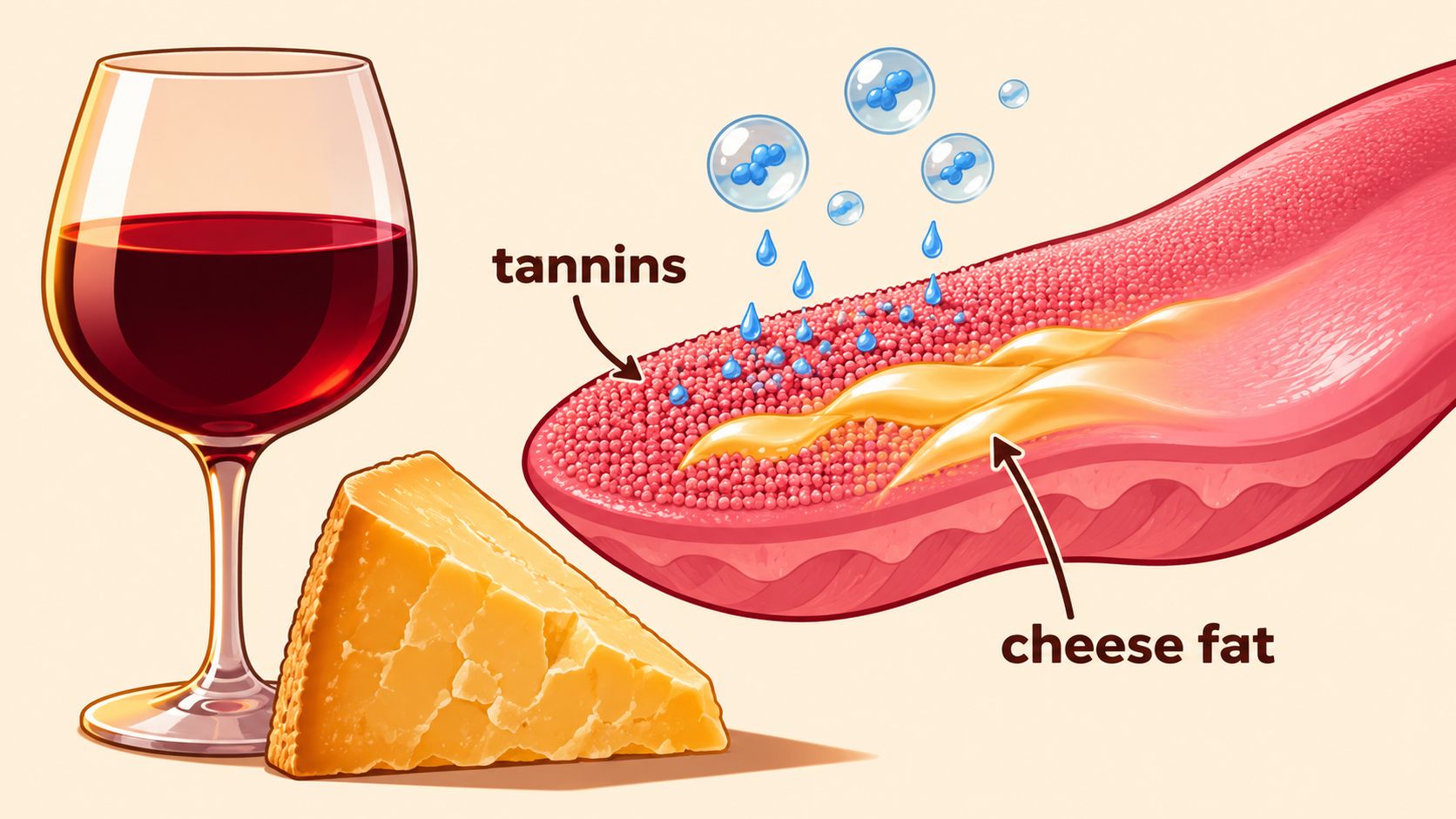
Cabernet's tannins can feel a little like fine sandpaper across the tongue and gums. That's an analogy for the sensation, not actual abrasion: tannins interact with proteins in saliva, reducing its lubricating effect and creating astringency, the dry, grippy feeling.
This diagram illustrates the mouthfeel change you're looking for.
Fat, protein and salt have different jobs
Fat changes the sensation of dryness. A rich cheese helps the mouth feel lubricated, so the same wine can seem less severe. It hasn't lost its structure; you're experiencing that structure alongside a different food texture.
Protein offers tannins other binding partners. Cheese provides proteins with which tannins can interact, rather than leaving the interaction centred on saliva. Our guide to tannins in wine explains why that gripping sensation differs from sourness or alcoholic warmth.
Salt changes the flavour balance. In a suitable amount, it can reduce apparent bitterness and make the fruit easier to notice. More isn't automatically better, especially when the cheese also has a very dry texture or concentrated savoury flavour.
Australian Wine's cheese-pairing guide specifically pairs Cabernet Sauvignon with aged cheddar and explains how creamy, fatty cheese balances wine's tannin and acidity. That's a better foundation than the blanket rule that all hard cheeses suit all red wines.
Compare the same wine with different textures
Try a young, mild cheddar beside a mature, richer example. With the mild cheese, you may notice mostly the Cabernet's drying finish, because the cheese's flavour fades quickly. With the mature cheese, the blackcurrant may become clearer and the finish feel more rounded.
Don't assume maturation alone caused every difference. The cheeses may also differ in moisture, fat, salt and production method.
The useful question isn't whether the cheese makes the wine softer at any cost. It's whether the wine becomes easier to enjoy while retaining its fruit and freshness.
This accompanying video offers another way to approach the pairing.
For a structured McLaren Vale style, choose developed, nutty flavour with enough richness to support the wine. Stop short of a cheese so salty or forceful that you can no longer recognise what's in the glass.
How Cabernet Style Changes the Right Cheese
A cheese recommendation makes more sense when you know which Cabernet you're pouring. Youthful grip, mature flavour, oak and alcoholic warmth can each change the result, even when the grape variety stays the same.
The UC Davis summary of expert wine-and-cheese assessments describes strong tannins being softened by creamy, buttery, high-fat cheeses, while also recording that Cabernet can dominate some firm cheeses. Hardness alone is therefore a poor buying rule.
Youthful grip versus mature delicacy
With a youthful, tannic Cabernet, choose a cheese with generous richness and enough savoury flavour to remain present. Mature cheddar or a rounded aged Gouda makes a sensible trial. Don't infer tannin strength from vintage alone, though: winemaking and the bottle's development also matter.
A mature Cabernet may call for less force. Try a supple cloth-bound cheddar or ripe Camembert, taking care that the rind doesn't overwhelm the wine's more delicate aromas.
For example, put mature cheddar beside a structured McLaren Vale Cabernet, then try ripe Camembert with a softer, developed bottle. You're matching the cheese to the wine's current behaviour, not awarding either cheese a permanent ranking.
Oak and alcohol change the emphasis
Noticeable toast, cedar or vanilla can sit comfortably beside nutty, savoury aged cheese. A less oak-driven Cabernet may benefit from a creamier, less assertive partner, although that doesn't make fresh ricotta an automatic match.
Alcoholic warmth is another reason to avoid treating salt as a cure-all. If the wine already feels hot, an aggressively salty cheese may make the combination less comfortable. Try a richer, gentler cheese and check the wine's serving temperature before replacing the bottle.
Our guide to Cabernet Sauvignon's structure and style can help you translate bottle descriptions into useful pairing choices.
Use the label as a starting point:
- Vintage: Consider possible development, but confirm it by tasting.
- Oak treatment: Look for references to cedar, toast, vanilla or barrel maturation.
- Alcohol: Read the stated level, then notice how warm the wine feels.
- Tannin description: Firm and structured suggest a different cheese choice from supple and mellow.
Step-by-Step Tasting and Mistakes to Avoid
Taste the wine alone before adding cheese. Otherwise, you won't know whether the cheese improved the combination or changed your impression of an already soft wine.
An Australian sensory study involving commercial Shiraz and cheddar found that eating cheese before the wine reduced perceived flavour length and astringency and made tannins feel silkier. The experiment used Shiraz, not Cabernet Sauvignon, so it supports paying attention to tasting order rather than promising an identical Cabernet result.
Use the sequence below to make the comparison deliberate.
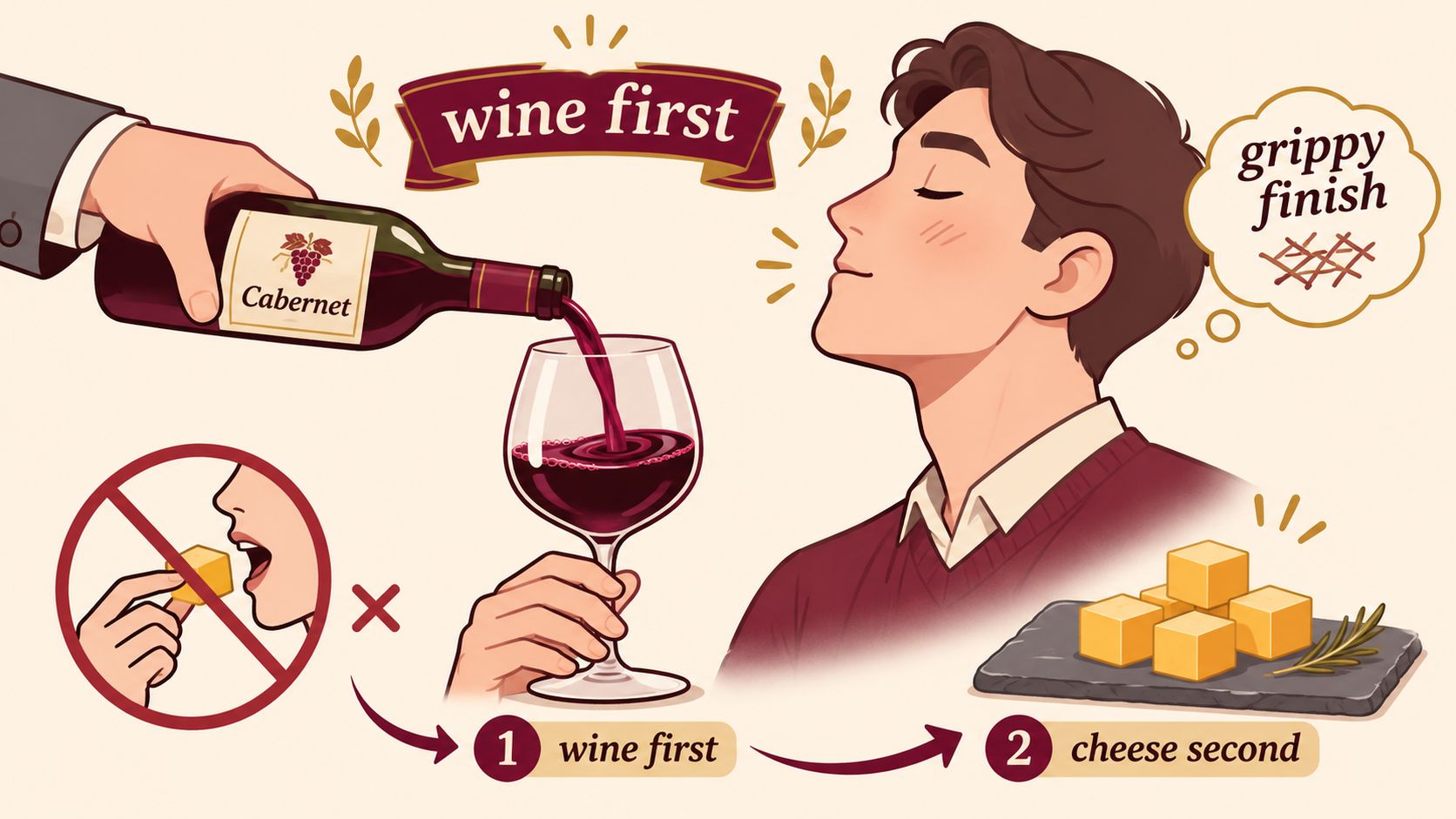
A controlled tasting sequence
- Establish the baseline. Sip the Cabernet without food. Notice the fruit, the drying sensation around your gums and how long the flavour remains after swallowing.
- Prepare the cheese so it's no longer fridge-cold. The centre should feel yielding for its style, not chilled and rigid; cold cheese releases less aroma and its fat feels firmer.
- Check the wine's temperature. Cabernet should feel slightly cool rather than warm. If it feels hot or smells predominantly alcoholic, chill it briefly and reassess instead of immediately blaming the cheese.
- Take a small piece of cheese and chew it fully. Then sip the wine while the cheese's flavour and texture are still present.
- Compare specific sensations. Ask whether the fruit is clearer, the grip gentler and the finish still recognisable. A pairing that removes every interesting feature from the wine isn't necessarily an improvement.
- Take another bite after the wine. Notice whether you prefer this order and whether the cheese itself tastes more savoury, sharper or less balanced.
- Change cheese, not everything. Keep the same wine and use a clean knife for the next cheese. Move from gentler flavours towards washed-rind or blue styles, with water and a pause between comparisons.
- Write a short note in everyday language. Rounder, fruitier, hotter, drier and overwhelmed are more useful than a complicated score you won't remember.
Our step-by-step wine-tasting guide offers a fuller method for describing the glass without relying on specialist vocabulary.
Pairing mistakes, causes and fixes
| Mistake | Why it happens | Fix |
|---|---|---|
| Serving young, mild cheddar | The cheese lacks flavour intensity, even if it contains substantial fat | Choose a richer, mature cheddar with developed savoury flavour |
| Cheese straight from the fridge | Cold mutes aroma and firms the fat | Let it lose its fridge chill before tasting |
| Cabernet served too warm | Alcoholic warmth can dominate and make the combination feel harsher | Chill briefly, then taste again |
| Fresh ricotta with Cabernet | Mild cheese lacks the intensity to balance the wine | Serve a lighter red or skip the pairing |
| Strong blue cheese with young Cabernet | Salt and mould character can magnify bitterness | Use a small piece, or try a mature Cabernet |
| Too much cheese at once | Lingering richness and palate fatigue hide differences | Use small bites and pause between comparisons |
Preference matters: If you enjoy salty blue cheese with a grippy young Cabernet, you don't need to reject it because the wine feels drier.
Technical balance and personal enjoyment aren't the same thing. Someone seeking a silky finish may dislike a contrast that another person finds lively and satisfying.
Before serving, check cheese maturity, serving temperature and portion size. Those adjustments often help more than opening a different wine.
Plan Your Cabernet and Cheese Board Tonight
Buy mature cheddar and an aged semi-hard sheep's-milk cheese, such as Manchego or pecorino, and pair them with a McLaren Vale Cabernet. Keep the board restrained so you can identify which cheese suits your bottle.
For a value-focused wine purchase, our Curtis Legion Cabernet Sauvignon 2021 costs $150.00 per dozen, or $12.50 a bottle. Treat the bottle's age as useful context rather than a guarantee of softness, then let your first unaccompanied sip guide the comparison.
A practical shopping and serving plan
Choose cheeses with a clear contrast in texture, not merely different names. A rich cheddar beside a nutty, supple Manchego will teach you more than several similarly dry, crumbly wedges.
- The foundation: A mature cheddar with savoury depth and a pleasant, rich finish.
- The comparison: A sheep's-milk cheese that tastes rounded rather than aggressively salty.
- The optional extra: Small pieces of Parmigiano-Reggiano for a more concentrated, savoury contrast.
- The accompaniments: Plain bread or neutral crackers and water, keeping sweet preserves separate during the initial tasting.
Cut modest pieces and leave the remaining cheese available for later. You can always serve more, but an overloaded plate encourages large bites that make subtle comparisons difficult.
If you have both a structured Cabernet and a softer, mature bottle available, compare them with the same cheeses. Don't assume the older bottle will win; the useful result is discovering which combination you'd choose to drink.
Keep the setting simple
Use separate knives, stable plates and glasses that let you smell the wine comfortably. If you're also replacing everyday plates and glasses, Everti's guide to choosing non-toxic tableware for families provides a separate resource for that household decision; tableware doesn't need to become another variable in the tasting.
A small board with deliberate choices is more useful than a crowded board where every bite changes the experiment.
Start with the gentlest-tasting cheese, not automatically the softest, and leave blue or pungent washed-rind cheese until last. Note which combination preserves the fruit and which makes you want another sip.
If you don't like a wine, we'll help you find one suited to your taste. Tonight, run the tasting with cheddar and your chosen sheep's-milk cheese, then record your preferred match before adding accompaniments.
At McLaren Vale Cellars, we offer Cabernet Sauvignon selections and practical wine education to help you choose and serve with confidence. Visit McLaren Vale Cellars to find a bottle for your cheddar-and-Manchego comparison, or ask us for help choosing a style that suits your taste.

Comments (0)
There are no comments for this article. Be the first one to leave a message!