
I still remember pouring a glass of Adelaide Hills Grüner Veltliner for someone who swore they only drank Sauvignon Blanc. One sip in, they looked up and said, “What is this?” That reaction is why I love this wine.
Australia's Exciting New White Wine Discovery
If you haven't spent much time with adelaide hills gruner veltliner, you're not alone. For plenty of Australian drinkers, it's still a discovery wine. But it doesn't taste obscure. It tastes like something that makes instant sense once it's in your glass.

Grüner Veltliner began life as an Austrian classic, yet it has settled into the Adelaide Hills with remarkable confidence. Adelaide Hills pioneered South Australia's first commercial Grüner Veltliner plantings in 2008, and the region has since been described as the “Mecca for Australia's most exciting new white varietal” in the Adelaide Hills Wine Region guide to Grüner Veltliner.
That phrase matters because it captures where this wine now sits. It's no longer just a curiosity for sommeliers or cellar door regulars. It has become one of the most interesting local answers to a simple question: what should I drink if I want a white with freshness, savoury detail, and proper food appeal?
Why it feels fresh and familiar at once
Grüner often lands somewhere between categories people already know. It has the brightness that fans of Riesling tend to enjoy, but with more texture through the middle of the palate. It has fruit, but not in a tropical or soft way. It has spice, but not oak-driven spice.
What makes it click: it gives you zing, shape, and savoury lift in the same glass.
For many drinkers, that's the moment of conversion. You taste citrus and orchard fruit first, then a fine peppery note, then a dry finish that makes you want food. It feels modern, but not fashionable for the sake of it.
Why Adelaide Hills matters so much
Not every region can make this grape feel complete. Adelaide Hills gives Grüner a style that feels precise rather than broad, energetic rather than heavy. That's why the region has become so closely associated with the variety in Australia.
If you enjoy white wines that are crisp without being thin, aromatic without being perfumed, and savoury without being severe, this is one to know.
Why The Adelaide Hills Are Perfect for Grüner
The easiest way to understand this grape in Australia is to ask a basic question. Why does it feel so at home in the Adelaide Hills, and not define warmer regions in the same way?
The answer is terroir, which is just a practical wine word for place. Climate, altitude, and soil all shape how the grapes ripen and how the finished wine tastes. If you want a useful primer on that idea, this guide on does wine origin affect taste lays out the principle clearly.

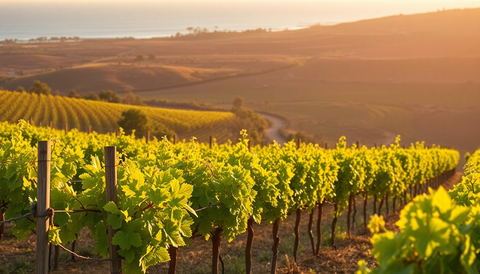
Adelaide Hills sits at around 450m to 500m above sea level, and the region experiences extreme diurnal temperature ranges. Warm daytime conditions can drop sharply at night, which helps grapes hold onto acidity while still developing flavour, as outlined in this regional Adelaide Hills wine overview.
The three conditions that make it work
Think of Grüner as a grape that prefers a disciplined environment. It doesn't usually shine when everything is easy for the vine.
- Height above sea level gives the region a cooler feel. That slows ripening and helps preserve tension in the fruit.
- Big day to night shifts let flavour build during the day while the cool nights protect freshness.
- Free-draining loamy sands mean the vines can't get lazy. Water moves through the soil, roots dig deeper, and flavour concentration improves.
The Adelaide Hills also has predominantly grey-brown and brown loamy sands with excellent free-draining properties, and that soil profile has proved ideally suited to Grüner Veltliner. You can taste the result in the wine's brightness and firm mineral line.
Why warmer regions show different strengths
Some drinkers often get confused. They assume a successful South Australian white variety should do equally well anywhere in the state. Wine doesn't work like that.
A warmer region such as McLaren Vale has its own strengths. It can produce generous, expressive whites with broader texture and riper fruit expression. Adelaide Hills Grüner goes in a different direction. It leans into cut, detail, spice, and line.
Cooler regions don't automatically make “better” white wine. They make different white wine, and Grüner happens to love the kind of structure the Adelaide Hills provides.
That contrast is useful. It explains why Adelaide Hills has become the specialist home for this variety, while warmer regions are better known for other styles. If you want precision, lift, and a white that seems built for savoury food, the Hills gives Grüner the right stage.
The Signature Taste Profile
The best way to approach adelaide hills gruner veltliner is to treat it like a tasting map. Not because you need to become technical, but because once you know what to look for, the wine becomes much easier to love.
A good example from the region consistently points you toward zingy citrus, green apple, a spicy white pepper note, and linear, mineral-driven acidity, as described in Wine Australia's feature on Adelaide Hills Grüner Veltliner.
What you notice first
On the nose, expect freshness rather than perfume. This isn't usually a loud, floral white. It's more about snap and definition.
You might pick up things like:
- Citrus pith rather than sweet citrus juice
- Green apple rather than ripe tropical fruit
- Stone fruit hints that stay restrained
- A peppery or savoury edge that gives the wine personality
That pepper note is often the moment people remember. It can show as white pepper, a faint rocket-like bite, or a savoury spice that sits behind the fruit.
What happens on the palate
The palate is where Grüner really separates itself from more familiar whites. It doesn't just hit and fade. It travels.
| Characteristic | Description |
|---|---|
| Aroma | Fresh citrus, green apple, and subtle stone fruit |
| Signature note | A savoury, spicy white pepper lift |
| Acidity | Bright and linear rather than soft or rounded |
| Texture | Fine mineral feel with gentle palate weight |
| Finish | Dry, crisp, and food-friendly |
If you're new to the term linear acidity, think of it as acidity that moves in a straight, focused line across your palate. It doesn't feel fat or diffuse. It gives the wine direction.
How to recognise a good example
You don't need to identify every detail. A practical check is simpler than that.
If the wine tastes crisp, dry, slightly spicy, and more savoury than fruity, you're in the Grüner zone.
The other thing to notice is the finish. Adelaide Hills Grüner usually finishes with a clean, mineral edge that makes the next sip feel inviting. That dry close is part of why it works so well at the table.
For drinkers used to Pinot Grigio, it can feel more characterful. For Sauvignon Blanc fans, it often feels less overtly aromatic and more structured. For Riesling lovers, it offers a similar energy with a different shape.
Producers to Know and Their Styles
One of the nicest things about this category is that it already has recognisable local personalities. The grape may still be new to many drinkers, but the producers behind it aren't guessing. They know what they want the wine to say.

Hahndorf Hill and the benchmark role
If you're learning this style, Hahndorf Hill is one of the key names to remember. The region's rise with Grüner has been recognised internationally, most notably when Hahndorf Hill Winery's 2023 Reserve Grüner Veltliner was crowned Best Wine from Australia at the Frankfurt International Wine Trophy 2025. That result reinforces the point that Adelaide Hills can produce world-class examples.
Hahndorf Hill often stands in for the more established, benchmark expression of the variety in the region. When people talk about Adelaide Hills as the leading Australian home for Grüner, producers like this are a big reason why.
The Pawn Wine Co and a more tension-driven style
Then you have a producer like The Pawn Wine Co., which shows how winemaking choices can fine-tune the grape's personality. In the winery, they use stainless steel fermentation, plus a portion of wild barrel ferment in older French oak, along with sur lie ageing and batonnage to build texture while preserving bright aromatics, as detailed in The Pawn Wine Co. 2023 Grüner Veltliner tasting notes.
That sounds technical, so here's the plain-English version:
- Stainless steel keeps the fruit clean and bright
- Older oak adds texture without obvious woody flavour
- Lees contact gives the palate more shape
- Batonnage helps build a broader mid-palate feel
The 2023 wine was harvested on 21 March 2023 from Macclesfield and cropped at 6.5 tonnes per hectare. It blended clones HHW1, HHW2, and IBBEY, and the finished wine showed 12.2% alcohol, pH 3.07, and TA 5.59 g/L in the tasting notes. That wine also won the Provenance Trophy at the 2023 Adelaide Hills Wine Show.
Other names that show the range
Guthrie Wild is another useful producer to know because it helps illustrate that Adelaide Hills Grüner isn't one fixed style. Across the region, some examples lean tighter and more citrus-driven. Others bring more stone fruit breadth or an oilier texture while still keeping that regional line and spice.
Buying tip: don't shop for one “perfect” Grüner style. Shop for the expression that suits how you like to drink white wine.
If you like very brisk, mineral whites, start with a leaner producer. If you enjoy more palate texture, look for bottles made with lees work or a little older oak influence. The region has enough stylistic range now that you can explore within the category, not just around it.
Perfect Food Pairings for Modern Australian Dining
Grüner is one of those rare whites that solves a common dinner problem. You want freshness, but you don't want a wine that disappears next to food. You want flavour, but you don't want a bottle that dominates the plate.

Adelaide Hills Grüner works especially well with modern Australian-Asian cuisine because its dry, crisp minerality and peppery edges can match aromatic, lively dishes without turning clumsy. That pairing strength is one of the region's most attractive calling cards.
Why it pairs so easily
Three features do the heavy lifting.
- Acidity cuts through richness in dishes like squid, pork, or creamy dressings.
- Peppery savouriness echoes spice and herbs without making the wine taste hot.
- A dry finish resets the palate so each bite still feels bright.
That combination makes it more versatile than many people expect. It isn't only for delicate seafood, and it isn't only for classic European dishes either.
What to put on the table
For an easy first match, try one of these:
- Salt and pepper squid because the wine's citrus and spice feel like part of the seasoning
- Vietnamese rice paper rolls where herbs, crunch, and freshness mirror the wine's own energy
- Grilled kingfish with citrus salsa because the wine can handle both the fish and the sharpness of the garnish
- Thai green curry if the dish is light enough to let the wine's acidity stay in charge
- Roast chicken with fennel or herbs when you want something more comforting than summery
If you like pairing white wine with seafood, poultry, or lighter pasta dishes, this broader guide to pairing white wines with seafood pasta and poultry is a helpful companion.
Grüner shines with dishes that have movement. Citrus, herbs, ginger, chilli, pepper, fresh greens, crisp crumbs. It likes food with edges.
A quick visual guide can help if you're still getting your head around the style:
One pairing rule worth remembering
Don't overcomplicate it. If a dish wants a white wine with freshness and shape, Grüner is a strong candidate.
That's also where the Adelaide Hills version stands apart from broader, warmer-climate whites. With richer regional styles, fruit can take the lead. With Adelaide Hills Grüner, the structure often takes the lead, and that makes it especially handy at the dinner table.
A Practical Guide to Serving Cellaring and Buying
You don't need a ritual to enjoy this wine, but a few simple choices will make your first bottle far more convincing.
How to serve it properly
Serve Adelaide Hills Grüner Veltliner chilled but not icy, ideally around 8 to 10°C. Too cold, and you mute the spice and texture. Too warm, and the wine can feel looser than it should.
Use a Riesling glass or a good universal white wine glass. You want enough room for the aromatics to lift, but not a huge bowl that makes the wine seem softer.
If you'd like a practical refresher on serving temperatures, glassware, and white wine storage, this guide to white wine temperature glassware and cellaring tips is worth bookmarking.
Can you cellar it
Yes, and this surprises a lot of people.
Well-made Adelaide Hills Grüner can cellar for 5 to 7 years, and some examples may go longer, especially when they have strong acidity and good textural balance. With time, the bright citrus and green apple notes can soften into a more layered, savoury profile.
Cellaring rule: if the wine already tastes balanced when young, with a firm dry finish rather than simple fruitiness, it's usually a better candidate for short to medium-term ageing.
If you're buying for the cellar, consider picking up two bottles. One for now. One for later. Grüner is a great teacher because the changes over time are often clear even to non-experts.
What to look for when buying
Start with producer and region before anything else. If the label says Adelaide Hills and the producer has a serious cool-climate focus, you're on good ground.
Then think about style:
- For crisp and racy drinking, choose bottles that emphasise freshness and stainless steel handling.
- For more texture, look for mention of lees contact, wild ferment, or older oak influence.
- For food matching, choose drier, more mineral examples over softer fruit-led whites.
If you're planning a tasting day in the region with friends and don't want anyone worrying about the drive, these Oz Coach Hire mini bus services can be a practical option for Adelaide Hills winery visits.
One last buying note. Grüner often offers a lot of character for the money because many drinkers are still catching up with the category. That makes it a smart bottle for curious buyers who want something distinctive without defaulting to imported alternatives.
Your Next Favourite White Wine Awaits
Adelaide Hills Grüner Veltliner earns attention because it does something many white wines don't. It gives you freshness, texture, savoury detail, and serious food friendliness without feeling heavy or predictable.
That combination starts in the vineyard. The cool elevation, sharp day to night shifts, and free-draining soils of the Adelaide Hills create a wine with cut and composure. In the glass, that becomes citrus, green apple, mineral drive, and that little flick of peppery spice that makes the variety so easy to remember.
It also helps answer a broader wine question. Not every region should try to be everything. Warmer regions have their own strengths. Adelaide Hills has become the cool-climate specialist for this grape, and that focus is exactly why the style feels so convincing.
If you usually reach for Sauvignon Blanc, try Grüner for a more savoury shape. If you like Pinot Grigio, try it for more character. If you love Riesling, try it for a different expression of energy and line.
The first bottle often starts as curiosity. The second bottle is usually deliberate.
So if you've been looking for a white wine that feels fresh but not simple, expressive but not loud, this is your nudge. Put a bottle of adelaide hills gruner veltliner on the table with dinner and let it do what it does best. Wake up the meal. Wake up your palate. Possibly change your house white.
If you're ready to explore South Australian wines with confidence, McLaren Vale Cellars is a great place to start. Their range, tasting guides, sample packs, and value-focused dozens make it easy to compare styles, discover new favourites, and buy with less guesswork.
Comments (0)
There are no comments for this article. Be the first one to leave a message!