
You're standing in front of a shelf, bottle turned in your hand, reading about blackberry, cedar and a persistent finish. It sounds good. You still don't know if it'll suit tonight's roast, feel heavy on a warm evening, or taste sweet. Good wine taste descriptions should answer those questions before you pull the cork.
Why Wine Taste Descriptions Confuse Even Regular Drinkers
You know the moment well. At a cellar door or in the bottle shop, you scan a back label that says medium-bodied with a savoury finish and nod as if that settles it. Then you get home, pour a glass, and find a wine that's far more drying, lighter, or sharper than you expected.
The words weren't necessarily wrong. You just hadn't been given a way to translate them into a feeling in your mouth. Most labels list aromas, because fruit and spice are easy to name, and skip the parts that decide whether you'll enjoy the wine, such as weight, grip, freshness and length.
That's why wine taste descriptions can feel like decoration. In practice, they're shorthand. A good note tells you what you'll smell, how intense it'll be, how it'll feel, and what will linger after you swallow.
What a useful description actually does
Think of a tasting note as a prediction, not poetry. Blackberry predicts a dark fruit smell. Firm tannin predicts a drying grip on your gums. Crisp acidity predicts your mouth will water. Persistent finish predicts the flavour won't vanish the second you swallow.
Once you read that way, the same bottle works for different jobs. A shopper can match it to a meal, a gift buyer can explain it without guessing, and a new drinker can choose something approachable instead of something that only sounds impressive.
Read every label for what you'll feel, not just what you'll smell. Texture and finish decide most second glasses.
Keep this guide as a decoder you can return to. Start with how perception works, learn a repeatable tasting routine, then use the categories, glossary and buying shortcuts at the shelf or the table. You don't need to memorise every term. You need a few anchor words you trust, and a clear picture of what each one delivers in the glass.
The Four Channels of Wine Perception
Most confusion starts when flavour is treated as one thing. It isn't. The Australian Wine Research Institute defines wine flavour as the combined perception of aroma, taste and texture in the mouth or after swallowing or spitting. Add finish, and you have four channels to check separately.
Here's a visual map of those four channels before you break them down one by one.
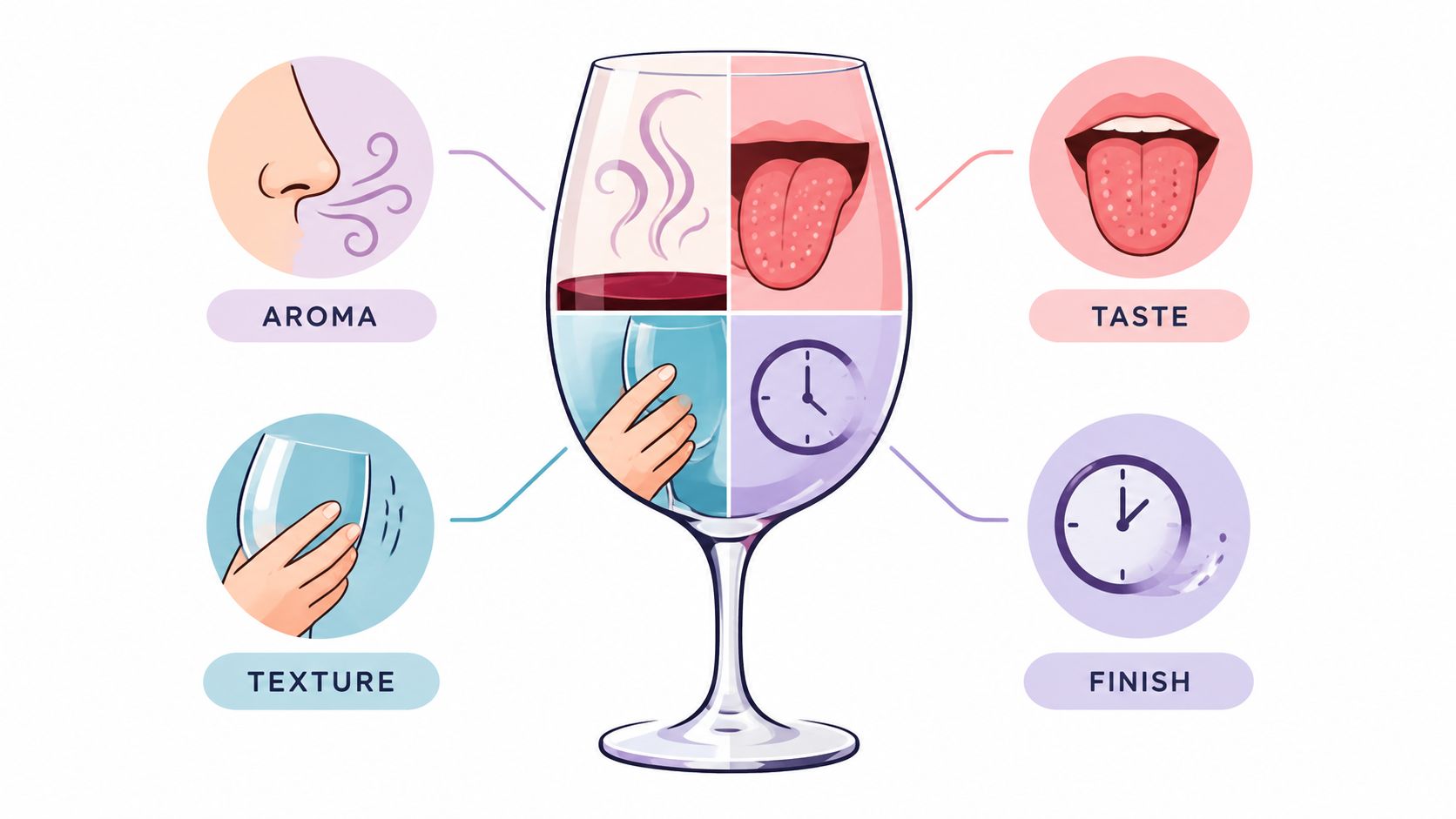
Aroma and taste are not the same job
Aroma is what you smell, both before you sip and as scent travels from the back of your mouth to your nose. That's where blackberry, lemon, vanilla, grass or cedar live. Taste is narrower and happens on your tongue. It covers sweetness, acidity, bitterness, saltiness and umami.
This split explains the most common surprise for new drinkers. A McLaren Vale Shiraz can smell intensely fruity, all ripe plum and dark berries, and still taste completely dry. Ripe fruit aroma isn't residual sugar. Your nose is reporting ripeness, your tongue is reporting that there's no sweetness left.
Texture and finish decide how it feels
Texture is everything you feel rather than taste. That includes body or weight, the drying grip of tannin, the warmth of alcohol, and whether acidity makes the wine feel sleek or sharp. A Cabernet might smell similar to a Shiraz but feel firmer and more chalky because its tannin is doing different work.
Finish is what remains after you swallow or spit. It might be a clean citrus fade from a Sauvignon Blanc, a peppery warmth from a regional blend, or a long dark fruit echo that invites another sip.
- Aroma asks: What do I smell, and how strong is it?
- Taste asks: Is it dry, tart, bitter or savoury?
- Texture asks: Is it light, plush, firm or warming?
- Finish asks: How long does it stay, and what's the last impression?
Read a note channel by channel and you can picture the wine before you buy it. You'll stop expecting sweetness from a fruity smell, and you'll start noticing the structure that makes a bottle right for food, weather and company.
A Simple Three-Step Tasting Technique
You don't need special equipment to taste with intention. You need a clean glass, reasonable light, and the same order every time. Repetition is what turns vague impressions into words you can reuse.
Step one is look. Tilt the glass against something white and check colour depth and clarity. A pale, bright white often signals a fresher, lighter style, while a deep ruby red suggests thicker skins, riper fruit or a fuller body. Colour won't tell you everything, but it sets an expectation you can test.
Step two is swirl and sniff. A gentle swirl coats the glass and releases volatile aromas. Take three short sniffs rather than one long inhale, and think in layers. First, primary fruit from the grape. Next, secondary notes from fermentation or lees, such as bread or cream. Then tertiary notes from oak or age, such as vanilla, toast or leather.
Coffee tasters use a similar discipline of smelling before tasting and scoring in a set order, which is why Cartograph Coffee's tasting guide is a useful cross-check if you want to see how another drink builds a sensory routine from scratch. The principle transfers directly. Slow down, separate the stages, and write what you notice before you judge it.
Give every descriptor a size
Step three is sip and grade. Let a small mouthful move across your palate, then note taste, texture and finish in that order. The first sip wakes your palate up. The second is where you can assess.
Borrow the intensity scale used at cellar doors so your words carry magnitude:
- Light: Present but delicate, you have to look for it
- Medium: Clear and balanced against the other elements
- Medium-plus: Confident, one of the first things you notice
- Pronounced: Dominant, it shapes the whole wine
Sketch a simple grid on paper if it helps. Put the wine name in the centre, the four channels around it, and tick descriptors as they appear. After a few bottles, you'll have two or three anchor aromas memorised, and that's enough to walk into a shop and describe what you liked last time in language staff can act on.
The Aroma and Flavour Descriptor Categories
Aroma words make more sense when they're grouped by family, because each family hints at grape, ripeness, winemaking or age. You're not hunting for one perfect word. You're placing the wine in the right neighbourhood, then narrowing down.
Start broad with fruit, the category most drinkers meet first. Red fruit includes strawberry, raspberry and cherry, common in Pinot Noir and rosé, where watermelon also appears. Dark fruit covers blackberry, plum and cassis, the classic signature of McLaren Vale Shiraz and Cabernet Sauvignon. Citrus brings lemon and lime, tropical brings passionfruit in Sauvignon Blanc, stone fruit brings pear and white peach in Pinot Grigio, and dried fruit such as fig or raisin points to ripeness or age.
That breadth isn't just vocabulary for its own sake. Australian consumer research using a Rate-All-That-Apply method across 21 red wines found 54 of 58 attributes were statistically significant, with positive liking linked to vanilla, confectionery and jammy aromas, and negative responses linked to cooked-vegetable and forest-floor characters. Drinkers really do distinguish these families, and they don't all like the same ones.
Beyond fruit
Floral terms such as violet, rose and elderflower usually signal perfume and delicacy, often at light to medium intensity in aromatic whites and lighter reds. Herbal and grassy notes include eucalyptus, mint, cut grass and bell pepper. A little can feel fresh and regional, a lot can feel green or unripe, so intensity matters here more than almost anywhere.
Spice splits into peppery spice, such as white or black pepper in Shiraz, and sweet spice, such as clove, cinnamon and liquorice from oak or grape character. Oak-derived terms include vanilla, cedar, coconut, toast and smoke. They tell you the wine has seen barrel time and will likely feel rounder or more structured.
Earthy and savoury characters, including leather, mushroom, olive and forest floor, tend to appear with age or in less fruit-driven styles. They can add complexity at medium intensity, or overwhelm the fruit if they dominate.
The same habit of grouping flavours by origin applies in other drinks too, and reading about what makes single-origin flavors distinct shows how place and process create recognisable families before you ever name a single note. For a deeper local tour of these families, see this guide to decoding fruity, floral and funky wine aromas.
Name the family first, the specific fruit second, and the intensity always. Medium-plus dark fruit tells a shopper far more than blackberry alone.
Remember, aroma is only half the story. Two wines can both smell of blackberry and feel completely different once body, tannin and acidity enter the picture.
Body, Tannin, Acidity, Sweetness and Alcohol
Structure is the part of a tasting note you feel rather than smell. Get these five elements right and you can predict mouthfeel from a back label instead of discovering it, sometimes unhappily, on the first sip.
The diagram below sets out the five structural elements side by side.
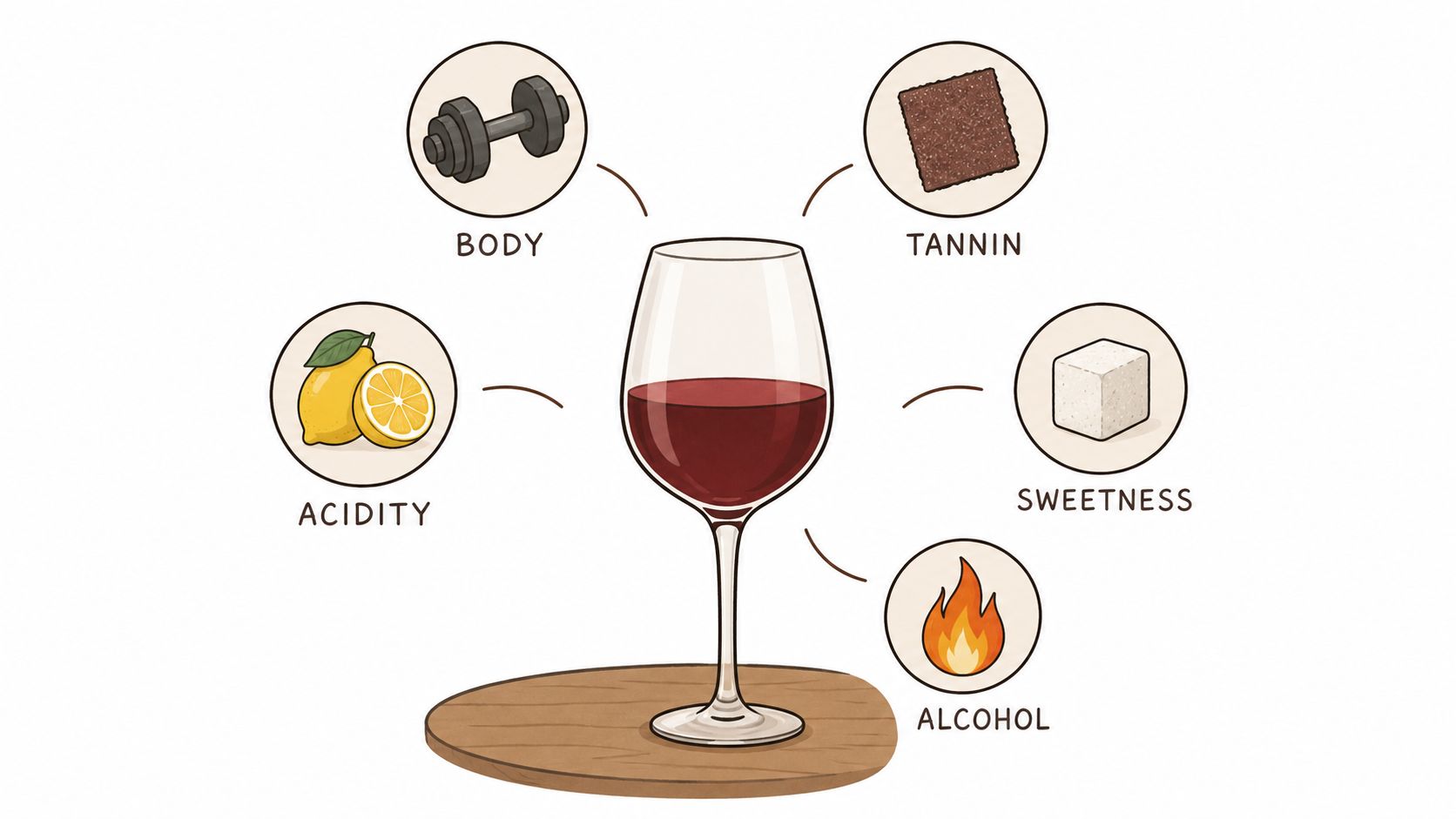
Body is weight and viscosity, the difference between skim milk and full cream milk in your mouth. A light-bodied Pinot Grigio feels nimble and refreshing, while a full-bodied McLaren Vale Shiraz coats your palate and sits heavier. Body comes from alcohol, sugar, extract and tannin combined, which is why alcohol percentage alone doesn't predict it. You can explore that relationship further in this complete guide to wine body, weight and texture.
Tannin is the drying, gripping sensation from grape skins, seeds, stems and oak, like black tea that's steeped too long. Young Cabernet can feel chalky and firm, while an aged red or a plush Shiraz feels smoother because those tannins have softened or were riper to begin with. Acidity is freshness that makes your mouth water, from the tingle of a cool-climate Riesling to the rounder, softer feel of a warmer-climate white. Without enough, a wine tastes flat or flabby.
Watch this short walkthrough to see how those structural elements show up in a glass as you taste.
Sweetness runs from bone-dry, where no sugar is perceptible, through off-dry to luscious. Don't confuse it with fruitiness. Alcohol shows as warmth in your throat and chest and adds body and grip, but a higher-alcohol wine with soft tannin can feel smoother than a leaner, high-acid wine that tastes sharper.
| Descriptor | What it feels like | Typical Australian example | Best for |
|---|---|---|---|
| Light-bodied, crisp | Fresh, mouth-watering, nimble | Pinot Grigio, Sauvignon Blanc | Warm days, seafood, salads |
| Medium-bodied, smooth | Rounded, gentle grip, easy flow | Merlot, lighter Shiraz blends | Weeknight dinners, mixed groups |
| Full-bodied, firm | Weighty, drying tannin, warming | Cabernet Sauvignon, bold Shiraz | Roasts, steak, slow-cooked dishes |
| Off-dry, fruity | Soft sweetness balancing acidity | Off-dry Riesling styles | Spicy food, new drinkers |
Quick Lookup Glossary of Wine Taste Descriptions
Keep this as your working dictionary at the table or in the shop. Each entry gives the sensation in plain English and where you're most likely to meet it, so you can look a word up in seconds and act on it.
It's worth knowing which of these words shoppers reach for. Australian market research found easy to drink was the most selected descriptor for white wine among regular Australian drinkers at 43 per cent, with smooth top for red at 38 per cent and full-bodied close behind at 37 per cent. Those three terms move buying decisions because they predict texture, not just aroma.
A to M
- Acidic or crisp: Mouth-watering freshness, like biting a green apple. Sauvignon Blanc, Riesling, sparkling.
- Austere: Lean and restrained, fruit held back by acidity or tannin. Young Cabernet, cool-climate styles.
- Balanced: Nothing sticks out. Fruit, acid, tannin and alcohol sit in proportion.
- Buttery: Soft, creamy texture and flavour, usually from malolactic conversion. Oaked Chardonnay.
- Dry: No perceptible sweetness. It says nothing about fruitiness.
- Earthy: Damp soil, mushroom or leaf litter. Aged reds, savoury styles.
- Easy-drinking: Low friction. Soft tannin, clear fruit, nothing harsh.
- Firm: Noticeable tannin grip that needs food or time. Cabernet Sauvignon.
- Flabby: Flat and shapeless because acidity is missing. Always a criticism.
- Fruit-forward: Fruit leads the aroma and palate. It doesn't mean sweet.
- Full-bodied: Heavy, coating weight. McLaren Vale Shiraz is the local benchmark.
- Jammy: Cooked, concentrated fruit, like berry jam. Ripe warm-climate reds.
- Lean: Light body with prominent acidity. Refreshing, sometimes severe.
- Minerally: Stony, chalky or saline impression. Certain Rieslings and crisp whites.
N to Z
- Oaky: Vanilla, toast, cedar or coconut from barrel ageing, obvious at medium-plus.
- Plush: Soft, generous, cushioned texture with ripe fruit. Mature Shiraz.
- Racy: Energetic acidity that makes the wine feel alive. Sparkling, Riesling.
- Savoury: Olive, herb, leather or cured meat rather than fruit. Food-friendly reds.
- Smooth: Low grip, integrated tannin, easy flow across the palate.
- Soft: Gentle acidity and tannin, rounded edges. Approachable blends.
- Spicy: Pepper or baking spice warmth. Shiraz, oaked reds.
- Structured: Clear tannin and acidity frame the fruit. Built for food or cellaring.
- Supple: Smooth and flexible, tannin present but polished.
- Tannic: Strongly drying. Needs protein, fat or patience.
- Velvety: Fine, silky tannin texture. Well-made aged reds.
- Zingy: Bright, lively acidity, usually in whites, rosé and sparkling.
When a term here points to texture, cross-check it against the body section above. When it points to aroma, check the category families. That two-step habit turns a single word into a full prediction.
Faults and Taints Versus Deliberate Style
Not every unfamiliar smell is a fault, and not every fault is obvious. Learning the difference protects you twice. You won't reject a sound bottle for a style you don't enjoy, and you won't politely finish a wine that's spoiled.
Context and intensity decide almost every case. AWRI reference material on wine faults links oxidation with bruised apple and sherry-like characters, hydrogen sulfide with rotten-egg aroma, and Brettanomyces with clove or smoky notes, all of which can be confused with deliberate winemaking choices without intensity and context.
Common faults and their signatures
Oxidation comes from too much air exposure, poor storage or a wine kept past its life. Expect bruised apple, sherry-like nuttiness, flat fruit and a browning colour in whites. A hint of nuttiness in an aged wine can be character. A young Sauvignon Blanc that smells like cut apple left on a bench is faulty.
Reduction and hydrogen sulfide sit at the opposite end, where a wine has had too little oxygen. The signature is rotten egg, struck match or cooked cabbage. A faint struck-match note in some whites can blow off with air and is sometimes a style choice. A persistent rotten-egg stink that doesn't clear after swirling is a fault.
Volatile acidity smells of vinegar or nail polish remover and stings the nose at high levels. Cork taint from TCA gives musty wet cardboard and flat, muted fruit, and it doesn't improve with air. Neither has a desirable low-level version in a fresh table wine.
The grey areas worth judging carefully
Brettanomyces, a yeast that can live in wineries and barrels, produces clove, spice, smoke and sometimes barnyard notes. At low intensity some drinkers read it as savoury complexity. At high intensity it strips fruit and dominates everything, which most tasters call spoilage.
Smoke is the trickiest call in Australian wine. Toasted oak can give a deliberate, pleasant smokiness in a Shiraz. Smoke taint from bushfire exposure gives ashy, burnt or medicinal characters, often with a drying, ashtray-like finish that grows in the mouth. If the smoke sits on top of the fruit and turns bitter on the finish, suspect taint rather than oak.
For practical checks you can run at home, including what to do with a suspect bottle, see this Australian guide to identifying wine faults. Describe what you smell, note its intensity, then decide. That order keeps you fair to the wine and honest with yourself.
Using Descriptors When You Buy
Vocabulary earns its keep at the shelf. Instead of reading every aroma on a label, pick two or three anchor words, picture what they'll feel like, and match them to the job the bottle has to do. The scenarios below cover most real purchases.
You're buying a gift. Choose confident, easy words you can repeat without a script. Smooth, full-bodied, dark fruit for a red drinker, or crisp, citrus, easy-drinking for a white drinker. Avoid austere, funky or highly tannic wines unless you know the recipient's taste well, because those descriptors promise a challenge, not a welcome.
You're planning a barbecue. Heat and charred food need refreshment and fruit that won't fight the grill. Look for bright acidity, juicy red fruit, soft tannin in reds you can serve slightly cool, and zingy, tropical or citrus whites and rosé. Save the firm, structured Cabernet for a seated dinner where it gets the attention and protein it needs.
Matching words to people and plates
You're buying for a new drinker. Approachability has a vocabulary. Easy-drinking, soft, fruity, smooth and off-dry all signal low grip and clear flavour. Steer away from bone-dry, austere or tannic on a first bottle, and let them build reference points they enjoy.
You're matching a specific dish. Structural words matter more than fruit words here. Fatty or slow-cooked meat wants firm tannin to cut through richness. Fried food, oysters and salads want crisp acidity. Spicy dishes often sit better with a touch of sweetness. Tomato-based sauces need acidity that can hold its own.
- Gift pack: Smooth, full-bodied, dark fruit, presentable and explainable
- Summer barbecue: Bright, juicy, refreshing, soft tannin
- New drinker: Easy-drinking, soft, fruity, low bitterness
- Food-driven dinner: Firm, crisp, savoury, structured
One low-risk way to practise is through mixed sample packs and half-case bundles, where you taste several styles side by side and attach words to real glasses. McLaren Vale Cellars sells curated packs across Shiraz, Cabernet Sauvignon, Sauvignon Blanc, Pinot Grigio and sparkling, which suits that compare-and-learn approach without committing to a full case of one style. However you source them, taste pairs. Comparison teaches faster than any single bottle.
A Pocket Cheat Sheet for the Fridge
Screenshot this section or copy it onto a card. It's organised by style, with the words you're most likely to see, a food hint, and a serving temperature, because temperature changes how every descriptor shows up. A red served too warm tastes flabby and alcoholic. A white served too cold loses its aroma entirely.
| Style | Look for these words | Food hint | Serve |
|---|---|---|---|
| Sparkling and Prosecco | Zingy, crisp, citrus, fine bead | Oysters, fried snacks, canapés | 6 to 8 degrees |
| Sauvignon Blanc, Pinot Grigio | Passionfruit, lemon, pear, refreshing | Seafood, salads, goat cheese | 8 to 10 degrees |
| Chardonnay, fuller whites | Stone fruit, buttery, nutty, textured | Roast chicken, creamy pasta | 10 to 12 degrees |
| Rosé | Strawberry, watermelon, dry, delicate | Charcuterie, grilled prawns | 6 to 8 degrees |
| Pinot Noir, lighter reds | Red cherry, silky, perfumed, soft | Duck, mushrooms, salmon | 13 to 15 degrees |
| Shiraz, Cabernet Sauvignon | Dark fruit, full-bodied, firm, spicy | Lamb, steak, slow-cooked beef | 16 to 18 degrees |
Fridge rule: Most Australian reds show best around 16 to 18 degrees, cooler than a warm room. Twenty minutes in the fridge before serving fixes more reds than any decanter.
Use it in two passes. First find your style row, then check that the label words sit inside that row's vocabulary. If a wine promises descriptors from a different row entirely, it's either an unusual style worth asking about, or a label reaching beyond what's in the glass.
Why Lighter and Lower-Intensity Wines Deserve Serious Words
Bold has never been the same thing as good, but wine language has often treated it that way. Powerful Shiraz got the rich vocabulary, while lighter styles were dismissed as simple, as if delicacy were a shortcoming. Australian drinking habits are moving in the opposite direction, and the words need to keep up.
A 2025 Australian industry report identified growing consumer interest in Pinot Noir, Pinot Grigio and Gris, Prosecco and rosé, alongside a reported national move toward lighter and more approachable styles rather than boldness as the default benchmark. Those wines aren't lesser versions of big reds. They're built for different pleasures, including warm weather, shared lunches and food that would be flattened by heavy tannin.
Three distinctions protect lighter wines from lazy descriptions. Body and flavour intensity are different things. A Pinot Grigio can be light in weight and pronounced in aroma. Freshness is not thinness. Thin means diluted and short, while fresh means lively acidity carrying clear flavour to a clean finish. Lower tannin doesn't mean less serious. A red can build its structure from acidity, fine phenolics and length instead of grip.
Use words that respect what these wines do:
- Delicate: Fine aromatics that reward attention rather than force
- Perfumed: Floral and fruit lift you notice before the first sip
- Saline: A savoury, sea-spray edge that makes whites gastronomic
- Textured: Weight or grip from lees, phenolics or skin contact, not oak
- Zippy: Energy from acidity, built for food and warm afternoons
When you describe a lighter McLaren Vale white, rosé or early-drinking red with that precision, you're not making excuses for it. You're telling the next drinker exactly why it's the right bottle for the occasion, which is the whole point of a description.
Quick Answers for Common Tasting Questions
How do I read a back label in seconds
Use three steps and ignore the rest until you've decided. First, find the texture words, such as smooth, firm, crisp or full-bodied, because they predict how the wine will feel. Second, find the fruit family, red, dark, citrus or tropical, to set the flavour direction. Third, check the finish and food suggestion to confirm the occasion. If those three agree with what you want, the longer aroma list is just detail.
What's the difference between sweet and fruity
Fruity is an aroma. Sweet is a taste from residual sugar left after fermentation. A dry Shiraz can smell like ripe blackberries and contain no perceptible sweetness, while an off-dry white can taste gently sweet with quite restrained fruit. If you're unsure in a shop, look for the words dry, off-dry or sweet rather than judging by the fruit named on the label. Ripe fruit language sells wine, but it doesn't tell you the sugar level.
What should I buy for someone new to wine
Start where the friction is lowest. Look for easy-drinking, smooth, soft and fruity on the label, and choose styles known for clear flavour and gentle structure, such as a friendly McLaren Vale Shiraz with plush tannin, a Sauvignon Blanc with bright passionfruit, or a mixed sample pack that lets them compare. Avoid words like austere, tannic and bone-dry until they've told you they enjoy grip and tartness. One bottle they love teaches more than three impressive ones they endure.
Are lighter wines worth cellaring
Some are, but they age on a different engine. Big reds cellar on tannin, which softens slowly and lets savoury tertiary flavours emerge. Lighter wines that age well usually rely on acidity, which preserves freshness while the flavours deepen, as with quality Riesling and sparkling. Most Pinot Grigio, rosé and early-drinking reds are made to be enjoyed young, while their fruit and perfume are at their peak. Check the descriptor set. If a note emphasises freshness, delicacy and bright fruit with no mention of structure, drink it soon and enjoy it as intended.
Put these wine taste descriptions to work on real bottles by browsing the Shiraz, Cabernet Sauvignon, Sauvignon Blanc, Pinot Grigio, rosé and sparkling ranges at McLaren Vale Cellars, where sample packs and mixed bundles let you compare styles side by side and build your own anchor words. Order a mixed pack, taste two wines against the fridge cheat sheet this week, and you'll walk into your next purchase knowing exactly which descriptors mean a wine is right for you.
Comments (0)
There are no comments for this article. Be the first one to leave a message!