
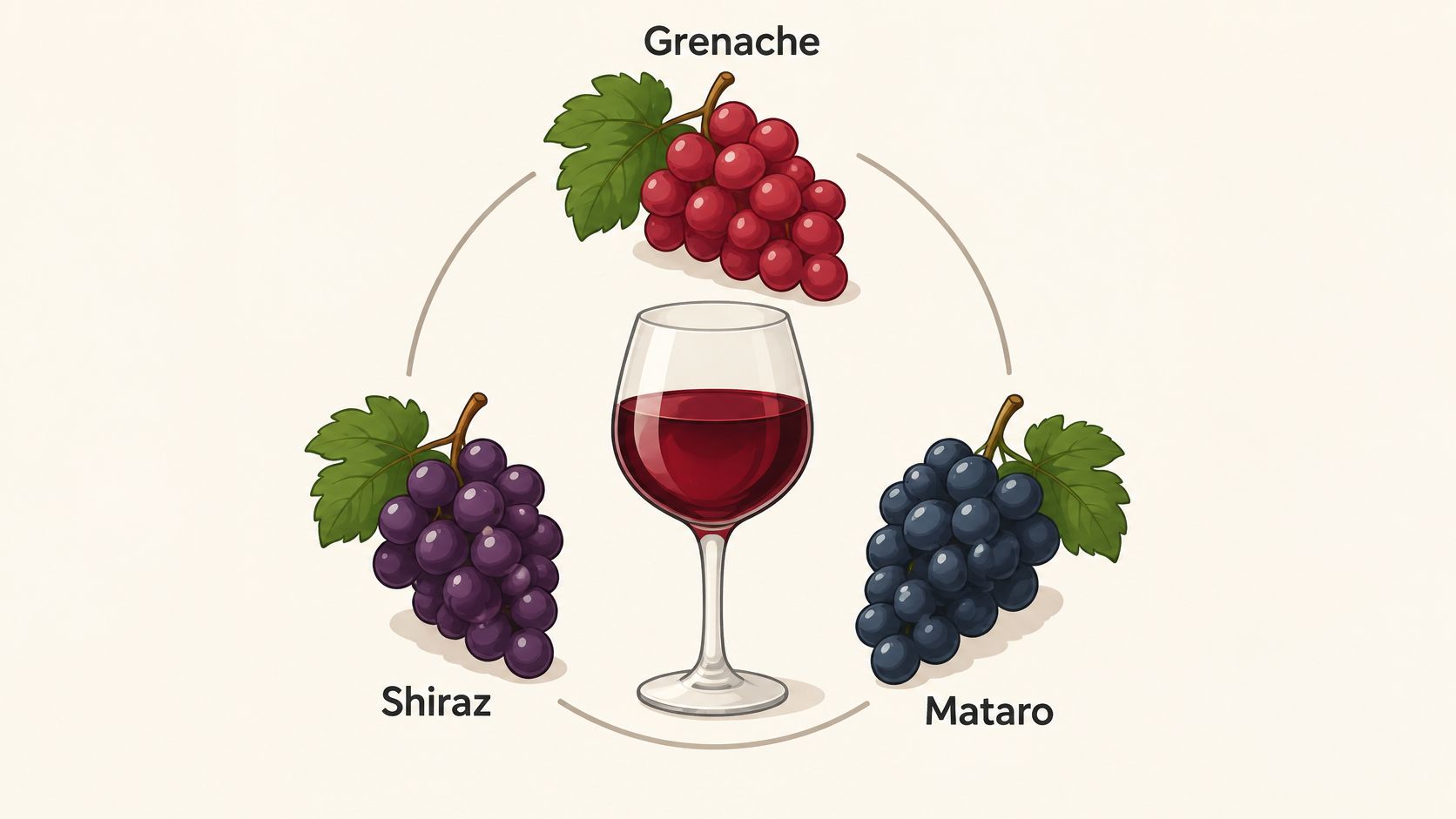
GSM is an Australian red wine blend of Grenache, Shiraz and Mataro, the Australian name commonly used for Mourvèdre. Three grapes, one label, and a surprisingly wide range of what ends up in the glass.
Which raises the question a wine list never answers. If the letters are the same on every bottle, why does one GSM taste of strawberries and warm spice while the next tastes dark, savoury and firmly built? The answer sits in the proportions, and once you can read them you can predict a bottle before you pull the cork.
What GSM Wine Actually Is
Ever stood in front of a shelf reading "GSM" with nothing else to go on? The three letters are a shopping list. GSM is Australia's established name for a red-wine blend of Grenache, Shiraz and Mataro, the Australian name commonly used for Mourvèdre, and each letter names a component rather than a proportion or a house style. Wine Australia's story of Australian Grenache sets out the basic division of labour across the three grapes.
A three-piece band is the clearest way to picture it. Grenache carries the melody, all red perfume and lifted fruit. Shiraz brings body and volume, filling out the middle of the sound. Mataro sits underneath on rhythm, the part you notice most when it stops. None of the three is a soloist, which is why the same initials can describe wines of quite different weight.
The question of what is GSM wine often comes up when a wine list prints three letters and no explanation. Here's the useful frame: the label tells you who's in the band, not what they'll play.
Why South Australia owns the style
GSM is a local tradition inspired by France's Rhône Valley rather than a copy of it, and South Australia is its heartland. Grenache was among the region's earliest successful varieties and adapted well to the warm, dry climate, with Grenache vineyards in McLaren Vale and the Barossa including sites dating from the late 1800s.
The grape's fortunes moved sharply. In the 1950s Grenache recorded Australia's highest red-grape crush at 21,200 tonnes against 12,400 tonnes for Shiraz; by 1976 Shiraz had overtaken it at 72,200 tonnes as the red-wine market expanded. Wine Australia's Grenache and blends educator guide charts the aftermath: harvests of about 72,000 tonnes in 1979 fell to roughly 15,000 tonnes in 2012, a reduction of around 79 percent, before Barossa winemaker Charlie Melton's dry-grown old-vine GSM helped prove the grape still belonged in serious dry reds.
The confusion worth clearing up first: GSM is a dry table red. Grenache's long association with fortified wine in Australia doesn't make these bottles sweet or fortified.
You can now recognise a GSM on a shelf or a list and understand it as a blend of three grapes rather than a single variety. If you're travelling and want to see how a producer presents a three-grape blend in a tasting room setting, plan a visit to Viansa and compare the experience with a McLaren Vale example when you're home.
The Three Grapes and the Flavours They Build
Three grapes, three jobs. Here's the reference version before the detail.
| Grape | Australian Name | What It Adds | What It Pushes the Wine Towards |
|---|---|---|---|
| Grenache | Grenache | Fragrance, strawberry-like red fruit, higher potential alcohol | Perfumed, warm, supple texture |
| Shiraz | Shiraz | Dark-fruit concentration, colour, mid-palate weight, structural backbone | Darker fruit, density, deeper colour |
| Mourvèdre | Mataro | Savoury, anise-like complexity, length, grainy tannin | Savoury grip, firmer tannin, longer finish |
The blend's technical value comes from complementary parts rather than a fixed recipe, and Wine Australia's Shiraz facilitation guide describes the three roles in precisely those terms. Grenache supplies fragrance, strawberry-like fruit and higher potential alcohol. Shiraz provides dark-fruit concentration, colour, mid-palate weight and structural backbone. Mataro contributes savoury, anise-like complexity, length and grainy tannin.
Where each grape takes the wheel
Increase the Grenache and the wine turns more perfumed, warm and supple. Push up the Shiraz or the Mataro and colour, density and tannin climb with it. That's the most reliable rule you can carry into a bottle shop, and it works on bottles you've never seen before.
Wine Australia describes GSM as a style in which Shiraz often plays the central role, but Australian examples vary substantially in grape proportions. The letters are a cast list; the winemaker decides the running order.
What each grape corrects in the others
Grenache carries warmth and a relatively soft structural profile, which is charming until the wine needs a spine. Shiraz and Mataro offset that warmth and softness while preserving Grenache's aromatic lift, which is why the finished wine tastes generous rather than loose.
Read texture rather than flavour words. A Grenache-led glass feels supple and approachable from the first sip. A Shiraz-heavy glass feels rounder and denser through the middle. Mataro leaves grainy tannin that firms the finish and stretches it out. Overall the blend lands warm and inviting rather than sharp, with moderate acidity, which is why it sits comfortably beside such a wide spread of food.
Reading a back label without being misled
Producers pick vocabulary from their influences. A French-leaning back label may list Syrah and Mourvèdre; an Australian one will usually say Shiraz and Mataro. Same three grapes, different passport. Some producers put Shiraz first and call the wine an SGM, or skip initials entirely and print "Rhône-style red blend".
Buying rule: the grape split predicts body, the tasting note describes it. Read the split before you read the poetry.
If you want to hear Grenache on its own before you hear the band, this guide to Grenache's history and character is worth ten minutes before you buy.
How Blend Proportions Change the Glass
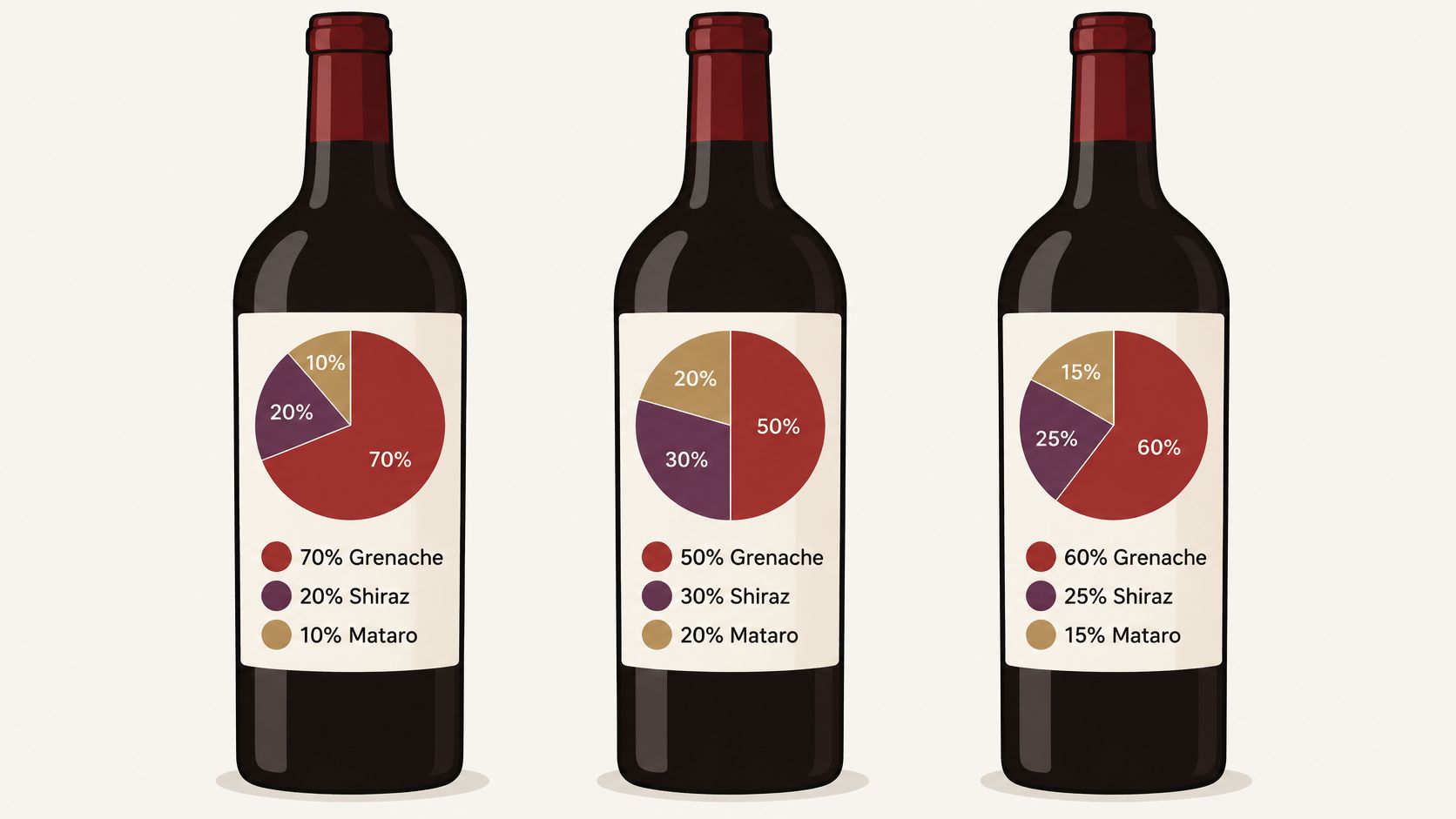
Two bottles from the same region, the same vintage and the same shelf can pour completely differently, because the letters name the ingredients while the percentages write the recipe. The most widely quoted Australian composition runs roughly 60 to 75 percent Grenache, 20 to 35 percent Shiraz and 5 to 10 percent Mataro, with 70/20/10 given as a typical pattern in Winemaker Magazine's overview of Australian wine. None of it is a legal requirement, so Shiraz-dominant and Mataro-led versions exist and are worth seeking out.
McLaren Vale shows why the ratio bends the way it does. Shiraz is the region's dominant red variety by a wide margin, and Mataro occupies a small share of vineyard land. The practical effect works like seasoning in a kitchen: Shiraz supplies the bulk of what ends up in the glass, and Mataro is added in smaller measure for what it does to the finish.
Proportions are easier to picture than to describe, so here they are as three bottles with their splits on the label.
| Blend Lean | Typical Proportions | Flavour and Texture |
|---|---|---|
| Grenache-led | Grenache at the upper end of 60-75% | Red fruit, fragrance, approachable texture |
| Benchmark blend | Grenache 70%, Shiraz 20%, Mataro 10% | Balanced red fruit, spice and structure |
| Shiraz-led | Shiraz at or beyond the top of 20-35% | Darker fruit, greater weight, more colour |
| Mataro-led | Mataro pushed past its usual 5-10% share | Savoury spice, firmer grip, longer tannic finish |
Use the table as a shopping tool. A bottle leading with Grenache at the top of its range should taste fragrant and red-fruited, with a texture you can enjoy before dinner even starts. Push the Shiraz share up and the same region's wine turns darker, denser and deeper in colour. Push Mataro and the finish firms up: more grip, more savoury spice, a longer tail of tannin after you swallow.
Buyers get caught at the Mataro end. A small share sounds like a small effect, but even 10 percent is enough to tighten the whole finish, the way a pinch of salt changes a whole pot of soup.
Order of operations: find the percentage split, match the biggest number to the weight you want, then check the vintage for how ready the wine is to drink.
If you are curious why winemakers bother blending at all instead of bottling each grape on its own, this explanation of why certain grapes are blended goes deeper into the mechanics.
Food Pairings Where GSM Shines
GSM is one of the easiest reds to put on a table, and the reason is structural. Moderate tannin and a savoury edge handle grilled and roasted meat, while red fruit and moderate acidity cope with tomato, spice and mushroom.
| Dish | Best GSM Style | Why It Works |
|---|---|---|
| Roast lamb | Shiraz-led or benchmark | Savoury meat and firm tannin cut through rich fat |
| Grilled or barbecued beef | Benchmark or Mataro-led | Charred flavours and grip match the wine's structure |
| Roast chicken or pork | Grenache-led | Lighter body and red fruit complement mild meat |
| Mushroom or spiced stew | Mataro-led | Earthy and savoury notes echo the wine |
| Tomato pasta or pizza | Grenache-led | Bright red fruit and acidity suit tomato |
| Aged hard cheese | Shiraz-led | Firm tannin and dark fruit balance rich, salty cheese |
The principle behind the table
Match weight to weight. A rich, fatty dish needs a wine with enough grip and body to cut through it, which is where benchmark and Shiraz-led blends earn their place. A milder dish needs a wine that won't shout over it, which is Grenache's job.
Flavour echoes matter just as much. Mataro's earthy, anise-like notes find a natural partner in mushrooms and slow-cooked stews, because the wine is already in that register. Tomato sauces work with Grenache-led bottles because the red fruit and acidity meet the sauce where it lives.
At the grill: reach for a Shiraz-led bottle for charred meat and aged cheese, and a Grenache-led bottle for roast chicken, pork and anything tomato-based.
Treat the table as a starting point rather than a rule book. A match that sings for one drinker can fall flat for another, and no chart knows your palate better than you do.
If you're building a whole evening around matched food and drink rather than one bottle, these foodie night out ideas in Amsterdam show how a menu can be structured so each course sets up the next. For dishes beyond this list, these top Grenache food pairings extend the same logic course by course.
Tasting and Serving GSM Well
You can judge any GSM the same way, in three moves, without a tasting sheet.
- Smell before you sip. Swirl the glass and look for the lift of red fruit. Grenache announces itself first.
- Taste for weight and spice. Hold the wine in your mouth and notice how broad it feels through the middle. That's the Shiraz speaking.
- Time the finish. Count how long the savoury grip lingers. A long, firm tail is Mataro's signature.
The profile arrives in layers. Bright red fruit lands first, spice and body sit in the middle, and a savoury grip closes the glass. Once you've noticed that sequence, you'll spot it in every GSM you open.
Age matters too. Grenache-led bottles are often ready sooner and suit the table young, while Shiraz-heavy or Mataro-led bottles reward a few years in the cellar as the tannin softens and the savoury notes knit together. Serve structured examples slightly cooler than room temperature, and give a youthful, firmly built bottle a short decant before pouring. Lighter Grenache-led bottlings can be opened and enjoyed without ceremony.
Describe the wine in your own words after the first glass: one fruit, one spice, and how long the finish lasted. You've just written a tasting note, and it's more useful than someone else's.
If you're working out which vessel to pour into, this comparison of whiskey and wine decanters covers the shapes and what each one does to a young red.
Pick Your First GSM With Confidence
Four checks stand between you and a bottle you'll enjoy.
- Read the grape split. Back label or producer notes, whatever gives the percentages. It's the single best predictor of body.
- Match the style to the meal. Grenache-led for lighter, fruit-forward dishes; benchmark or Shiraz-led for richer meats.
- Check the vintage against your plans. Shiraz-heavy and Mataro-led bottles reward patience, so buy one for now and one for later.
- Don't write off the category on one bottle. If a Shiraz-led GSM feels too heavy for you, the answer is a Grenache-led bottle rather than a different grape entirely.
If a wine doesn't suit you, we'll help you find one that does. Call McLaren Vale Cellars on 0409 605 605 and tell us what you usually drink, and we'll point you towards a style closer to your taste.
The best next step costs the price of two bottles. Buy one Grenache-led and one Shiraz-led GSM, cook the same meal for both, and taste them side by side. Note which one you reach for second, and why. That answer tells you more than any score out of 100.
McLaren Vale Cellars stocks the regional styles this article walks through, including a McLaren Vale Grenache Shiraz 6 pack at $231, or $38.50 a bottle, alongside Shiraz-led and Grenache-led reds you can line up against each other. Running the two-bottle test is easier with a mixed Half & Half pack than with six of the same wine, and the Taste Guarantee gives you room to try a style outside your usual order. Start at McLaren Vale Cellars and build a box around the proportions you now know how to read.
Comments (0)
There are no comments for this article. Be the first one to leave a message!