
If you like Sauvignon Blanc, is a blended white just the cheaper version of the same idea? That is the usual shelf assumption, and it sends plenty of buyers to the wrong bottle. Sem sauv blanc wine is its own Australian style. Semillon changes the shape of the glass, the temperature you should pour it at, and how long the bottle in your hand is worth keeping.
The blend only tastes like itself when those three things line up. A fresh bottling served too warm goes flabby. An older Semillon-led bottle poured ice-cold tastes closed and dull. Price does not tell you which one you are holding. The label, the proportion and the vintage do.
Sem Sauv Blanc at a Glance
Sem sauv blanc wine is a blend of Semillon and Sauvignon Blanc, usually from South Australia or the Hunter Valley, and the proportion of each grape decides how it tastes.
You will meet three styles on Australian shelves. They are not three qualities of the same wine. They are three jobs, with different drink windows and different pouring temperatures.
| Style | Typical character | Drink window | Serve at |
|---|---|---|---|
| Fresh, early-drinking blend | Citrus, green herb and a brisk finish | 1-2 years from vintage | 8-10°C |
| Textured mid-weight blend | Riper fruit with more body from Semillon | 2-4 years | 9-11°C |
| Bottle-aged Semillon-led blend | Honeyed and toasty notes developing with age, fuller texture | 5-10 years | 10-12°C |
Read the table as a buying filter, not a tasting essay. A current vintage with a high share of Sauvignon Blanc sits in the first row. A Semillon-led wine from an older vintage sits in the third. The middle row is the weekday bottle that has enough fruit to stand up to a roast chicken and enough freshness that you do not need a cellar.
Three things to taste for
Once the wine is in the glass, hunt for three anchors rather than a long list of fruit.
- Citrus zest: Lemon or grapefruit on the front of the palate. That lift usually comes from Sauvignon Blanc.
- Fresh herb or cut grass: A green, savoury edge. Cooler fruit makes this sharper. Warmer fruit softens it toward ripe tropical notes.
- Soft, rounded texture: Weight through the middle of the mouth, sometimes a little waxy or creamy. That is Semillon doing its job, and it is the reason the blend is not a straight Sauvignon Blanc with a different label.
Label rule: If the back label or the shop note says young and crisp, expect the first style. If it mentions cellaring, expect the third.
Do not wait for the word "complex" to appear. Producers who want you to drink the wine this summer say so. Producers who built the wine for honey and toast say that too, usually by naming a cellaring window or by putting Semillon first in the blend.
Why Semillon and Sauvignon Blanc Are Blended and Whether It Is Just Cheaper
Is sem sauv blanc wine just a discount Sauvignon Blanc? The average prices make the question fair. They do not make the answer yes.
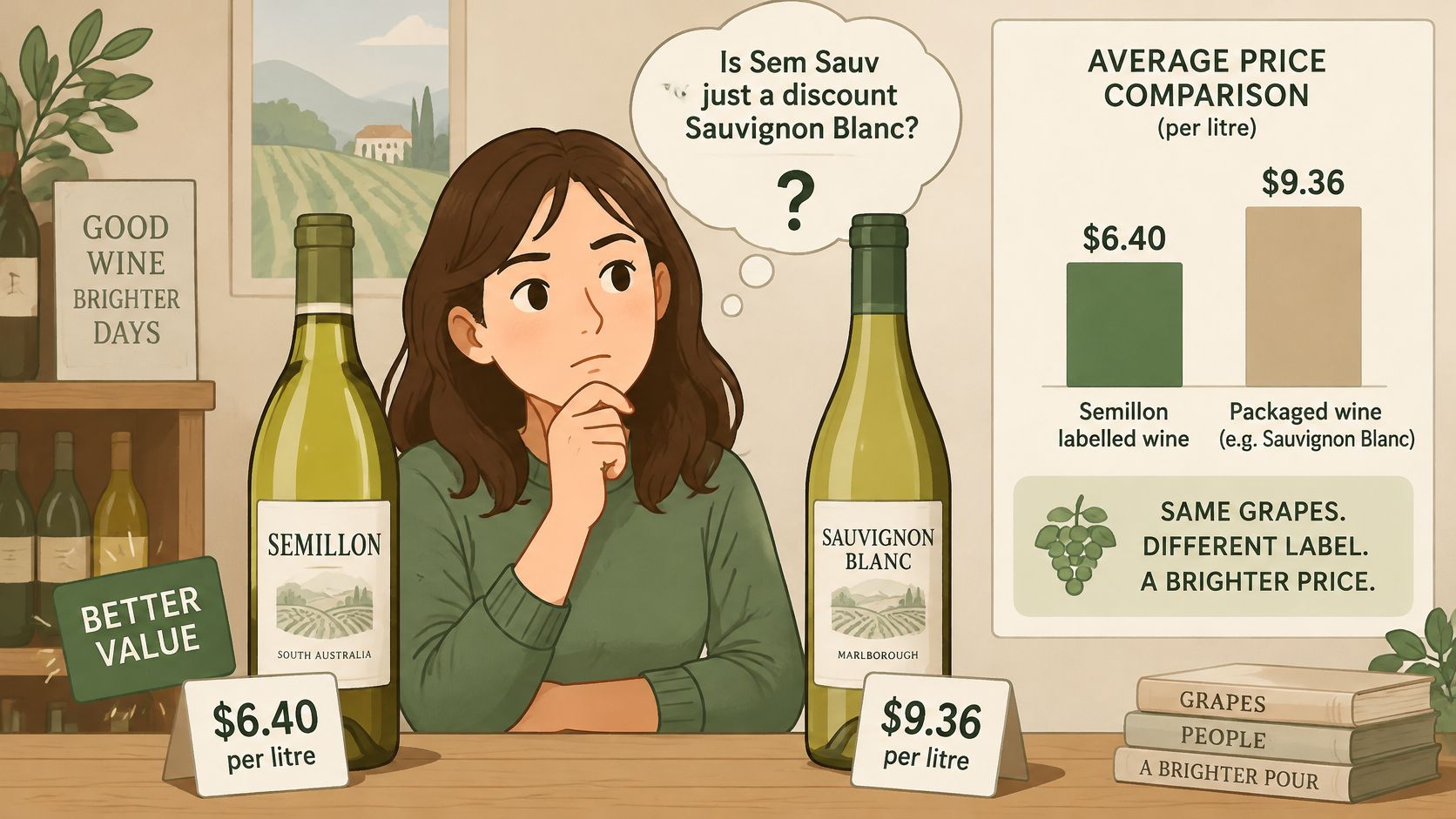
The Wine Australia 2025 vintage summary puts Semillon-labelled wine at an average of $6.40 per litre, against $9.36 for packaged wine overall. In 2024-25, Semillon-labelled exports fell 14% in volume while total packaged-wine exports rose 6%. In the 2025 vintage, Sauvignon Blanc crush volume rose 31% year on year and Semillon rose 16%. Both grapes have supply behind them. The lower Semillon average is a market position, driven by volume and by how the category is sold, not a lab result that says the wine in the bottle is worse.
A dozen at a friendly price can be a fresh, well-made blend. A dearer bottle can be a tired one. You still have to read the style.
What each grape is hired to do
Blending here is a job split, the same idea we unpack in our guide to why certain grapes are blended. Neither grape is a filler.
Sauvignon Blanc brings the lift. Expect citrus, tropical notes when the vintage runs warm, green herb when the fruit is cooler, and high acidity that keeps the finish brisk. On its own, that grape is the zesty glass people already know.
Semillon brings the structure. Aromatic intensity is lower, so the nose is quieter. Texture is the point: a creamy or waxy feel, and body through the mid-palate. With bottle age, dry Hunter Semillon can move toward toast and honey without anyone adding sugar.
Push the proportion toward Sauvignon Blanc and the glass gets brighter and more aromatic. Push it toward Semillon and you get weight, a longer finish, and a wine that sits more happily with food that has some richness. Say a Tuesday pasta in a light cream sauce. Straight Sauvignon Blanc can taste sharp against that sauce. A Semillon-led blend has the texture to meet it.
Semillon is not a recent add-on. The Australian Wine Semillon and Sauvignon Blanc consumer guide records the variety arriving through James Busby's vine collection in 1832, then propagated by Thomas Shepherd at the Darling Nursery near Sydney. It took hold in the Hunter Valley because it was productive, vigorous, easy to propagate and relatively disease-resistant. For much of that history it was not sold as Semillon. Hunter bottles were commonly labelled "Hunter River Riesling", "Shepherd's Riesling", "Hock", "White Burgundy" or "Chablis". Identity was recognised by the 1940s, yet many wineries did not use "Semillon" consistently until the 1980s. The same guide identifies Semillon vines dating from the early 1900s, in a region whose vineyards date back to the 1860s. Those old vines underpin a dry style that is light-bodied and lower in alcohol when young, then capable of complex, toasty characters with bottle age.
Older regional bottles may name the same grape under a different word. If the label says Hunter River Riesling or White Burgundy, read it as Semillon until the producer says otherwise.
The decision, then three checks
Choose sem sauv blanc wine when you want a textured, food-friendly white with more body than a straight Sauvignon Blanc. Choose straight Sauvignon Blanc when you want maximum zesty lift and you are drinking it young, with something saline or herbal.
Before you pay, check three things on the bottle.
- Stated proportion. More Sauvignon Blanc means brighter aroma. More Semillon means weight and a longer finish.
- Vintage. A one-year-old wine is built for the fresh style. A five-year-old Semillon-led wine is a different drink.
- The producer's own words. "Fresh" means drink it. "Cellar" or "age-worthy" means the third style in the table above.
A short clip on how the two grapes meet in the glass is worth a look before you compare bottles.
Where Sem Sauv Blanc Is Made in Australia
Region sets climate and acidity. Grape proportion sets texture. Those are separate levers, and the label usually tells you both if you look.
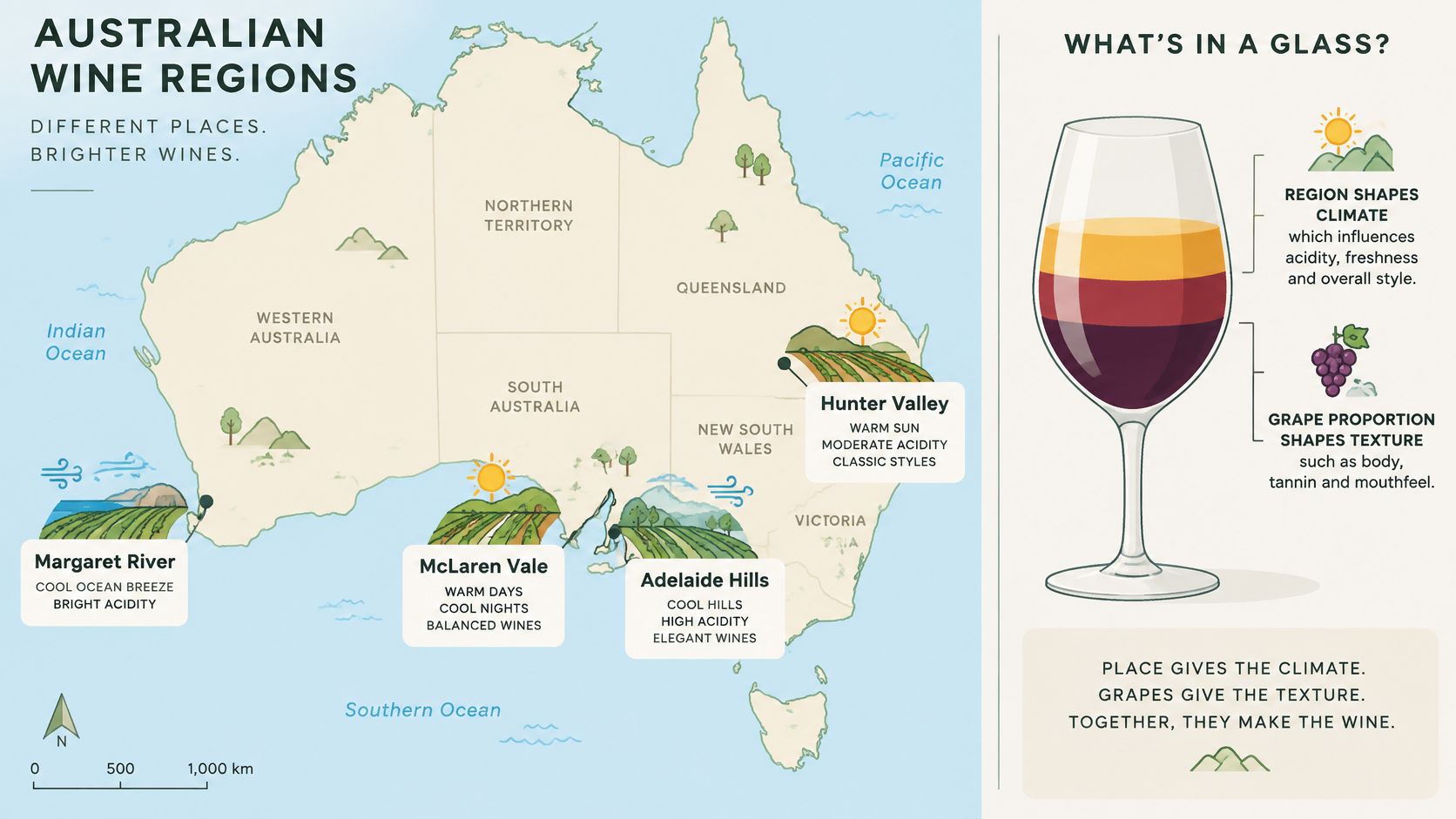
| Region | Dominant grape | Climate | Typical style |
|---|---|---|---|
| Hunter Valley, NSW | Semillon | Warm and humid | Light-bodied and lower in alcohol when young, toasty with age |
| Adelaide Hills, SA | Sauvignon Blanc | Cool | Lifted citrus and herb, crisp and zesty |
| McLaren Vale, SA | Sauvignon Blanc-led | Coastal Mediterranean with sea breezes | Riper citrus and tropical fruit, softer acid, rounder middle |
| Margaret River, WA | Semillon and Sauvignon Blanc in close shares | Cool maritime | Grass and citrus up front, a waxy, textured middle |
Two regions with a clear job
The Hunter Valley is Semillon country. In a blend, that Semillon component is the structural half. It keeps the wine lean through its first years, then carries it toward toast and honeyed depth with time in the cellar. Treat age as part of the design in a Hunter-led bottle, not a bonus.
The Adelaide Hills plays the opposite role. Cool nights keep acid high, so Hills Sauvignon Blanc brings the lift: citrus, cut herb and a brisk, zesty finish. In a blend built on Hills fruit, Sauvignon Blanc usually does the talking up front while Semillon fills in behind. If you want to taste that zesty pole on its own before judging what the blend adds, our notes on the best Australian Sauvignon Blanc are a useful benchmark.
The two grapes pull in different regional directions, and that is the point of blending them. Semillon's deepest Australian identity sits in New South Wales. Sauvignon Blanc's momentum sits in cooler southern country.
Two regions that play the blend differently
Margaret River made this pairing its signature white. Cool maritime air keeps the grass-and-citrus line sharp, while even shares of Semillon build a waxy texture through the middle of the palate. A Margaret River bottle is often the most balanced expression of the blend you will find, because neither grape is just a seasoning.
McLaren Vale runs warmer, cooled only partly by sea breezes off Gulf St Vincent. Whites from the Vale lean generous rather than lean, so a Vale blend will generally taste riper and rounder than a Hills or Margaret River bottle of the same vintage. Expect softer acid and more weight in the fruit. If freshness is what you are after, check the alcohol level and look for freshness cues in the producer's own tasting note.
Do not borrow a Hunter tasting note for a Vale bottle, or a Margaret River note for a Hills one. Climate is a clue. It is not the wine.
Region tells you the likely climate and acidity. Proportion tells you the texture. A cool-region Sauvignon Blanc share keeps the acid line bright. A Semillon share from warmer country adds mid-palate, even when the other half of the blend grew somewhere cooler. Two bottles carrying the same wording on the front label can be nearly opposite drinks, which is exactly why the blend deserves to be read as its own Australian style rather than a discount version of either grape.
How to Serve, Store and Age Your Sem Sauv Blanc
Pour between 8 and 12°C. Fresh styles belong at the cooler end of that range. Aged, Semillon-led styles belong nearer the warmer end. That spread is the whole serving rule.
A very cold refrigerator mutes aroma. Fruit, herb and texture all shrink, and a good bottle can taste like faintly sour water. Take it out and wait 10 to 15 minutes. As the wine warms a few degrees, citrus and herb come back, and Semillon's texture shows up in the middle of the mouth. Taste at the start of that window and again at the end before you decide the bottle is plain.
Where the bottle should live
Storage is about stability, not a special fridge.
- Heat and light: Keep bottles out of the kitchen window, the car boot and the top of the fridge. Warmth speeds ageing in a messy way, and strong light tires white wine.
- Cork: Lie the bottle on its side so the cork stays moist and does not shrink.
- Screwcap: Store upright. There is no cork to keep wet, and upright storage keeps the seal doing a simple job.
Vintage conditions and closure both change how fast a given bottle moves. Two wines from the same year can taste a year apart if one saw more warmth in the vineyard and the other was sealed under screwcap and kept cool.
What is worth cellaring
Fresh, early-drinking blends are for the first one to two years after vintage. Drink them while the citrus and herb are still bright. Semillon-led blends with enough acidity and phenolic structure can sit for several years and pick up honeyed, toasty notes. You are not waiting for the wine to become sweet. You are waiting for toast, honey and a fuller texture on a wine that is still dry.
Market noise is a poor guide to that choice. Wine Australia's 2024-25 pricing and supply report records national white-wine production up 2% in 2025, with the stock-to-sales ratio rising after strong demand for Sauvignon Blanc during overseas supply shortages. The average global bulk offer price for Australian Sauvignon Blanc fell from $1.08 to $0.68 between 2022 and the latest reported period. A cheaper offer on the bulk market does not tell you whether the bottle on your table is a drink-now wine or a short-term cellar wine. The label's style does.
- Check the style on the label. Fresh means open it. A cellaring note means you can wait.
- Chill into the right range. Cooler for the brisk bottle, a little warmer for the older one.
- Open it and taste across 15 minutes. Judge the wine after it has woken up, not in the first cold sip.
Food Pairings for Each Sem Sauv Blanc Style
Acidity cuts richness and salt. Body suits savoury cooking. Texture holds a creamy sauce so the wine does not vanish. Match those three traits to the plate, and sem sauv blanc wine stops being a default seafood pour.
| Style | Pairs well with | Why it works |
|---|---|---|
| Fresh, early-drinking blend | Oysters, steamed prawns, herbed white fish, goat's cheese | Acidity cuts through brine and richness |
| Textured mid-weight blend | Roast chicken, pork with apple, creamy pasta, buttered vegetables | Body matches savoury cooking without overwhelming it |
| Bottle-aged Semillon-led blend | Smoked fish, roast poultry with rich sauce, hard aged cheese | Toasty, honeyed notes echo roasted and aged flavours |
Why the plate works
Most pairing advice stops at seafood. It includes the fresh row and then gives up. The mid-weight row is where weeknight cooking lives.
Take pork with apple. The apple brings a little sweetness, the pork brings fat, and a mid-weight blend has enough body to sit with both without the herb note turning shrill. Creamy pasta works for the same reason. Dairy fat needs acid, and Semillon's texture stops the wine tasting like a squeeze of lemon on a cream sauce. Roast chicken is the safe test. If the wine tastes thin next to the skin and the jus, you wanted more Semillon. If it tastes dull next to a herbed fish, you wanted more Sauvignon Blanc.
The aged row is a different match. Smoke, roasted poultry with a rich sauce, and a hard aged cheese all carry browned, savoury flavours. Honey and toast in the wine echo those flavours instead of fighting them. A young, grassy blend next to smoked fish often tastes green and sharp. The older bottle does not.
For a straight Sauvignon Blanc take on similar plates, see our notes on pairing McLaren Vale Sauvignon Blanc with food. Use that when the bottle is all lift. Use the table here when Semillon is in the blend.
Match weight to weight, and acidity to fat. A light wine with a heavy sauce tastes watery. A rich wine with a plain oyster tastes clumsy. Acid is what lets you keep cheese and butter on the table.
Very spicy dishes can clash with the fruit, because chilli heat and ripe citrus compete rather than complement. Heavy red-meat dishes overpower most of these styles. A charred steak needs a red. Do not ask a white blend, even an older one, to keep up with it.
Choose Your Bottle, Sample Pack or Mixed Case
The format you buy decides how much you learn per dollar. A single bottle answers one question about one dinner. A mixed set answers the bigger question: which of the three styles, fresh, mid-weight or bottle-aged, suits your cooking.
| Format | Best for | Trade-off |
|---|---|---|
| Single bottle | Testing one style with a specific meal | Highest cost per bottle and no comparison |
| Sample pack | Comparing styles side by side | Only a few bottles of each style |
| Mixed dozen | Trying several styles, then restocking | Requires choosing a range up front |
| Straight dozen of one wine | A favourite you already know | Little variety and no chance to compare |
What you give up with each format
A single bottle is the right call when dinner is already planned. Oysters tonight, a fresh blend, done. You pay the highest per-bottle price of the four options and learn nothing about the other two styles.
A sample pack is the comparison tool. Open a fresh, grassy blend and a Semillon-led bottle on the same night, in the same glasses, with the same food. The difference in texture shows up faster than any tasting note on a back label. You only get a few bottles of each style, so treat it as a trial run before you buy in volume.
A mixed dozen is the step after that. You work through several styles, finish the ones that suit your cooking and restock the winner. The catch is that you choose the range before the case arrives, so decide what you want up front. Pick one fresh, one mid-weight, one older if you can.
A straight dozen suits a wine you have already finished and want again. Our Troublemaker SA Sauvignon Blanc 2025 dozen is $120.00, which is $10.00 a bottle, and a repeat buy at that price only makes sense once the style has earned it. Twelve bottles of an untried blend is how people decide they "don't like Semillon" after meeting one awkward bottle.
The same logic holds outside wine. These craft beer variety pack buying tips make the same point for mixed beer cases: variety first, then bulk buys of the favourite you finished.
At McLaren Vale Cellars you can build your own mix, find the bottles you like and buy those in bulk later. If a wine does not suit you, we will help you find one that does. No dozen has to be a gamble.
- Pick the style that fits your cooking: fresh and grassy, mid-weight and textured, or bottle-aged.
- Buy a sample pack or a mixed case and taste two or three styles side by side.
- Note the blend proportion and the vintage on the labels you liked. Those two lines are your re-order note.
- Buy the dozen of the one that suits your food and your cellar.
Order the sample pack first. The dozen can wait until one bottle has earned it.
McLaren Vale Cellars stocks South Australian whites, including Sauvignon Blanc, alongside curated sample packs and mixed packs so you can compare styles before you commit. If a bottle misses your taste, we will help you find one that fits your food and your cellar. Visit McLaren Vale Cellars and start with a sample pack.
Comments (0)
There are no comments for this article. Be the first one to leave a message!