
“Choose Sauvignon Blanc if you like sharp, grassy white wine” is familiar advice, but it can send you towards the wrong bottle. Sauvignon Blanc wine isn't a single flavour profile. A citrus-led, herbal example and a rounder, passionfruit-scented bottle can offer quite different pleasures, even when both come from South Australia.
The better starting point is your own palate. Do you enjoy the snap of grapefruit, the fragrance of freshly cut herbs or the generous aroma of ripe tropical fruit? Those preferences are more useful than deciding whether you like the grape as a whole.
Why Sauvignon Blanc Is More Varied Than It Looks
The green-apple or passionfruit description on a bottle gives you a clue, not a complete picture. It doesn't tell you whether the wine will feel lean and brisk, fragrant and generous, or somewhere between those impressions. Nor does a grassy note necessarily dominate everything else.
Think of fruit at the kitchen bench. Grapefruit peel smells different from grapefruit juice, and a freshly cut passionfruit offers fragrance as well as tartness. Wine descriptions work in a similar way: they describe associations, not ingredients added to the bottle.
Look beyond the loudest aroma
Sauvignon Blanc is a white grape variety, but its name alone won't tell you how a particular wine will taste. Growing conditions and decisions made during production help shape the result. Australian examples give shoppers room to explore citrus, tropical fruit, herbal detail and differences in texture rather than searching for a single correct expression.
A useful comparison is the difference between smelling a lime and drinking lime juice. Aroma and taste aren't interchangeable. A bottle can smell richly fruity yet feel brisk on the palate, so a passionfruit description shouldn't automatically send you looking elsewhere if you prefer dry wine.
Treat a tasting note as a set of clues, not a promise that every sip will resemble the same piece of fruit.
Give yourself a simple tasting framework
Instead of trying to recognise every aroma, pay attention to a few broad impressions:
- Freshness: Does the wine feel gently refreshing or sharply mouthwatering?
- Fruit direction: Are you reminded more of citrus and green fruit, or ripe tropical fruit?
- Other details: Can you notice herbs, a leafy edge or a savoury impression?
- Shape: Does the wine feel light and straight, or broader across your mouth?
You don't need to like every expression. Someone who enjoys a restrained white with lunch might find an intensely aromatic bottle distracting, while another drinker might love that immediate fragrance.
The useful discovery isn't that your original preference was wrong. It's that disliking one Sauvignon Blanc doesn't rule out the whole variety. Keep the description of what you enjoyed, rather than just the grape name.
How Sauvignon Blanc Became an Australian Favourite
Sauvignon Blanc's presence on Australian shelves can make it seem like a long-established cornerstone of the vineyard. Its commercial rise was comparatively recent, particularly beside varieties such as Shiraz and Riesling.
Australia's plantings grew from just 20 hectares in 1970 to approximately 6,100 hectares by 2015, an increase of about 30,400% over 45 years; by 2014, Sauvignon Blanc had become the country's second-largest white winegrape variety behind Chardonnay, according to Wine Australia's Sauvignon Blanc profile. Those milestones explain how a grape with a small domestic footprint became such a familiar shopping choice.
A modern Australian wine story
That expansion matters because it changes how we should think about Australian Sauvignon Blanc. Rather than looking for one inherited national style, it's more useful to recognise a developing relationship between growers, regions and winemakers.
Wine Australia identifies Adelaide Hills and Margaret River as particularly important regions, alongside production in Tasmania, Orange and the Yarra Valley. For South Australian shoppers, Adelaide Hills provides an especially useful reference because its elevation and cool conditions support aromatic, high-acid expressions.
The history isn't about planting more vines. It also gives context to the emphasis on fruit clarity and aroma in contemporary Australian examples. Growers choose sites, while winemakers decide how to handle the fruit and what kind of finished wine they want to make.
| Historical perspective | What it means when shopping |
|---|---|
| A relatively recent domestic rise | Don't assume every producer follows one traditional style |
| Production across different regions | Look for the grape-growing region, not just the variety |
| Strong aromatic potential | Read the producer's flavour description before committing |
Use history without turning it into homework
You don't need to memorise vineyard milestones to buy well. The practical lesson is that Sauvignon Blanc's Australian identity includes regional difference, rather than a fixed national recipe.
For a broader background, the account of Sauvignon Blanc's origins and Australian development provides useful context. At the shelf, turn that curiosity into a straightforward habit: check where the grapes came from, then look at how the producer describes the wine.
A familiar grape name can help you begin. Regional information helps you choose more precisely.
Reading Flavour Acidity Body and Texture
Read a typical tasting note and two kinds of information sit side by side, often with nothing to tell them apart. "Passionfruit" describes what reaches your nose. "Crisp" describes what your mouth does in response. Keeping those channels separate is the single skill that turns a wall of adjectives into a buying decision.
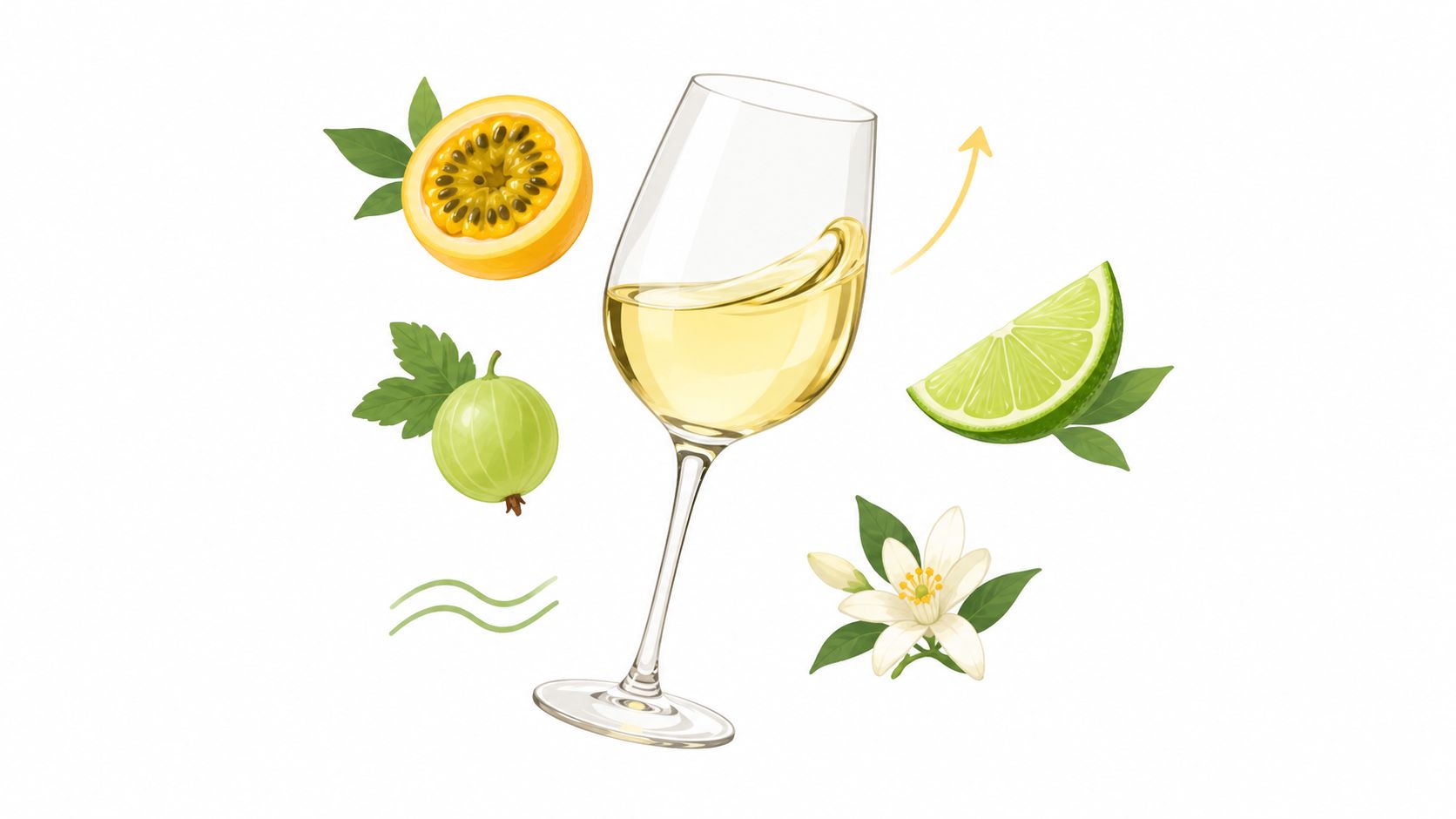
Start with the glass still. Smell before you sip, and settle on a broad category before chasing specifics: citrus, green fruit, tropical fruit or herbs. If grapefruit comes to mind, stop there. Deciding whether it resembles pink grapefruit or freshly grated peel matters far less than noticing it at all.
Part of Sauvignon Blanc's striking fragrance comes from volatile thiols, aroma compounds the nose registers in tiny concentrations. The Australian Wine Research Institute reports sensory thresholds of approximately 60 ng/L for 3-MH and 4 ng/L for 3-MHA, and links them to passionfruit, grapefruit and box-hedge characters in its technical review of Sauvignon Blanc aroma compounds. You never need that chemistry vocabulary at a shop counter. What it explains is why a dry, brisk wine can still smell explosive.
Then let your mouth answer different questions
A sip gives you four separate readings, and each one responds to a different question.
Acidity shows up as mouthwatering. A squeeze of lemon triggers the same physical reaction, so judge the response rather than the flavour.
Sweetness is a sugary impression on the tongue. Smell cannot answer this one, so ignore the fragrance and check the sip.
Body is overall weight: light and skimming, or more substantial and coating. Aroma volume tells you nothing here.
Texture describes the surface feel. Sleek, rounded, slightly grippy or creamy all count as textures, and they sit separately from weight.
Those four channels combine in unexpected ways. One wine may smell exuberantly tropical yet finish brisk and dry. Another may smell restrained but feel broad and persistent. Neither pairing is a contradiction.
Tasting shortcut: Aroma describes the fragrance, acidity describes the mouthwatering response, and texture describes how the wine feels. Judge them together, but don't confuse them.
If you prefer to watch someone taste rather than read about it, run the video below while you compare your own impressions.
Back at the shelf, translate adjectives rather than collect them. Crisp suggests an emphasis on freshness; rounded points you towards mouthfeel; aromatic describes fragrance alone. None of those words establishes sweetness on its own. They also carry an early clue about whether a bottle leans citrus-led and lean or riper and broader, which is where Australian regional signals start earning their keep.
Keep your own notes equally simple. "Fragrant but too sharp for me" will steer your next purchase far better than an elaborate list of fruit you're not sure you recognised.
Comparing Cooler and Warmer Australian Styles
Place a citrus-led Sauvignon Blanc beside a riper, more rounded example and the grape can seem surprisingly flexible. Climate offers a useful way to interpret that contrast, provided you treat it as a style signal rather than a guarantee.
Cooler expressions may emphasise citrus, green fruit, herbs and a more pointed impression of acidity. Warmer expressions can lean towards riper tropical fruit and a broader feel. Vintage conditions, vineyard choices and winemaking can complicate either expectation.
Adelaide Hills as a reference, not a rule
Adelaide Hills is a helpful South Australian starting point for drinkers seeking aromatic freshness. Its cool conditions and elevation make it relevant to this conversation, as noted in the regional history above. That doesn't mean every bottle will be austere, intensely herbal or identical to its neighbours.
McLaren Vale invites a different buying question: does this particular wine offer the broader, more textural expression I'm looking for? Don't turn that question into an automatic claim about every locally sold bottle.
A shop's location, a producer's address and the origin of its grapes aren't necessarily the same piece of information. If a label says South Australia, do not assume that means McLaren Vale. Read the declared region and ask for clarification when regional origin matters to your purchase.
Cooler and warmer Australian Sauvignon Blanc styles
| Style signal | Common flavour emphasis | Likely texture | Best buying match |
|---|---|---|---|
| Cooler-leaning expression | Citrus, green fruit, herbal detail | Leaner or more sharply defined | Drinkers seeking a brisk, precise style |
| Warmer-leaning expression | Riper tropical fruit | Broader or rounder | Drinkers who find very angular whites tiring |
| A balance of both | Citrus freshness with ripe fruit fragrance | Fresh without feeling especially lean | Shared dinners with different preferences |
| Region or style unclear | Don't infer flavour from the grape alone | Check the producer's description | Shoppers willing to ask before buying |
These are comparison prompts, not grading categories. A restrained bottle isn't automatically more refined, and a generous one isn't automatically simpler. The better choice depends on what you want to drink.
The discussion of how climate shapes wine style offers another way to interpret regional descriptions without treating geography as destiny.
Production figures don't describe flavour
Regional and national industry signals can also move differently. Wine Australia's reported 2026 figures show South Australian Sauvignon Blanc production increasing by about 9–10% to 5,784 tonnes in the state survey, while the national Sauvignon Blanc crush fell 7%, as detailed in its industry market bulletin.
That contrast is useful context, but it doesn't tell you whether an individual bottle tastes tropical, herbal or citrus-led. Nor does a production increase, on its own, prove stronger consumer demand.
For buying purposes, keep industry scale and drinking style separate. Use production reporting to understand the category, then use origin, tasting notes and producer information to choose your wine.
Matching Sauvignon Blanc to Your Table
A Tuesday plate of grilled prawns with lemon asks for a different bottle than Saturday chicken in creamy sauce, even when both labels read Sauvignon Blanc. Australian shoppers meet this split often, because a cool climate citrus style and a warmer South Australian fruit style behave like different companions at dinner.
Start where your tongue goes first. Cooks in Adelaide learn this fast. Salt, lime leaf, fresh coriander or chilli will shape the match more than the protein does. A lean, lime driven wine sits comfortably beside cooked fish, oyster or lemon dressed leaves, since its acidity does similar work to a wedge of citrus. The ideas in this guide to pairing fresh seafood with South Australian white wines show how that citrus logic plays across several local dishes.
Herbs pull you toward herbaceous bottles. Basil, dill, parsley or mint echo the greener side of the grape, which explains why goat cheese with lemon and herbs loves a fresh style while the same cheese with quince or sweet chutney prefers riper fruit. Texture matters too. Creamy dressings, soft cheese or a rich coconut sauce need a wine with a little breadth, not the sharpest option on the shelf.
Chilli changes the rules. Strong heat can make high acid feel harsher, so very hot dishes often suit another variety altogether. Gently spiced food is kinder. Try a rounded, passionfruit led pour with coriander heavy vegetables, lime chicken or yoghurt sides, then taste wine, food, wine again. Hosts who test these flights for groups sometimes borrow planning tips from operators who run culinary walking tours efficiently, because small pours and notes keep comparisons clear.
Keep three invitations in mind. Citrus led wine with plain seafood. Herbal wine with greens and fresh cheese. Rounder fruit led wine with mild spice. Let your palate confirm the choice.
Serving and Storing Sauvignon Blanc
Serve Sauvignon Blanc chilled, but don't assume the coldest possible glass gives you the fullest experience. Temperature is something you can adjust while drinking, not a test you must pass before opening the bottle.
My practical approach is to begin with a chilled bottle and pour a modest amount. If the wine seems muted or difficult to smell, let the glass warm slightly and reassess before deciding it lacks character.
Use the glass as a tasting aid
A clean wine glass with room to swirl is a sensible starting point. A narrower opening can help you concentrate on fragrance, while a broader bowl gives you room to explore it. You don't need a specialised collection to make a useful comparison.
Avoid filling the glass so high that swirling becomes awkward. Smell before swirling, then swirl gently and smell again. This also helps distinguish a quiet first impression from a wine you don't find expressive.
| Serving check | Practical action |
|---|---|
| Temperature | Start chilled and reassess as the wine warms |
| Glass | Use a clean glass with enough space to swirl |
| Opening plan | Open when you're ready to taste and serve |
| Remaining wine | Reclose the bottle and refrigerate it |
| Storage | Keep unopened bottles away from heat and direct light |
Let the producer guide the drinking window
For a young, aromatic style, freshness is a sensible buying priority. That doesn't create a universal expiry date, and an older bottle shouldn't be dismissed just because it isn't the latest vintage.
Ask the producer or retailer about the intended drinking window, especially if you're considering an older wine. Storage history deserves attention too: knowing how a bottle has been kept is more useful than assuming age alone tells the story.
Bottle format should fit your actual drinking plans. A pack may be convenient for repeated dinners, but the saving means little if the wine sits somewhere unsuitable. Before ordering, decide where the unopened bottles will go and whether you expect to enjoy them within the producer's guidance.
For an opened bottle, avoid promising yourself a fixed number of good days. Reclose it promptly, keep it refrigerated and check its aroma and flavour when you return to it. If its freshness has faded, use that experience to adjust how much you open next time.
Choosing Single Bottles Samples and Value Packs
A full case can be the expensive way to stay unsure. One Adelaide Hills bottle may read lean and herbal while a warmer South Australian label leans tropical, so the first purchase is really a test of which direction suits your table.
Use certainty as the measure. A mixed pack works like a cellar-door flight: small pours, clear contrasts, quick learning. A repeated-bottle case is closer to signing the lease after one visit; sensible when the producer, region and style are already familiar, wasteful while you are still guessing.
Before the discount banner decides for you, ask three things in order: what style the listing promises, where the grapes were grown, and how many bottles in the pack you would happily open this month. If any answer is vague, buy less or ask the retailer to explain the mix, the vintages and whether every component is Sauvignon Blanc.
Single bottles suit unfamiliar producers and narrow comparisons, such as a cooler-climate wine beside a rounder SA example. Curated sample packs can show range, though the name alone does not promise miniature bottles or a focused tasting set. Half-and-half formats fit households split between citrus-led freshness and riper fruit. A known-favourite case earns its place after the vintage, region and drinking plan line up, especially when the same wine has already worked at your table.
Nut House SA Sauvignon Blanc and Troublemaker SA Sauvignon Blanc are the sort of names that make this check practical: SA signals a broad state origin, so look for finer regional detail or a producer note before assuming a cooler or warmer style.
For gifts, choose the recipient's known preference over your own curiosity. Compare delivery, returns or taste-guarantee terms, read the payment and contact details, then judge value by bottles you want to finish and by whether the carton size matches that appetite.
Finding Your Ideal Sauvignon Blanc
Your ideal Sauvignon Blanc isn't necessarily the most aromatic, the sharpest or the one with the most prestigious-sounding origin. It's the bottle that fits your preferences and the occasion, with enough information available to make the purchase feel considered.
Use a linked decision sequence rather than searching for a universal winner. Decide what you want to taste, what you'll eat, which regional direction interests you, how much variation you welcome and what total spend feels comfortable.
Choose a direction you can explain
- The aromatic seeker: Prioritise a clearly described passionfruit or tropical-fruit expression. Start with a single bottle if the producer is unfamiliar.
- The crisp seafood drinker: Look for a citrus-led description and a fresh finish, then choose a bottle for a specific meal.
- The regional explorer: Compare declared origins and contrasting styles through a suitable mixed selection. Keep brief notes so the discovery informs your next order.
Sustainability can sit alongside those preferences without replacing them. Wine Australia research found that 56% of surveyed consumers in 2025 considered certified sustainable production very or somewhat important, as reported in its consumer research on wine and sustainability.
Ask what the environmental claim means
Look for a named certification and a clear explanation of what it covers. If a winery describes lighter packaging, water management or vineyard biodiversity, assess those as specific practices rather than assuming a broad green claim proves everything.
A sustainability claim deserves the same attention as a tasting note: look for detail you can understand and evidence you can check.
Certification doesn't automatically promise superior flavour or justify any price. Keep region, vintage, producer practices and value in the decision too.
Trust begins with a clear description and ends with your experience in the glass. You don't need to master every expression. You need a reliable way to recognise what you enjoy and enough curiosity to try a neighbouring style.
McLaren Vale Cellars offers Sauvignon Blanc alongside curated sample packs, mixed Half & Half packs and value-focused case options for different levels of curiosity and commitment. Visit McLaren Vale Cellars to compare current listings, check the declared region and tasting notes, and choose a bottle or pack for your next meal.
Comments (0)
There are no comments for this article. Be the first one to leave a message!