
You're standing at the white wine shelf or scrolling a bottle shop page, and two names keep popping up: Sauvignon Blanc and Chenin Blanc. One looks familiar, one looks like a gamble, and both can solve the same problem, getting the right bottle on the table without overthinking it.
Here's the blunt version. If you want the safer buy, pick Sauvignon Blanc. If you want the bottle that gives you more texture, more curiosity and a better chance of surprising yourself, reach for Chenin Blanc. In Australia, that choice isn't just about flavour, it's about scale, availability and how much risk you want in the glass.
| Question | Sauvignon Blanc | Chenin Blanc |
|---|---|---|
| Shelf presence | Common, easy to find | Scarcer, more specialist |
| Buying risk | Low | Medium |
| Style | Fresh, crisp, obvious | Broader, more variable |
| Best for | Easy crowd-pleasing | Curious drinkers, food flexibility |
| Australian footprint | Much larger | Much smaller |
Wine Australia's 2026 National Vintage Report recorded 107,719 tonnes of Sauvignon Blanc crushed nationally, against only 2,940 tonnes of Chenin Blanc, and Sauvignon Blanc was consumed by 48% of regular Australian wine drinkers in 2023 (report, market insights). That scale gap tells you a lot before you even twist the cap.
If you're planning a tasting trip or want a reason to browse beyond the supermarket aisle, a good way to compare these wines in the wild is to browse upcoming winery events and taste different white styles side by side.
The Two Whites on the Shelf
At the bottle shop, the choice often comes down to the occasion, not a tasting-note contest. You are choosing between a known quantity and a smaller, more variable bet.
Start with the question, not the grape
Ask what the bottle must do tonight. For a mixed group, barbecue seafood, or a no-fuss midweek dinner, Sauvignon Blanc is the practical call. Australian shoppers recognise it, retailers stock it widely, and its fresh style rarely needs much explanation. Chenin Blanc suits a table where you want the wine to contribute more, with broader texture and less predictability.
That difference matters on a retail floor. Sauvignon Blanc is the bottle you can grab quickly and expect to work. Chenin Blanc is the bottle for exploring without stepping into an obscure style.
Practical rule: buy Sauvignon Blanc when the wine needs to disappear into the occasion, buy Chenin Blanc when you want the wine to have a bit more say.
Availability changes the decision too. Sauvignon Blanc appears across supermarkets, independent bottle shops and regional ranges because it is a major commercial variety in Australia. Chenin Blanc appears more selectively, so the label, producer and retailer recommendation carry more weight. That makes Chenin a less automatic purchase, but a rewarding option when you want something beyond the standard shelf choice.
If you're planning a tasting trip or want a reason to browse beyond the supermarket aisle, compare these wines in the wild by browse upcoming winery events and taste different white styles side by side. A tasting gives Chenin Blanc room to show why its variation can be an advantage, rather than a buying risk.
The buying rule is simple: match Sauvignon Blanc to convenience and Chenin Blanc to discovery. The right choice depends on how much attention you want the bottle to demand.
Grape Origins and Australian Footprint
Why one is mainstream and the other is niche
At an Australian bottle shop, Sauvignon Blanc earns shelf space through scale. It appears across supermarkets, independent retailers and regional ranges because growers, producers and distributors work with it widely. Chenin Blanc occupies a smaller corner, so it reads as a discovery bottle rather than an automatic choice.
The planting figures make the difference clear. Approximately 6,100 hectares of Sauvignon Blanc were planted nationally in 2015, compared with 520 hectares of Chenin Blanc in 2012. South Australia's 2025 vineyard data recorded around 2,415 hectares of Sauvignon Blanc against only 88 hectares of Chenin Blanc (AWRI, Wine Australia bulletin). A gap that size is a different market reality, not a rounding error.
What that means at the bottle shop
Scale gives Sauvignon Blanc a practical advantage. More producers, wider distribution and familiar styles make it easier to choose quickly, especially when you need a reliable white for a weeknight meal or a gathering. Chenin Blanc offers fewer casual comparisons, but the stronger bottles can stand out because the category is less predictable.
That difference changes how you should shop. With Sauvignon Blanc, the variety often gives you enough information to make a quick decision. With Chenin Blanc, read the producer, region and style cues, then ask the retailer for guidance if the label leaves you unsure.
Chenin is harder to find by accident. Buy it when you want to explore Australian white wine beyond the standard crisp option, or when a region or producer has caught your attention.
Sauvignon Blanc's Loire roots and Australian development provide useful context in this Sauvignon Blanc overview. The history helps explain its comfort on Australian shelves, while Chenin Blanc's smaller footprint makes it the more deliberate purchase.
Flavour, Structure and What the Palate Really Shows
What Sauvignon Blanc usually delivers
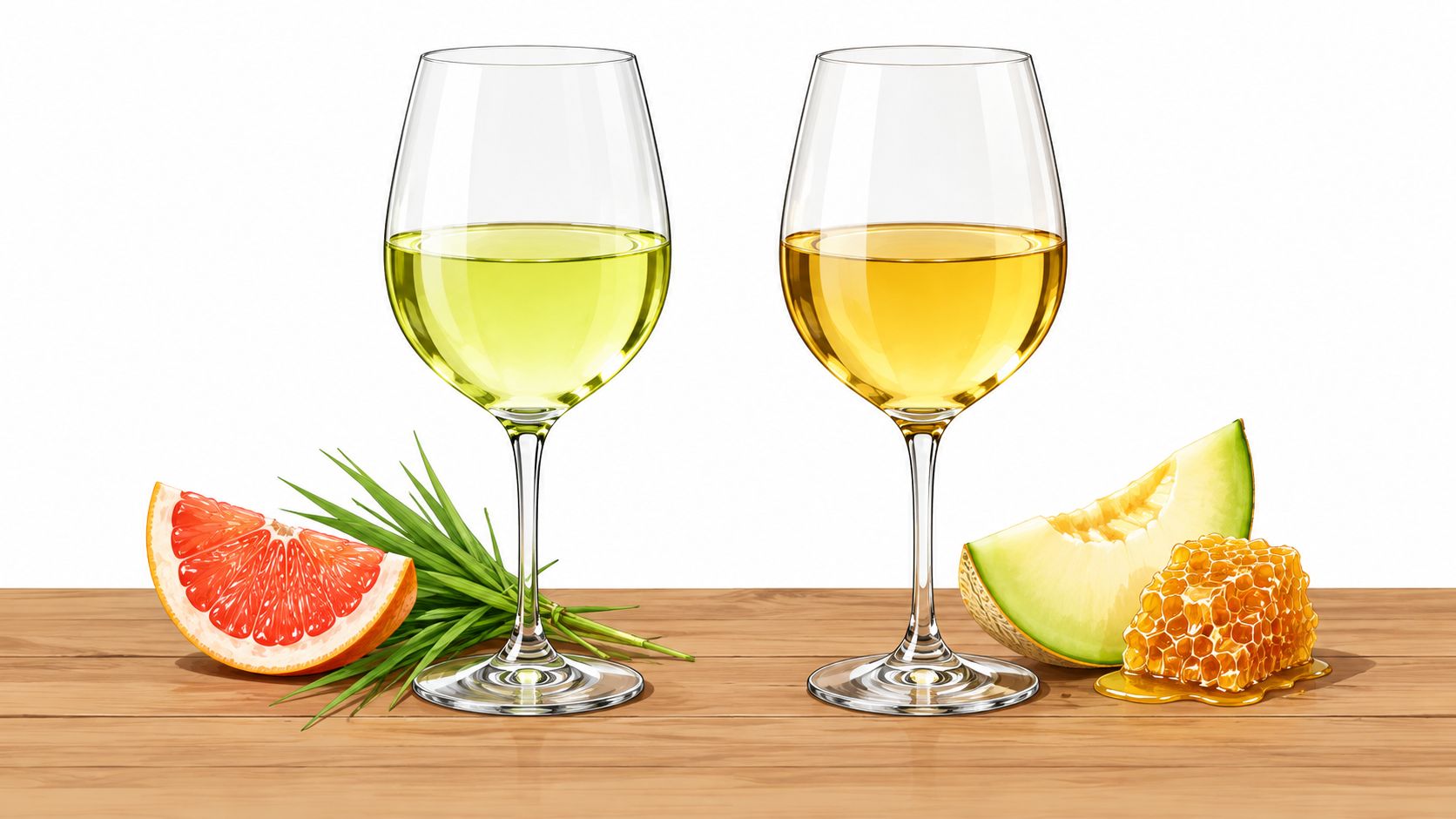
Sauvignon Blanc is the grab-and-go white. It sits on Australian shelves because it is easy to read, bright, and built for freshness first. That is why buyers reach for it when they want a clean, lively white that does the job without asking for much thought.
Its structure is the point. Sauvignon Blanc usually works best when the wine stays brisk, crisp, and direct, so it suits shoppers after refreshment rather than texture. It also tends to be a drink-now style, which makes it a safe pick for weeknight drinking, lunches, and casual pours.
What Chenin Blanc gives you instead
Chenin Blanc has more range. It can come through lean and taut, or rounder and more generous, depending on site and winemaking. That flexibility matters, because the grape gives producers room to make a wine with more shape and mid-palate interest.
Key contrast: Sauvignon Blanc usually hits first. Chenin Blanc opens out more slowly.
That is the shelf difference. Sauvignon Blanc gives you immediate clarity. Chenin Blanc can bring more texture through the middle, a little more ripeness, and a finish that changes with food. In plain terms, Sauvignon Blanc is the sharper tool, Chenin Blanc is the more adaptable bottle.
Read the label with that in mind. If the wine is meant to be fast, fresh, and unambiguous, it is usually leaning Sauvignon Blanc. If the maker is chasing texture, subtle sweetness, or a more layered finish, Chenin Blanc deserves a closer look.
Where Each Grape Grows Best in Australia
Cooler sites suit the cleaner style
A smart Australian buy starts with region. Sauvignon Blanc does its best work in cool, sunny places such as Adelaide Hills, Margaret River, Tasmania, Orange and the Yarra Valley, where early ripening can keep the wine fresh without tipping into hard green edges. It still needs careful canopy work, because the vine is vigorous. If growers do not manage shoots, leaves and crop load properly, the wine loses precision.
Chenin Blanc asks for a different read. It is earlier-budding, mid-season ripening, highly vigorous and high-yielding, with Australian plantings historically concentrated in the Riverland, Swan Districts and Margaret River, as shown in the AWRI varietal data. That makes it a grape with range, but not a grape that forgives sloppy vineyard work.
Region matters more than people think
Late-season rain is a problem for both grapes because they have thin skins and compact bunches, and Chenin Blanc is especially susceptible to bunch rot, per the same AWRI varietal data. That makes harvest timing and canopy airflow practical quality controls in the vineyard.
| Australian regions and styles at a glance | ||
|---|---|---|
| Region | Grape | Typical style |
| Adelaide Hills | Sauvignon Blanc | Crisp, aromatic, brisk |
| Margaret River | Sauvignon Blanc | Refined, fresh, structured |
| Tasmania | Sauvignon Blanc | Cooler, tighter, lively |
| Riverland | Chenin Blanc | Broader, more workmanlike unless carefully handled |
| Swan Districts | Chenin Blanc | Niche, variable, producer-led |
| McLaren Vale | Chenin Blanc | Small-volume, style-dependent, worth checking the maker |
For buyers, the rule is simple. Region gives you the better clue than grape name alone. A Sauvignon Blanc from a cool site usually gives the fresh, reliable shape most shoppers want. Chenin Blanc needs more producer context, because its style depends more on who made it and how hard they worked in the vineyard.
Styles from Dry to Sparkling and Sweet
Don't assume either grape only does one thing
Sauvignon Blanc is usually bought as a dry, fresh white, and that remains the safest Australian shelf choice for a crisp, uncomplicated drink. Chenin Blanc offers a broader stylistic spread. It can be dry, richer, lightly sweet, or sparkling, so the grape name alone does not tell you what will be in the bottle.
That difference matters at the checkout. A dry Chenin can feel taut and savoury, while a fuller version may bring more texture and roundness. Sauvignon Blanc can also shift away from its familiar bright style when the maker adds sweetness, oak, lees work, or bubbles. Choose the style for the occasion, not just the variety on the label.
Read the label for clues
Words such as dry, off-dry, sparkling, residual sugar, lees, and oak give you a better buying signal than the grape name alone. A sparkling or lightly sweet bottle suits aperitif drinking and celebrations; a dry, straightforward wine works better when you want refreshment with minimal thought. That is a useful cue: the wine is designed for a different moment.
If you want to understand how production choices shape sparkling wine, read this guide to sparkling wine varieties and styles. For the fresher, more experimental end of fizz, this overview of pet nat wine explains why the style can taste less polished and more characterful than conventional sparkling wine.
Chenin deserves closer label reading because Australian examples are less standardised across the shelf than Sauvignon Blanc. Producer, region, sweetness and winemaking choices can change the result substantially. That uncertainty is a drawback when you want a predictable bottle, but it is an advantage when you enjoy finding distinctive wines. The practical rule is simple: buy Sauvignon Blanc for reliable freshness, and choose Chenin Blanc when the label gives you enough information to match the style to the occasion.
Food Pairings for Real Australian Kitchens
Use Sauvignon Blanc for sharp, fresh plates
Sauvignon Blanc is the easy win when you've got seafood, goat cheese, salad, or Thai-style food on the table. Its freshness cuts through salt, citrus, herbs and chilli in a way that keeps the meal moving. If you're serving something light and bright, don't overthink it.
That's especially useful in Australian homes where dinner can be a bit of a hybrid, a tray of prawns, a salad, some grilled fish, maybe a spicy dressing on the side. Sauvignon Blanc handles that kind of scattershot menu better than a fuller white because it doesn't try to dominate the plate.
Use Chenin Blanc when the food has more weight
Chenin Blanc does better when the meal needs texture, not just zip. Roast chicken, richer seafood, soft cheeses, pork and gently spiced curries are all stronger matches because Chenin can meet the dish halfway instead of just slicing through it. If there's a little sweetness or roundness in the wine, it can also calm spice rather than fight it.
For a practical pairing rule, think like this:
- Choose Sauvignon Blanc when the meal is driven by acidity, herbs and freshness.
- Choose Chenin Blanc when the meal needs a little more body, softness or flexibility.
- Break the rule if the producer has made an unusually textural Sauvignon Blanc or a very dry, lean Chenin.
A good dinner party move is to serve Sauvignon Blanc for the lighter plates and keep Chenin Blanc for the second bottle when the food gets richer.
If you want a broader framework for matching wine to food, this wine and food pairing guide gives you a few more practical matching rules without turning it into a lecture.
Which One Should You Actually Buy

Buy Sauvignon Blanc when you want low risk
If you're buying for a crowd, a casual lunch or a night where nobody wants surprises, Sauvignon Blanc is the smart default. It's widely available, the style is familiar, and it usually delivers what most Australian drinkers expect from a fresh white. That's why it stays the safer gift and the easier bottle to place on a mixed table.
There's also a retail reality here. Sauvignon Blanc's broad footprint means there are more reliable options at more levels of the shelf, so it's easier to buy with confidence when you don't want to spend time decoding the label.
Buy Chenin Blanc when you want more from the bottle
Chenin Blanc is the better call when you already know you like Sauvignon Blanc and want something with a bit more texture, ripeness or food range. It's the bottle for shoppers who don't mind asking staff a question, checking the producer and trusting a smaller-volume style. That smaller production can work in your favour if you're choosing well, because the bottle often reflects more deliberate winemaking rather than mass-market familiarity.
If you're comparing value, don't make the lazy assumption that the more popular grape is automatically the better buy. Popularity makes Sauvignon Blanc easier to find. It doesn't make Chenin Blanc less interesting or less rewarding.
For a few broader shopping ideas around value and offers, these wine value tips from Northern Spain Travel are useful as a mindset even if you're not buying from Spain, because the same habit applies, look for the producer, the style and the occasion, not just the label.
A simple buying rule
- Sauvignon Blanc for familiarity, freshness and easy crowd appeal.
- Chenin Blanc for curiosity, texture and a better chance of food flexibility.
- Mixed case if you want to compare them properly without guessing from a single bottle.
Ageing, Serving and Common Buyer Questions
Serve Sauvignon Blanc cool, but not ice-cold, so the freshness stays bright without shutting down the flavour. Chenin Blanc can handle a similar chill, though a little more warmth often helps the texture show through. Use a standard white wine glass for both and don't overcomplicate it.
Neither grape is a long-term cellar candidate in the kind of Australian styles most buyers pick up off the shelf. They're better bought for drinking than storing, unless the producer has clearly made a more structured Chenin Blanc with ageing in mind. In other words, don't stockpile these wines hoping they'll become something else.
Is Chenin Blanc worth paying more for? Sometimes, yes. If the bottle comes from a careful producer and you want more texture or a broader food match, the extra spend can make sense.
Is Sauvignon Blanc still the safer gift? Absolutely. If you don't know the recipient's taste, Sauvignon Blanc is the less risky choice.
Should I buy both? Yes, if you're learning. A mixed purchase tells you more than any tasting note ever will.
Best takeaway: Sauvignon Blanc is the reliable default, Chenin Blanc is the better explorer's bottle.
If you want help choosing between the two on a real shelf, McLaren Vale Cellars has white wine options, tasting guides and mixed packs that make side-by-side comparison easy. Visit when you want a practical recommendation, a regional bottle or a smarter way to test what you like.

Comments (0)
There are no comments for this article. Be the first one to leave a message!