
You've poured a Sauvignon Blanc, read passionfruit and fresh-cut grass on the label, and found something closer to grapefruit peel and herbs. Is the wine disappointing, or are you looking for the wrong things? Sauvignon Blanc tasting notes are most useful when they describe how the wine behaves, not just which fruits it resembles.
Start with aromatic intensity and integration, then examine the acidity, texture and finish. That approach helps you enjoy an exuberant tropical wine without mistaking a quieter Australian expression for a flawed one.
Sauvignon Blanc Tasting Notes at a Glance
| Descriptor family | Typical aromas | Main aroma source | Strength or excess signal |
|---|---|---|---|
| Tropical | Passionfruit, guava, ripe tropical fruit | 3-mercaptohexyl acetate (3-MHA), especially for passionfruit | Clean and lifted when balanced; pungent when excessive |
| Citrus | Grapefruit, lime, lemon zest | 3-mercaptohexan-1-ol (3-MH), particularly for grapefruit | Adds freshness and definition; assess pungency across the whole aroma |
| Green and herbal | Cut grass, capsicum, green bean | Methoxypyrazines, particularly IBMP for capsicum and green bean | Adds herbal definition; can dominate weaker fruit |
| Box hedge | Box hedge, blackcurrant leaf | 4-MMP and other thiols at elevated concentrations | Distinctive in moderation; intrusive when overly pungent |
| Savoury and mineral | Flint, wet stone, saline | No single compound established for this descriptor group | Adds interest when supported by flavour and structure |
These are aroma families, not quality grades. The chemical column identifies important contributors, not a laboratory diagnosis of everything you smell. In particular, describing lime or wet stone doesn't establish that a specific compound caused that impression.
Match the impression before naming the fruit
Tropical describes the rounded, ripe-fruit side of the aroma. You don't need to distinguish guava from passionfruit to write a useful note. Recognising ripe tropical fruit is enough, provided you also record whether it feels inviting or overpowering.
Citrus is the sharper-smelling family. Grapefruit flesh, lemon zest and lime peel offer useful everyday comparisons, but smelling citrus isn't the same as measuring acidity. Your nose supplies the descriptor; your palate checks the freshness.
Green and herbal covers leafy, grassy and vegetable-like impressions. Fresh herbs can provide welcome definition, while dominant capsicum may be less appealing to someone who prefers fruit-led wines. Neither preference establishes a fault.
Box hedge is more penetrating than ordinary grassiness, with a pungent leafy character. The Australian Wine Research Institute's technical review of Sauvignon Blanc thiols explains that concentration affects whether these aromas contribute attractive fruit character or become excessively pungent.
Savoury and mineral is a practical sensory grouping, not proof that you're tasting vineyard rocks. Use these words when they describe your actual impression, rather than as shorthand for expensive or refined.
Useful distinction: A descriptor becomes a strength when it contributes to a coherent wine, not simply because it appears on a desirable tasting-note list.
For a cellar-door visit, keep this lookup on your phone alongside your bookings. Hamptons Leisure Limo's guide to planning a wine tour itinerary can help organise the practical side, leaving you time to compare what's in each glass.
Serving Temperature and Food Pairings
| Style | Serving temperature | Best pairing |
|---|---|---|
| Crisp, lean, Loire-type or unoaked | Well chilled, but not so cold that the aroma disappears | Oysters, goat's cheese salad, lemon-dressed seafood |
| Fruit-forward, Marlborough-type | Chilled, with enough warmth for the fruit to become expressive | Chicken salad, prawns, sushi |
| Textured or barrel-fermented | Lightly chilled, allowing texture and savoury detail to emerge | Grilled fish, roast chicken with herbs, creamy pasta |
Serve for the style, not the price. A delicate, lean wine and a broad, barrel-fermented example don't necessarily show their best at the same temperature. Use the table as a starting point, then adjust according to what you smell and taste.
Excessive chilling can suppress aroma and make an expressive wine seem unusually quiet. If your glass smells almost blank, let it warm slightly before deciding the wine lacks character. Conversely, an overly warm glass can seem broad, heavy or less refreshing.
Temperature changes your perception of acidity; it doesn't remove the acid from the wine. That distinction matters when a bottle tastes noticeably fresher after chilling.
Make small adjustments in the glass
Chill the bottle in the fridge, then test a small pour rather than relying on a fixed chilling time. Fridge settings, starting temperature and bottle size all affect how quickly the wine cools.
- For a muted glass: Hold off on returning the bottle to the fridge immediately. Swirl gently and reassess as the wine warms.
- For a heavy-feeling glass: Put the bottle back in the fridge and compare a fresh, cooler pour.
- For a warm dining room: Pour smaller amounts so the wine doesn't sit warming in a large glass.
Food pairing works best when you match both flavour and weight. Lemon-dressed seafood suits a citrus-led wine, while herbal chicken dishes can connect with leafy aromas. Asparagus and green beans are also worth trying when you enjoy Sauvignon Blanc's greener side.
A textured example can stand alongside grilled fish or a creamy sauce without seeming slight. Our guide to pairing McLaren Vale Sauvignon Blanc with food offers further combinations to try at the table.
Don't reject a pairing after smelling the wine alone. Taste the food, take a sip, and judge whether you want another mouthful of both.
How to Taste and Describe Sauvignon Blanc
Use a clean white-wine glass with room to swirl, and taste once the wine is suitably chilled for its style. Avoid strongly scented detergent residue or perfume nearby, which can make identifying the wine's own aromas harder.
- Judge intensity before searching for descriptors. Smell gently and decide whether the aromatic lift is low, moderate or high. The common mistake is assuming that the most forceful wine must be the best.
- Choose the dominant aroma family. Decide whether the clearest impression is tropical, citrus, green, pungently leafy or savoury. Listing every possible fruit usually communicates less than identifying the main character accurately.
- Check integration. Ask whether that dominant impression feels clean and proportionate, or whether it overwhelms everything else. Don't turn personal dislike into a fault diagnosis: an assertively herbal wine may be sound but not your preference.
- Find a supporting family. Look for a second impression that adds contrast, such as grapefruit beside passionfruit or herbs behind citrus. Don't force a second descriptor if you can't confidently identify one.
- Test the acidity with a sip. Notice whether you salivate and whether the wine leaves your palate refreshed after swallowing or spitting. Avoid confusing acid-driven freshness with the drying sensation of phenolic grip.
- Describe weight, texture and persistence. Decide whether the wine feels lean and crunchy, rounded, or lightly grippy, then notice what remains after the sip. A common slip is recording only the smell and missing a hollow middle or an attractive, sustained finish.
Turn observations into a useful note
Write in this order: intensity, dominant family, integration, then structure. This keeps the note readable and makes it useful when you're choosing another bottle.
For example, you might write: high-intensity passionfruit and grapefruit, clean and lifted, with brisk acidity and a lean finish. A contrasting note might read: pronounced tropical fruit with intrusive box-hedge pungency, a rounded middle and a bitter finish.
Neither example needs a long list of exotic ingredients. The difference lies in how the components work together, not in the writer's vocabulary.
For broader terminology, our guide to describing wine the Australian way can help you distinguish aroma, flavour, body and finish. Keep your own language specific enough that you'll recognise your preferences when you read the note later.
What Creates the Aromas in Your Glass
Think of your sense of smell as a smoke alarm that can respond to tiny amounts of a substance. Sauvignon Blanc's important aroma compounds can become perceptible at exceptionally low concentrations, so a powerful smell doesn't require a large quantity of material.
This illustration shows the relationship between trace compounds and sensory sensitivity.
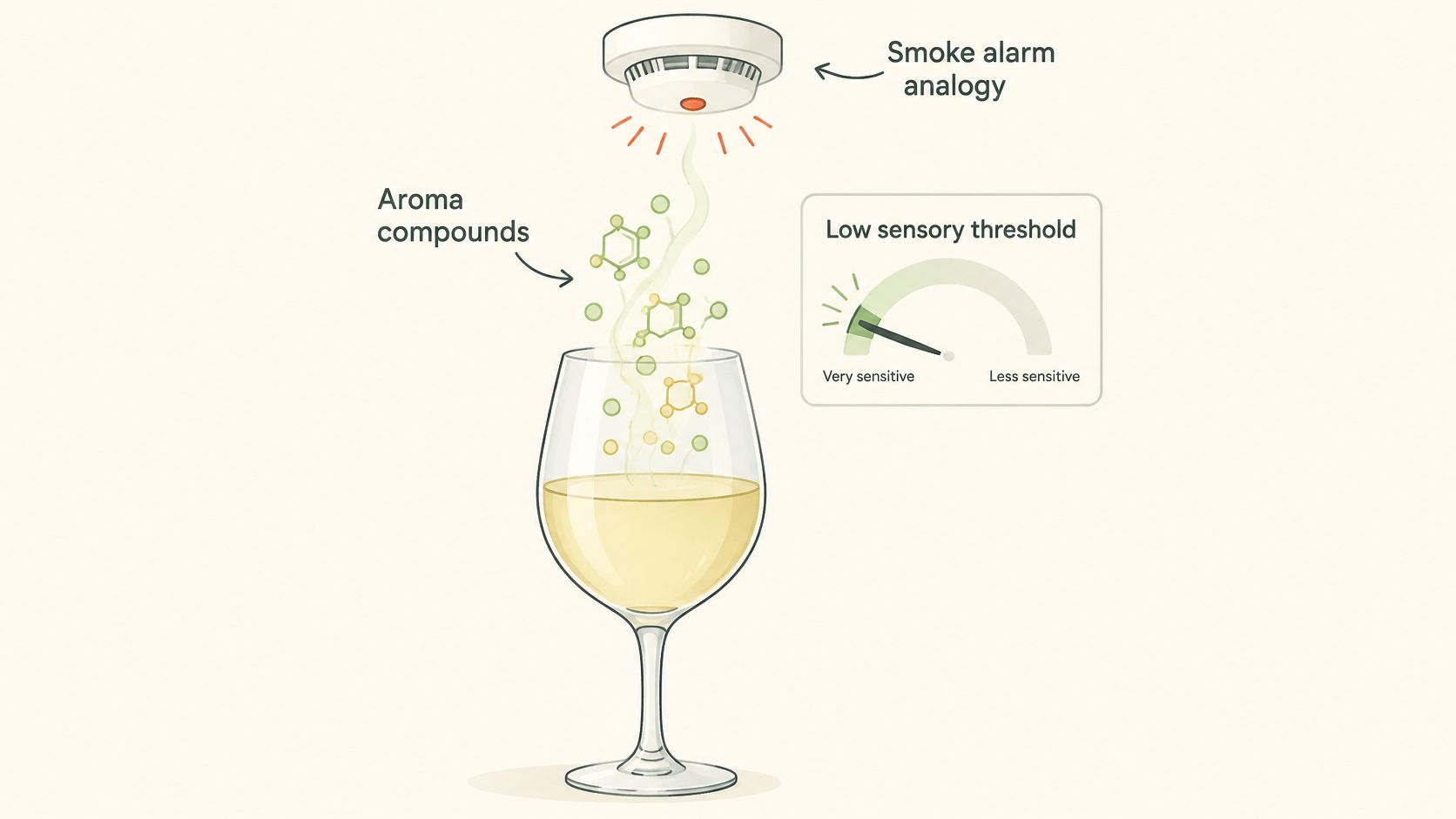
The Australian Wine Research Institute's grape-variety guidance identifies approximate sensory thresholds of 60 ng/L for grapefruit-associated 3-MH, 4 ng/L for passionfruit-associated 3-MHA, and 0.8 ng/L for green or box-hedge-associated 4-MMP, and reports that 3-MH concentrations in Sauvignon Blanc commonly range from 1,530 to 7,080 ng/L.
A nanogram per litre is a concentration measurement, not a quality score. Those measured levels help explain aromatic power, but they don't tell you whether you'll enjoy the bottle. The surrounding aromas and the palate still matter.
Why tropical fruit and capsicum can coexist
The green side has another important contributor: methoxypyrazines. The AWRI report on Sauvignon Blanc flavour interactions explains that these compounds are concentrated mainly in stems, skins and seeds, with levels influenced by berry maturity, climate, fruit exposure and processing; its sensory work also found that capsicum-associated IBMP generally dominated mixtures, while tropical thiols reduced perceived fresh-green intensity.
That interaction explains why your glass doesn't have to choose between tropical and herbal. The compounds occur together, and their combined sensory effect isn't just a stack of independent smells. A change in one component can alter how strongly you perceive another.
Use the accompanying video as another prompt for paying attention to aroma.
The chemistry supports confident description, but it doesn't make your nose a measuring instrument. You can identify a pungent leafy impression without claiming to know the wine's thiol concentration.
Our guide to decoding fruity, floral and funky wine aromas helps put that distinction into everyday language. Name the sensation you perceive, then judge its contribution to the whole glass.
Regional Styles and Judging Restrained Wines
| Region | Signature aromas | Acidity and texture | Typical style |
|---|---|---|---|
| Marlborough, New Zealand | Intense passionfruit, gooseberry, cut grass | Vibrant acidity and high aromatic lift | Bold, aromatic, tropical-leaning |
| Loire Valley, France, including Sancerre and Pouilly-Fumé | Flint, gooseberry, lime, wet stone | High acidity, lean and mineral in impression | Restrained, savoury, food-driven |
| Adelaide Hills, South Australia | Grapefruit, passionfruit, cut grass | Fresh acidity, with potentially drier, more textural expression | Fruit-led, often less opulent than classic Marlborough styles |
Treat these as style signposts, not guarantees. Producer choices and growing conditions can make neighbouring wines taste quite different. The table is most useful for setting expectations before you open a bottle, not for deciding what you're required to smell.
Marlborough provides a familiar reference for people who enjoy immediate aromatic impact. Loire styles offer a contrasting reference for drinkers who value citrus, restraint and a leaner impression. Neither is the standard against which every Australian wine must be judged.
Regional travel can make those differences more tangible. If a New Zealand celebration includes cellar-door visits, Venue Finder's directory of Marlborough vineyard wedding venues can help connect the setting with the region you're exploring, though venue choice isn't a guide to wine quality.
Read South Australian style on its own terms
Wine Australia's Sauvignon Blanc overview describes Australian expressions ranging from light, crisp, lemony and herbal to fuller tropical wines with barrel fermentation or ageing, and identifies Adelaide Hills vineyards at roughly 400–650 metres as an important setting for concentrated aromas and fresh acidity.
Don't extend an Adelaide Hills description to every South Australian bottle. A broad South Australian regional designation doesn't establish that the fruit came from high-altitude Hills vineyards. Read the actual region on the label before applying a regional expectation.
Grapefruit and cut-grass notes can make an Australian wine feel more restrained than a richly tropical benchmark. That doesn't establish that it has less flavour. Pay attention to what happens during the sip: a quieter aroma may accompany substantial texture and a persistent finish.
Equally, restraint isn't automatically complexity. If the wine offers little aroma, little mid-palate flavour and an abrupt finish, calling it subtle doesn't resolve those shortcomings.
The quality test: A restrained wine needs something worth paying attention to, whether that's precise acidity, satisfying texture, developing flavour or a sustained finish.
Check structure before rewarding restraint
Use a consistent sequence when deciding whether a quieter wine is compelling.
- Acidity balance: Look for freshness that supports the flavour. If the wine feels sour and stripped of fruit, high acidity alone isn't a virtue.
- Mid-palate weight: Notice what happens between the first impression and the finish. A lean wine can still feel complete; a hollow one seems to disappear midway through the sip.
- Finish length: Follow the flavour after swallowing or spitting. Distinguish an attractive continuation of citrus or herbs from lingering harshness.
- Bitterness and phenolic grip: A gentle drying edge can provide shape, especially with food. Strong bitterness that obscures the flavour is a different experience.
- Oak integration: In a barrel-influenced style, ask whether the wood-related impressions fit the fruit and texture. Obvious oak isn't proof of greater quality.
Young Gun of Wine's examination of alternative Australian Sauvignon Blanc highlights skin contact, neutral or older oak and textural winemaking, with tasting descriptions including grapefruit, spice, rose petal, oat biscuit, grass and orange blossom alongside greater palate depth.
Those descriptors offer alternatives to a purely tropical-fruit vocabulary. They don't mean every unusual wine is successful, or that a familiar crisp expression has become less worthwhile.
Try a restrained bottle with seafood or grilled fish and assess whether its savoury or herbal character becomes more enjoyable with the meal. Food can provide a useful context for texture, but it shouldn't be an excuse for a wine you don't like.
For these quieter styles, judge structural completeness before rewarding aroma volume. Then keep preference separate from quality: you can recognise a carefully balanced savoury wine and still choose the bright, passionfruit-led bottle you'd rather drink.
Choose Your Next Sauvignon Blanc by Palate
Make your next purchase answer a specific preference rather than a vague search for the best Sauvignon Blanc. You'll learn more from a deliberate comparison than from choosing another bottle solely because its label promises tropical fruit.
- Pick your favourite family: Decide whether you most enjoy citrus, tropical fruit, herbs or savoury detail.
- Choose the mouthfeel: Look for lean and refreshing, rounded and fruit-led, or textured and gently grippy.
- Use the regional clue: Match those preferences to the regional signposts, then read the producer's style description.
On South Australian labels, check the region, vintage and winemaking cues. Unoaked suggests a different starting point from barrel-fermented, but neither term guarantees quality or a particular aroma. The vintage identifies the harvest year; it isn't a complete prediction of freshness or flavour.
Our Nut House SA Sauvignon Blanc 2025 Dozen and Troublemaker SA Sauvignon Blanc 2025 Dozen are entry points, each priced at $120.00 a dozen, or $10.00 a bottle. If you don't like a wine, we'll help you find one suited to your taste.
For broader exploration, B.R. Cohn Winery's information for people looking to join a Sonoma Valley wine club provides another regional avenue to consider. Choose any ongoing wine purchase around the styles you enjoy, rather than assuming every selection will match your palate.
Taste contrasting styles side by side, each appropriately chilled. Write a short intensity-plus-integration note for each, add your impression of structure, and record which you'd buy again.
McLaren Vale Cellars offers South Australian wines and tasting guides to help you choose by aroma, texture and finish. Visit McLaren Vale Cellars to choose your next Sauvignon Blanc and put your palate preferences into practice.
Comments (0)
There are no comments for this article. Be the first one to leave a message!