
The most useful advice about sparkling wine is often the least helpful: choose a vintage-dated bottle if you want quality. That assumption treats non-vintage, or NV, sparkling wine as a cheaper substitute, when its real purpose is far more deliberate. An NV wine is built to express a producer's house style consistently, even when harvest conditions change.
That makes NV especially practical for Australian drinkers. You can return to a familiar bottle for brunch, a birthday or an impromptu dinner without expecting the wine to taste completely different because the grapes came from another season. The missing year isn't a quality warning. It's a sign that the winemaker is blending across years to create a recognisable style.
Rethinking Non-Vintage Sparkling Wine
Non-vintage sparkling wine is not a quality warning or a failed attempt at vintage wine. It is a deliberate blend designed to deliver a producer's house style beyond the limits of one harvest. The label omits a single year because the wine may combine base wines from several harvests, with reserve wine helping the winemaker maintain the intended balance.
A vintage bottle highlights one growing season. An NV bottle tests something different: how consistently can the winemaker reproduce a house style? That style may be bright and citrusy, creamy and lees-driven, fruit-forward or finely structured. Each release should belong to the same family, even when the wines in the blend come from different seasons.
The useful mindset: assess NV sparkling wine by its balance, freshness, texture and consistency, rather than by the missing date.
Australia's sparkling-wine story reaches back further than many shoppers expect. The Victorian Champagne Company was established in 1881, involving Melbourne doctor Henry Lindeman and French winemaker Auguste D'Argent. In South Australia, Edmund Mazure was making sparkling Shiraz in 1893, evidence that local producers were exploring distinctive sparkling styles more than 130 years ago. Wine Australia's sparkling-wine educator guide places these developments in context.
Copying Champagne was never the plan. Australian producers developed their own traditions, including red sparkling made from Shiraz and white wines based on Chardonnay and Pinot Noir. For South Australian shoppers, NV can express both careful winemaking and a local approach to blending.
A guide to sparkling wines and the styles beyond Champagne offers a plain-language introduction to the wider category. The key idea is simple: NV is often the clearest expression of a winery's signature, because the winemaker recreates it release after release instead of depending on the personality of one exceptional year.
The Art of the Multi-Vintage Blend
A vintage sparkling wine can tell the story of one harvest. NV sparkling wine has a broader brief: it represents the winemaker's house style year after year. Base wines from different harvests are combined to keep acidity, fruit character, structure and texture in balance. Wine Australia's technical notes describes NV as a multi-vintage blending strategy, rather than a single-harvest expression.
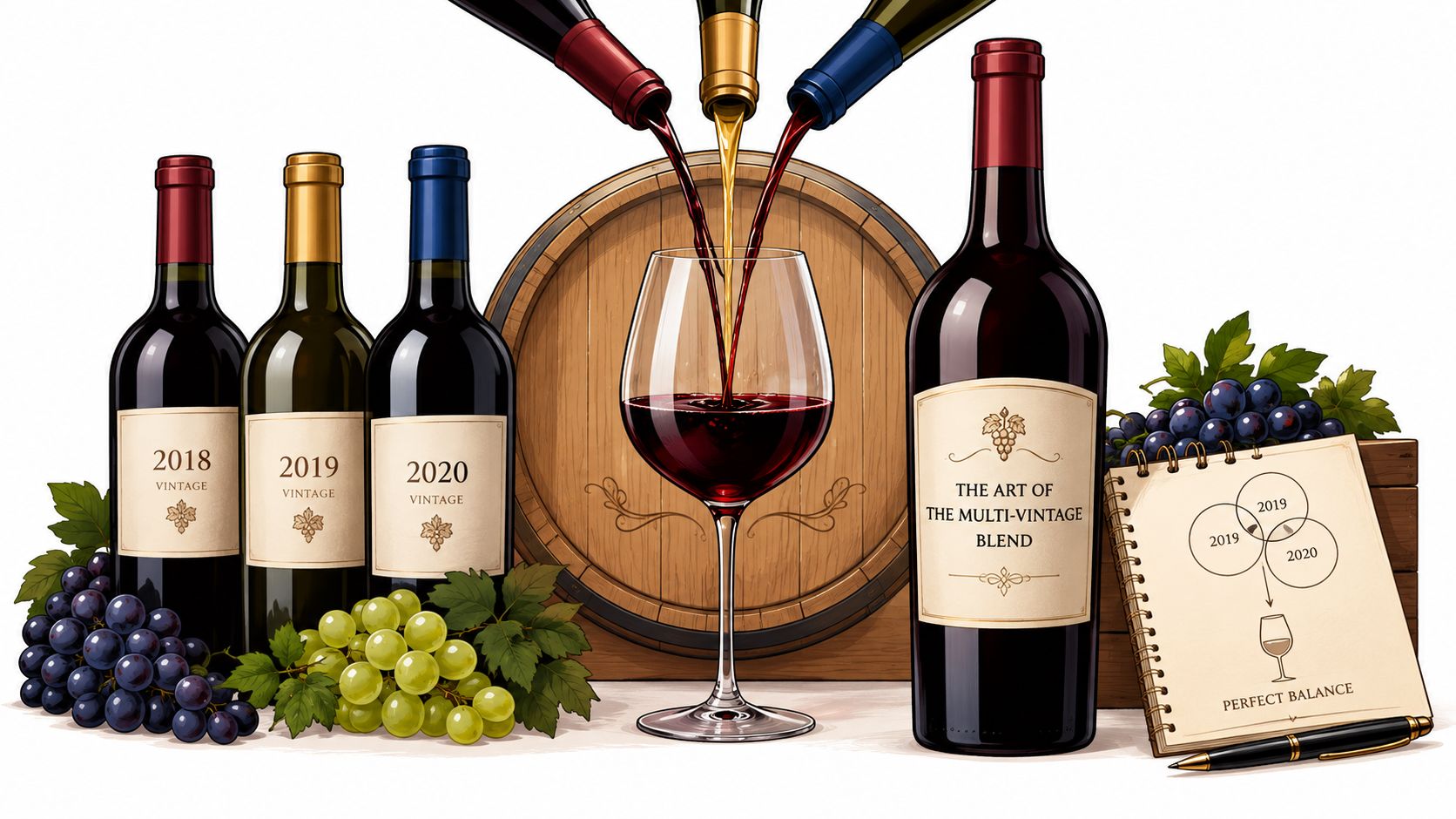
The blend works like a sound mixer. One wine may provide crisp acidity, another apple and citrus fruit, while reserve wine adds depth or a wider mid-palate. The finished NV should not be dominated by its loudest component. Its success lies in how the parts work together.
What happens after blending
In traditional-method production, the winemaker adds tirage liqueur, a mixture containing approximately 19–26 g/L of sugar and yeast. This starts a second fermentation inside the bottle. Yeast converts the sugar into ethanol and dissolved carbon dioxide, creating the bubbles.
Fermentation typically takes weeks, after which the wine begins extended ageing on its lees, the spent yeast cells remaining in the bottle. This contact can build a fuller texture and flavours associated with bread, pastry or brioche. Riddling moves the sediment towards the neck, and disgorgement removes it. The winemaker then adds dosage, a small amount of wine that sets the final sweetness and helps balance the finished bottle.
The result explains why two NV wines can both be dry yet feel quite different. One may be taut and lemony, while another feels rounder and creamier. Grape varieties, the proportion of reserve wine, lees contact and dosage each influence the final style.
How to read the bottle
Labels rarely reveal every blending decision, so producer information and your own taste remain useful guides. Blanc de Blancs generally means a white sparkling wine made from white grapes, often Chardonnay. A Pinot Noir-led blend can feel broader and more red-fruited. Sparkling Shiraz offers a distinctly Australian alternative, with a richer red-wine character.
An NV label also does not mean the wine is young or simple. A producer may allow an NV wine extended lees ageing before release, building texture and layers. Other bottles are made to show lively primary fruit and are best enjoyed for that freshness. The missing vintage tells you how the wine was blended, not its complete quality level. For shoppers, that makes NV a practical way to seek a reliable house style, rather than merely a lower-priced substitute for vintage wine.
Comparing NV and Vintage Bottlings
The choice between NV and vintage sparkling wine comes down to what you want the bottle to do. NV prioritises consistency, making it a dependable choice when you already know the style you enjoy. Vintage sparkling focuses on one harvest, so it can show the character of a particular season more directly.
A vintage-dated wine may offer a more individual drinking experience. Its personality can be shaped by the conditions of that year, the fruit selected and the producer's decision to release it as a vintage. That doesn't automatically make it better. It makes it different.
| Feature | NV Sparkling | Vintage Sparkling |
|---|---|---|
| Blend | Wines from more than one harvest | Grapes from one harvest |
| Main purpose | Reproduce a house style | Express a particular year |
| Flavour expectation | Familiar and consistent | More distinctive from release to release |
| Buying occasion | Brunches, gatherings and regular celebrations | Milestones, gifts and focused tastings |
| Cellaring question | Depends on the producer and style | Often chosen by drinkers seeking development |
| Best buying cue | Balance, freshness, texture and producer reliability | Interest in the vintage character and bottle age |
A practical rule: if you want the same style you enjoyed last time, start with NV. If you want to explore how one season shaped the wine, look for vintage.
For a weekend lunch, NV Blanc de Blancs can bring clean acidity and a refreshing lift without demanding a formal occasion. It works when several guests are drinking different foods and you need a versatile bottle. A Pinot Noir-dominant NV may suit a richer menu or a drinker who prefers more body and red-fruit character.
Vintage sparkling becomes more compelling when the year itself is part of the conversation. You might serve it at an anniversary, compare it with another release or open it slowly with food. The point isn't to pay more just for a date on the label. The point is to choose a wine whose single-season identity interests you.
Price also needs careful interpretation. An NV wine may be positioned as an accessible everyday option, but that isn't an inherent rule. Production method, grape source, lees ageing, dosage and producer reputation all influence value. A carefully made NV can be a more satisfying purchase than a poorly chosen vintage bottle.
The Value and Scale of Australian NV
Australia's sparkling-wine culture has deep roots, and the modern category has meaningful scale. The country produces approximately 7 million cases of sparkling wine annually and ranks among the world's ten largest sparkling-wine producers by volume, according to the market overview published in the Australian sparkling-wine research.
The category also reaches well beyond luxury occasions. Almost half of Australian adults, approximately 9 million consumers, regularly drink sparkling wine, according to the same source. White sparkling represents the largest share of production, while rosé, sparkling red, Prosecco and Moscato broaden the choices available in shops.
Wine Australia estimates 49 million litres of sparkling production in 2024–25, representing 4% of total Australian wine production, with 90% white sparkling. The organisation also records domestic wine sales falling 3% by volume to 443 million litres during that period. These figures make confidence and value important for shoppers, but they don't mean every buyer should choose only the lowest-priced bottle. Wine Australia's market bulletin supports a more useful conclusion: compare what the producer tells you about style and construction.
Why blending helps shoppers
A multi-vintage model gives producers a way to maintain a recognisable wine when individual harvests vary. That supports year-round retail availability, because the wine isn't restricted to one small release from a single season. For a household that has found a dependable NV style, this makes repeat buying easier.
South Australia has an important place in that story. Adelaide Hills is recognised as a notable mainland sparkling region, and its cooler elevations suit Chardonnay and Pinot Noir. McLaren Vale shoppers can also find NV styles that reflect the region's broader wine culture, including white blends and sparkling Shiraz.
A tasting club can be useful for people who want to compare house styles over time rather than buy one bottle at random. For example, the B.R. Cohn Winery tasting club provides a model for discovering wines through an organised membership format. The principle applies to NV shopping too: repeated tasting helps you identify the texture, acidity and fruit profile you enjoy.
NV's value is therefore practical, not merely financial. It gives winemakers a framework for consistency and gives drinkers a reliable starting point across celebrations, casual meals and mixed selections.
Serving and Storing for the Perfect Pour
A sound bottle can still pour poorly if it's warm, shaken or opened too aggressively. Carbon dioxide dissolves more readily in colder wine, so chilling helps keep the gas in solution and supports a finer, more controlled mousse.
The Australian Wine Research Institute's guidance on carbon dioxide in sparkling wine reports that wines containing more than 12 g/L of dissolved CO₂ are more prone to gushing. Australian sparkling wine must contain at least 5 g/L of CO₂ at 20°C, regardless of whether the carbonation comes from bottle fermentation, tank production or another permitted process. That broad technical range is one reason temperature and handling matter at home.
A calmer opening
Store the bottle away from heat and avoid moving it around immediately before serving. If it has travelled in a car or been carried through a busy room, let it settle before you remove the foil.
Chill it thoroughly, then keep it cold while you pour. Hold the bottle at an angle, point it away from people and valuable objects, and control the cork with your hand while turning the bottle slowly. You're aiming for a quiet release rather than a dramatic pop. The wine should emerge with its bubbles intact, not rush out as foam.
Cold, still and controlled is the simplest formula for protecting the mousse.
Use clean sparkling glasses with enough room to swirl gently without sloshing. Flutes can help direct the bubbles and preserve the wine's lift, while a narrower white-wine glass can give you more room to smell the fruit and lees character. For larger gatherings, reusable plastic flutes for parties offer a practical serving option, provided they're clean and suitable for sparkling wine.
Keep the pour lively
Dirty glasses can make bubbles disappear quickly because residue changes how carbon dioxide forms and escapes. Excessive warmth has a similar effect. A bottle that tastes crisp and elegant when cold can seem aggressively fizzy when served too warm, or lose its bubble structure before everyone has finished a glass.
For more detail on chilling, storage and opening technique, use this guide to storing and serving sparkling wine. The practical takeaway is straightforward: handle NV sparkling as a pressure-sensitive wine, not as an ordinary still bottle.
Food Pairings for Every NV Style
NV sparkling wine belongs at the table, not only beside oysters. Its acidity refreshes the palate, bubbles lift rich textures, and dosage influences the wine's sweetness. Salty snacks, fried foods, seafood, soft cheeses and lighter meals can all work well when the dish and wine have similar weight.
Blanc de Blancs is a natural match for fresh, citrus-led flavours. Try it with prawns, grilled fish, sushi or fried zucchini. Its acidity cuts through oil, while its texture supports delicate ingredients instead of overwhelming them. Before dinner, pour it with potato crisps or salted nuts for an easy, reliable pairing.
Pinot Noir-dominant NV blends usually bring more red-fruit flavour and a broader palate. They suit roast chicken, pork terrine, mushroom dishes and roast salmon. The wine has enough savoury presence to meet these foods, while its freshness keeps the meal from feeling heavy.
The Australian red option
Sparkling Shiraz calls for richer food. Australia's early sparkling-wine history includes Edmund Mazure's South Australian production of sparkling red from Shiraz in 1893, a detail noted earlier. Its colour, fruit and lively structure make it a good partner for barbecue, glazed ham, duck and hearty winter dishes.
Pair the weight, not the tradition. A delicate Blanc de Blancs may disappear beside a heavy stew. Sparkling Shiraz can hold its own.
Dosage changes the pairing again. A dry NV style can sharpen salty seafood and fried appetisers, while a fruitier or sweeter impression may balance spicy dishes or dessert-style courses. Taste the wine before serving the meal, then adjust the food to suit it rather than forcing a familiar rule.
For a broader explanation, use this complete guide to wine and food pairing. For a food-focused trip or celebration, the Approved Experiences Traveler planning guide can help connect regional dining with the wines you plan to open.
McLaren Vale Cellars offers NV sparkling wines, including Blanc de Blancs and sparkling Shiraz styles, with tasting guides and mixed selections for comparing different house profiles. Visit McLaren Vale Cellars to compare bottles for a celebration, meal or relaxed weekend pour.

Comments (0)
There are no comments for this article. Be the first one to leave a message!