
Let's get straight to it: Chardonnay is almost always a dry white wine. When you grab a bottle with 'Chardonnay' on the label, you can bet it won't be sweet. Winemakers make sure of this by fermenting nearly all the natural grape sugars into alcohol.
Decoding Chardonnay Sweetness
So, if that's the case, why does the "is Chardonnay dry or sweet?" question pop up all the time? It really boils down to the difference between a wine's actual sugar content and how it feels in your mouth.
A wine is technically 'dry' when there's little to no leftover sugar after fermentation. Simple enough, right? But here's where it gets interesting.
Lots of things can make a completely dry Chardonnay taste rich, fruity, and give off an impression of sweetness. Take a Chardonnay from a warm spot like McLaren Vale, for example. It might burst with ripe tropical fruit notes like pineapple and mango. Combine those flavours with a creamy texture from certain winemaking techniques, and the wine can feel lush and full-bodied, even without a speck of sugar.
A wine's dryness is determined by its residual sugar—the sugar left after fermentation. A rich, fruity flavour profile doesn't mean a wine is sweet; it simply reflects the ripeness of the grapes and the winemaker's style.
To get a real feel for this, let's quickly compare the two styles.
Chardonnay Sweetness At a Glance
This table breaks down the key differences between the classic dry Chardonnay you'll find almost everywhere and its much rarer sweet counterpart.
| Characteristic | Dry Chardonnay (Most Common) | Sweet Chardonnay (Rare) |
|---|---|---|
| Residual Sugar | Very low (0-6 g/L) | Higher (can be 30+ g/L) |
| Flavour Profile | Apple, citrus, pear, tropical fruit, oak notes | Honey, apricot, caramel, candied fruit |
| Body & Texture | Light to full-bodied, crisp or creamy | Viscous, syrupy, rich |
| When to Drink | With meals (seafood, poultry, pasta) | As a dessert wine or with cheese |
| Examples | Chablis, Burgundy, most Australian Chardonnay | Late-harvest or botrytis-affected styles |
As you can see, the vast majority of Chardonnay is crafted to be dry and food-friendly.
Getting your head around the differences between dry and sweet white wines is the key to understanding why a wine can taste intensely fruity without actually being sugary. This guide will walk you through everything you need to know, from how sweetness is measured to reading a label like a pro.
Understanding What Makes a Wine Dry or Sweet
To get to the bottom of the "is Chardonnay dry or sweet?" puzzle, we need to peek behind the curtain at how wine is actually made. The secret is all about something called residual sugar (or RS, as you'll hear it called), which is simply the natural grape sugar left over after the winemaking party is over.
Picture this: winemaking starts with sweet grape juice. Tiny yeast cells are added, and their one and only job is to feast on all that delicious sugar. As they eat, they create two crucial things: alcohol and carbon dioxide.
If the winemaker lets the yeast eat every last crumb of sugar, you end up with a wine that has almost no RS. That's what we call a dry wine. But, if the winemaker decides to stop the feast early, some sugar remains, creating a wine that's off-dry or even sweet. It's this one simple decision that shapes whether a Chardonnay lands on the dry or sweet side of the spectrum.
The Spectrum of Wine Sweetness
While the idea is pretty simple, the wine world has its own lingo for describing just how much sugar is left. You don't need to memorise the numbers, but getting a feel for the categories will help you know what to expect when you pop a cork.
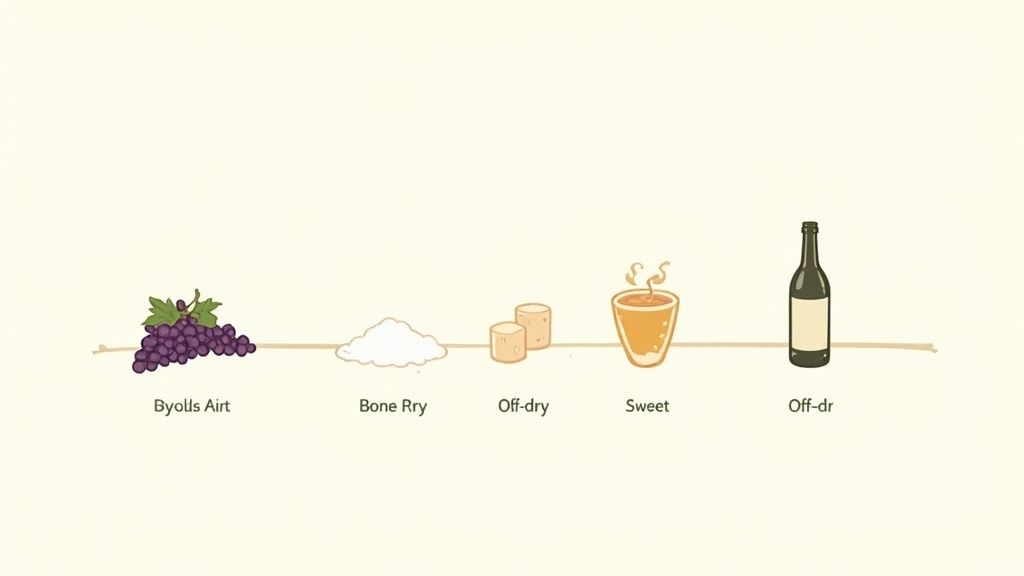
Here’s a quick guide to the terms you might see, measured in grams of sugar per litre (g/L):
- Bone Dry: Less than 1 g/L of residual sugar. You won't taste any sweetness here at all.
- Dry: This is where most Chardonnay lives, with typically under 10 g/L of sugar. Any sweetness is basically undetectable to most palates.
- Off-Dry: With 10-35 g/L of sugar, these wines have a hint of sweetness that often balances out their zesty acidity.
- Sweet: These are the dessert-style wines, packing over 35 g/L of sugar and sometimes much, much more.
It’s crucial to remember that acidity plays a massive role in how we perceive sweetness. A wine with high acidity can taste much drier than another wine with the exact same amount of sugar.
This dance between sugar and acidity is everything. A great winemaker aims for perfect harmony, making sure no single element shouts louder than the others. For Chardonnay, achieving that harmony almost always means fermenting it all the way to dryness.
How Winemakers Craft a Classic Dry Chardonnay
Crafting that iconic dry Chardonnay style isn't an accident; it’s a series of deliberate choices made by the winemaker, both in the vineyard and the winery. It's a real art, a balancing act between what nature gives you and the techniques used to shape the final wine.
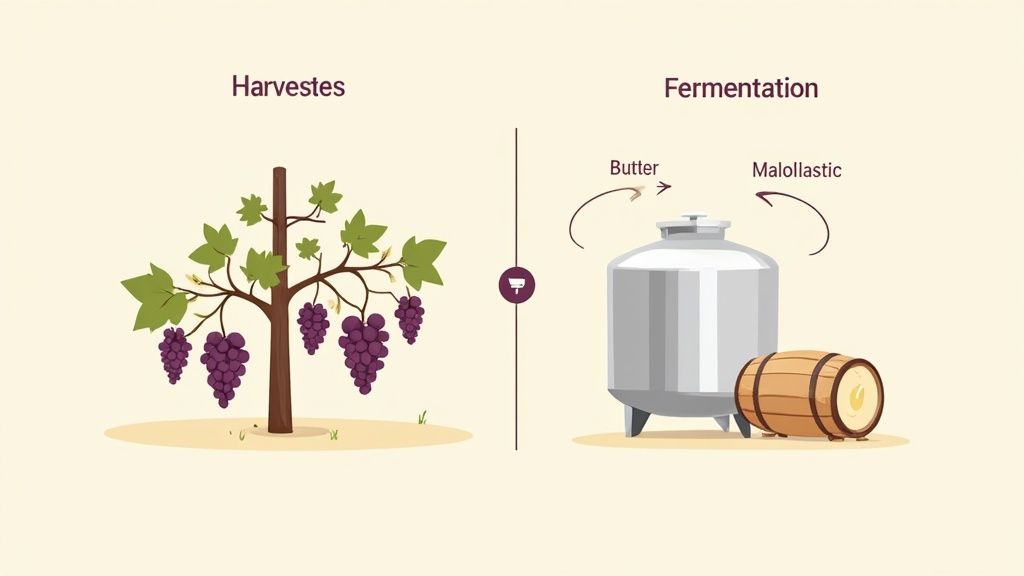
The whole journey kicks off at harvest. A winemaker has to pinpoint the exact right moment to pick the grapes, because this single decision sets the stage for the wine's ultimate balance of sugar and acidity. Pick earlier, and you get higher acidity and less sugar, resulting in a leaner, more zesty, citrus-driven wine.
This is a massive deal here in Australia, where Chardonnay is an absolute cornerstone of our wine industry. To give you some perspective, it made up roughly 23% of the country's entire grape crush back in 2019/20. With that kind of scale, it’s no surprise that the vast majority of Aussie Chardonnay is crafted to be dry. The industry standard is pretty clear: 'dry' means the wine has less than 10 g/L of residual sugar.
Fermentation and Flavour Development
Once the grapes are in, the next big decision is where to ferment the juice. This choice completely changes the wine's final personality.
- Stainless Steel Tanks: Using steel is all about preserving the pure, vibrant fruit flavours of the grape. This path leads to a crisp, clean Chardonnay—often called 'unoaked'—bursting with notes of green apple, lemon, and pear.
- Oak Barrels: On the other hand, fermenting or ageing in oak barrels brings a whole different level of complexity. It introduces those classic notes of vanilla, spice, and toast, adding richness and a much fuller body to the wine.
Another key piece of the puzzle is a process called malolactic conversion (MLC). Think of it as a secondary fermentation that cleverly converts the sharp, tart malic acid (like in green apples) into a softer, creamier lactic acid (like in milk). This is where that famous buttery texture in many Chardonnays comes from.
It's that creamy, buttery character that often plays tricks on our taste buds. We perceive those rich notes from MLC as sweetness, but they’re purely about texture and flavour. The wine itself is still technically dry.
Getting your head around this process is a game-changer for appreciating the wine's depth. To dive deeper, check out our complete guide on what malolactic fermentation is and how it works.
Why Some Dry Chardonnays Still Taste Rich and Fruity
Have you ever sipped a Chardonnay that felt lush and almost sweet, even though the label said it was dry? You’re not imagining things. While the technical answer to "is Chardonnay dry or sweet?" is almost always dry, our senses can sometimes tell us a different story.
This fascinating gap between what’s technically in the bottle and what we perceive on our palate comes down to a few key winemaking elements that play a clever trick on our brains.
The Role of Ripe Fruit and Oak
First up, ripe fruit flavours. In warmer climates like many parts of Australia, Chardonnay grapes can ripen beautifully, developing intense tropical fruit notes like pineapple, mango, and guava. These aromas are naturally sweet-smelling, and that powerful impression carries right through to the palate, even when there's no actual sugar left.
Then there’s the influence of oak. When a Chardonnay is aged in oak barrels, it soaks up all those gorgeous, decadent flavours of vanilla, caramel, and butterscotch. Our brains are hardwired to associate these tastes and smells with desserts and sweet treats, which reinforces that sensation of richness.
It's like comparing black coffee to a creamy latte. You haven't added any sugar to the latte, but the milk's texture and flavour make it feel far more indulgent and less stark than a straight-up black coffee.
Body and Texture
Finally, the wine's body—its weight and feel in your mouth—plays a huge part. Winemaking techniques like malolactic conversion give Chardonnay that fuller, creamier texture we all love. This smooth, rounded mouthfeel can be interpreted by our palate as a form of richness that mimics sweetness.
Even with all these luscious characteristics, a standard 150 mL glass of dry Australian Chardonnay contains only about 1–2 grams of sugar. This tiny amount keeps it firmly in the dry category, but it’s the clever combination of ripe fruit, oak, and texture that delivers that wonderfully rich experience. You can find out more about the sugar content in Australian Chardonnay on Clear About Wine.
How Region Shapes Your Chardonnay's Style
A Chardonnay's personality is deeply tied to where its vines sink their roots. The climate, soil, and geography—what the French call terroir—play a massive role in shaping whether the final wine is lean and zesty or rich and fruit-forward.
Understanding this connection is your secret weapon to predicting a wine's style just by looking at the label.
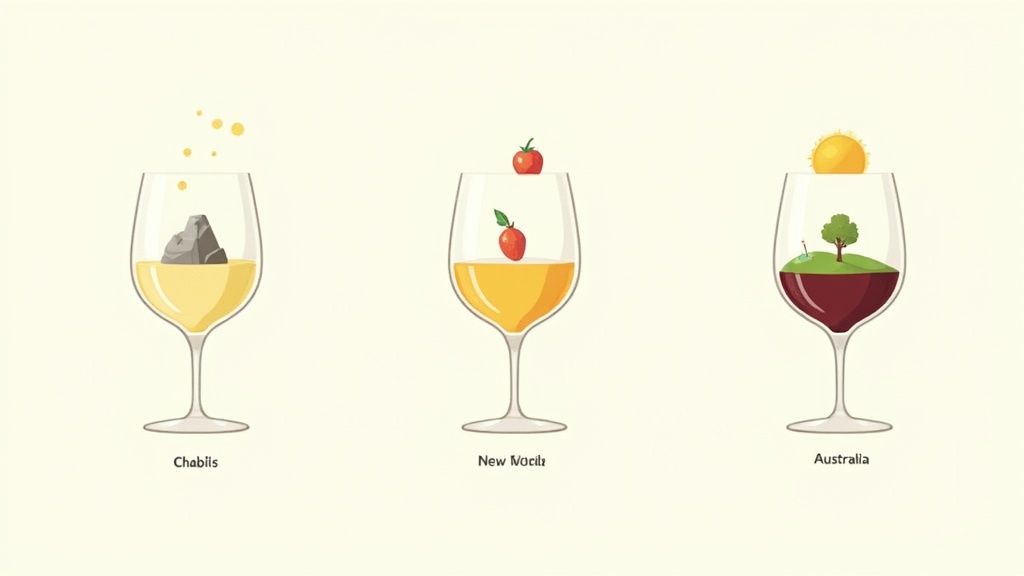
Think of it like this: grapes grown in cooler climates have to work a little harder to ripen. This struggle helps them hold onto their natural acidity, leading to wines that are crisp, elegant, and often have a distinct mineral or stony quality.
On the other hand, grapes basking in warmer, sunnier regions ripen more easily and fully. This bumps up their sugar levels at harvest, which in a dry wine, translates into higher potential alcohol and bolder, riper fruit flavours.
Old World vs New World Styles
This climate difference really comes to life when you compare Old World and New World Chardonnays.
- Cool-Climate "Old World" (e.g., Chablis, France): This is the spiritual home of lean, unoaked Chardonnay. Expect sharp acidity and flavours of green apple, lemon, and wet stone. They're almost always bone dry and incredibly refreshing.
- Warm-Climate "New World" (e.g., California, South Australia): These regions tend to produce Chardonnays that are fuller-bodied and more fruit-driven. You’ll find notes of pineapple and baked apple, often with a creamy texture from oak ageing. To dive deeper into this contrast, check out our delicious comparison between South Australian Chardonnay and its Californian counterparts.
While a warmer climate leads to riper fruit flavours that can feel richer, it doesn't automatically mean the wine is sweet. Winemakers in these regions still ferment the wine to be completely dry; the difference is in the flavour profile, not the sugar content.
Australia offers a brilliant showcase of this diversity all within one country. In a fascinating shift, Chardonnay recently overtook Shiraz as the nation's largest crush for the first time since 2013, representing about 23% of the total harvest.
Despite this, there's been a clear trend among winemakers toward cooler sites and leaner styles. They're crafting Chardonnays with higher acidity and more subtle flavours, moving away from the big, overtly ripe profiles of the past.
Your Chardonnay Questions, Answered
Even after getting the basics down, a few questions always seem to pop up when we're talking about Chardonnay. Nailing these details is often the final step to feeling totally confident when you're staring at a wall of wine, trying to pick the perfect bottle.
Let’s clear up some of the most common queries once and for all.
Is Oaked Chardonnay Sweeter Than Unoaked?
In a word, no—at least, not in terms of sugar. When a Chardonnay is described as 'oaked', it means it's been aged in oak barrels, which is where those delicious vanilla, butter, and spice notes come from. These rich, creamy flavours can trick our brains into thinking we're tasting something sweet, but the wine itself is almost always fermented completely dry.
An unoaked Chardonnay, on the other hand, is typically aged in steel tanks. This lets the grape's natural crisp fruit flavours—like green apple and zesty citrus—really shine through. So, the difference is all about the flavour and texture, not the actual sugar content. Both styles are overwhelmingly dry.
How Can I Tell If a Chardonnay Is Dry Just by Looking at the Label?
Here’s the easy part: you can pretty much assume any standard Chardonnay is dry unless the label screams otherwise with words like 'Dessert Wine' or 'Late Harvest'. But if you want to dig a little deeper, you can look for stylistic clues.
Check the alcohol percentage (ABV). A lower ABV (under 13%) often points to a cooler climate, which usually means a leaner, crisper style of wine. A higher ABV (13.5% or more) suggests riper grapes from a warmer climate, giving you a richer, more fruit-forward wine that is still definitely dry. Regional clues are also a great tell—a Chardonnay from chilly Tasmania will taste worlds apart from one grown in a sun-drenched region.
Key Takeaway: With Chardonnay, the real question isn't "is it sweet?" but rather "is it lean and crisp, or rich and fruity?" The answer is always in the region and the winemaker's style, not the sugar.
So, Are There Any Genuinely Sweet Chardonnays?
Yes, but they're the unicorns of the wine world. These are always clearly labelled as 'dessert wine' or 'late harvest' and are incredibly rare. To make them, winemakers leave the grapes on the vine long after the normal harvest, allowing the sugars to become super-concentrated. The result is a luscious, intensely sweet wine.
You'll never find one of these hiding in the regular Chardonnay section. If the bottle simply says 'Chardonnay,' you can be 100% confident you're buying a dry wine.
Ready to explore the incredible diversity of dry Chardonnay for yourself? McLaren Vale Cellars offers a hand-picked selection of premium South Australian styles, from crisp and vibrant to rich and complex. Discover your next favourite Chardonnay today!

Comments (0)
There are no comments for this article. Be the first one to leave a message!