
An unopened bottle doesn't need to sit in scorching heat to lose quality. A warmer cupboard with changing temperatures can be a worse storage choice than a consistently cool room, even when neither feels hot. If you're deciding how to store unopened wine, start by checking the conditions around the bottle, not by buying a rack.
Ideal Conditions and Why Stability Beats a Set Point
Choose the coolest stable place you can verify. For wine you'll drink soon, a suitable interior cupboard may be enough. For bottles you intend to age, controlled storage gives you much better protection against summer peaks.
Ideal storage conditions for unopened wine
| Factor | Target | Avoid |
|---|---|---|
| Temperature | Approximately 13–16°C for long-term cellaring, according to WineAway's fine-wine storage guide; AWRI's general cool-storage range is given below | WineAway identifies prolonged exposure above 25°C and brief exposure above 40°C as quality risks |
| Humidity | Around 50–70% relative humidity, a practical benchmark in the same guide, not a proven universal ideal | Severe dryness around natural corks; damp conditions that encourage mould and packaging damage |
| Light | Full darkness, preferably an enclosed cupboard or carton | Windows, sunlit shelves and downlights close to bottles |
| Bottle position | Natural cork on its side; screwcaps can stand upright | Natural-cork bottles standing upright for years |
| Vibration | Stable, undisturbed shelving | Washing machines, fridges and speakers nearby |
| Temperature swings | Minimal change between day and night | Repeated large cycles, hot cars and refrigerator cycling |
Match the conditions to the job
For general bottled-wine storage, the Australian Wine Research Institute's storage guidance recommends a cool, dry place at approximately 15–20°C; its research also found significantly different sulphur-dioxide levels after 12 months between wine stored at an average 21.5°C, with a 1.8°C standard deviation, and wine stored at 15.1°C, with only 0.3°C variation. That comparison supports choosing a cooler, steadier environment, but it doesn't isolate temperature fluctuation from average temperature. Both conditions differed.
For wine you'll drink within months, the general cool-storage range is a useful household starting point rather than a promise of preservation. For age-worthy McLaren Vale Shiraz or Cabernet Sauvignon, use the tighter long-term target and verify that your storage maintains it. Storage temperature and serving temperature aren't the same job: don't keep changing the whole collection's conditions to suit tonight's bottle.
Humidity deserves proportionate attention. A modestly dry cupboard isn't a reason to start spraying corks, and a damp basement isn't automatically a good cellar. Watch for persistent condensation, mould on cartons and softening labels rather than chasing a precise humidity reading.
Keep light out with a cupboard door or closed carton. Dark glass isn't a substitute for sensible placement, particularly beside a bright window; our guide to protecting wine from sunlight and light damage explains that risk in more detail.
Read the peaks, not just the average
Repeated warming and cooling makes wine expand and contract, stressing closures and increasing leakage risk. A comfortable-looking average can conceal an unsuitable afternoon peak.
Consider a hypothetical hall cupboard averaging 20°C but reaching 32°C each afternoon, compared with an interior room holding a steady 17°C. The steady room is the better choice for this scenario, despite neither space matching a textbook cellar setting exactly.
Practical rule: Judge a storage spot by its highest and lowest logged readings, and how long it stays warm, not just its average.
If your home can't provide steady conditions, compare a wine cabinet with off-site storage. Home Removals Sydney's resource on choosing a climate controlled unit is useful context when assessing storage options, but ask specifically about wine suitability, monitoring and actual operating conditions. A climate-controlled label alone doesn't establish that a facility suits long-term wine storage.
Whether Closure Type Decides Bottle Position
Natural cork and screwcap bottles don't need the same position. Put natural-cork bottles intended for long ageing on their sides; stand screwcaps upright when that makes your shelves safer or easier to organise.
Storage position by closure type
| Closure | Store on its side? | Why | Note |
|---|---|---|---|
| Natural cork | Yes, for long ageing | Keeps the cork in contact with wine | Inspect for leakage or seepage before shelving |
| Screwcap | No, upright is fine | The seal doesn't depend on cork moisture | Stand upright if that saves space or improves stability |
| Synthetic cork | Check the producer's guidance | Synthetic closures were adopted partly to reduce cork taint and random oxidation | Follow advice for the particular closure |
| Sparkling wine | Treat separately | Pressure and intended drinking window differ from still wine | Follow the bottle's own storage advice |
The distinction is reflected in Sokufu's wine-storage guidance: closure type, wine style and intended storage period are more useful than a blanket instruction to lay every bottle down. Don't assume that a cork-shaped closure is natural cork, either. If the packaging doesn't make it clear, check the producer's information before committing the bottle to long ageing.
Can screwcap McLaren Vale Shiraz stand upright?
Yes. Upright storage is suitable for screwcap Shiraz, provided the location itself is appropriate. Laying it down is also fine if your rack holds it securely, but there's no cork-moisture benefit to gain.
Our cork or screwcap guide explains the closure comparison in more detail. The practical mistake isn't an upright screwcap bottle; it's leaving natural-cork wine upright through extended cellaring.
Do bottles need regular rotating?
No routine rotation is needed for ordinary home storage. Leave bottles accessible and organised rather than handling them to an arbitrary schedule; specialist sparkling-wine production practices aren't instructions for your home rack.
Say you're keeping screwcap Shiraz for later drinking and natural-cork Shiraz for extended maturation. The screwcap can occupy a secure upright shelf, while the cork-sealed bottle belongs in a horizontal rack. Neither position compensates for a hot storage location, and neither tells you whether the wine itself will improve with age.
Storing Unopened Wine Without a Dedicated Cellar
For wine you'll drink within weeks or months, choose the coolest dark interior cupboard away from cooking heat. For multi-year ageing, choose temperature-controlled storage or a dedicated wine fridge rather than hoping an ordinary room will stay suitable through summer.
Use the cupboard's location, not its appearance, to assess it.
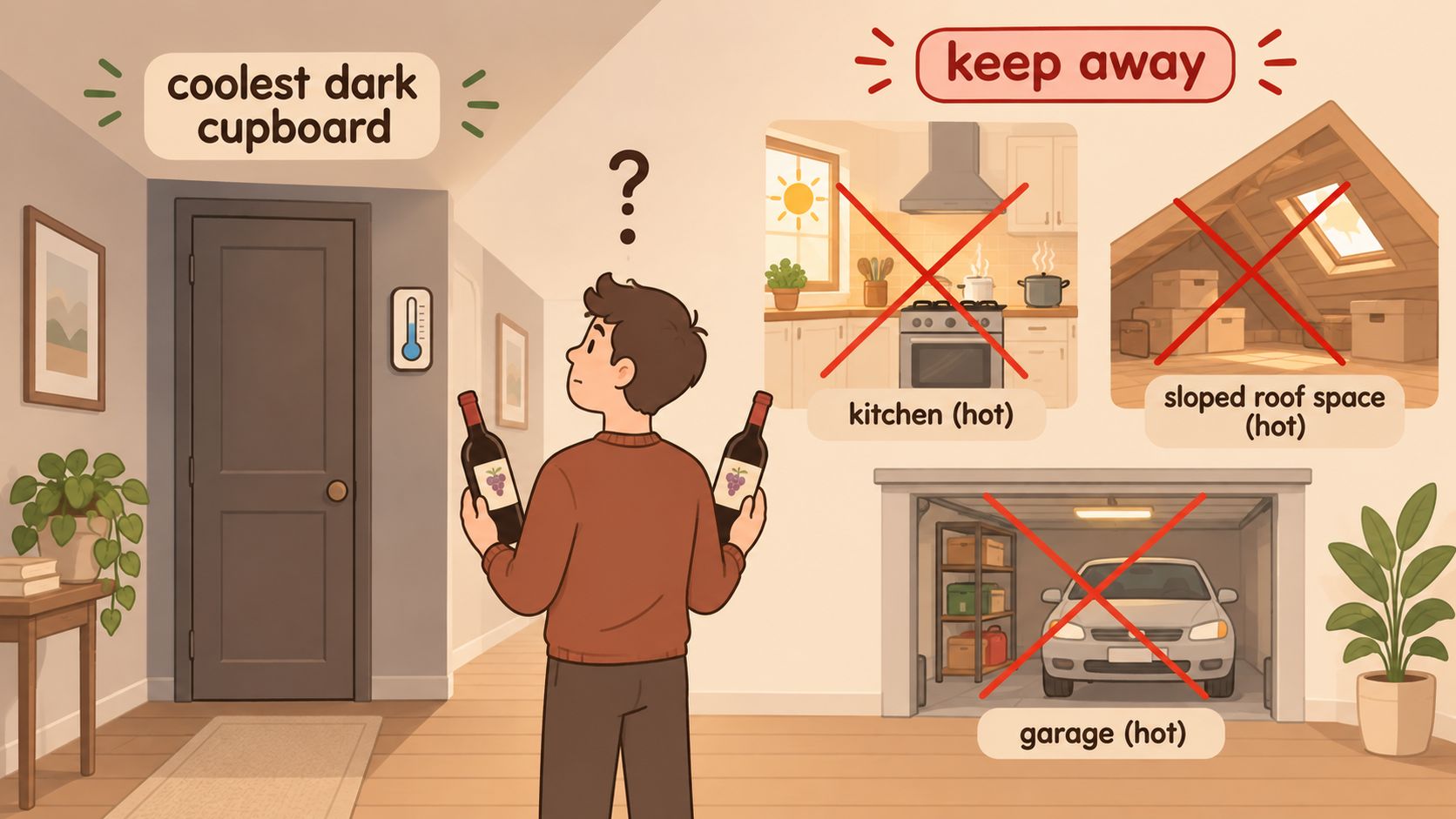
Home storage spots ranked for unopened wine
| Spot | Suitability | Watch for |
|---|---|---|
| Coolest interior cupboard away from kitchens | Best ordinary-home option for weeks to months | Heat from nearby ovens or dishwashers |
| Interior spare room on an inside wall | Good candidate where temperatures remain steady | Afternoon sun through windows |
| Under-stair cupboard or interior wardrobe | Often promising | Verify conditions with a data logger |
| Garage | Poor in summer | Heat accumulation and sharp peaks |
| Shed or roof space | Avoid | Large daily and seasonal changes |
| Kitchen or near appliances | Avoid | Heat and vibration |
Handle summer deliveries sensibly
Australian delivery conditions deserve attention before the bottles reach your rack. Wine Daddy's storage-temperature guide identifies prolonged exposure above 25°C and brief exposure above 40°C as quality risks, with land transport a particular concern for temperature fluctuations.
Bring delivered wine inside promptly and let it settle towards a stable, cool indoor temperature. Don't shuttle the case between a hot car, a refrigerator and the room. There's no universal resting period that reverses heat damage.
A hot garage doesn't automatically mean every bottle is ruined. Exposure duration, peak conditions and the bottle's condition matter, so inspect the wine and stop using the garage while you assess it.
- Keep useful packaging: Original cartons help exclude light and keep bottles organised, but they don't provide temperature control.
- Check what's underneath: Don't put cases on a fridge, hot-water system or other heat-producing appliance.
- Test before filling: Log the candidate space across several weeks, including warm weather, before committing valuable stock.
If you're moving house or renovating, temporary storage needs the same scrutiny. The TLC Moving & Storage advice provides useful context for deciding whether climate control is necessary; confirm wine-specific conditions rather than treating ordinary furniture storage as a cellar.
Set Up and Verify Your Storage Spot
A storage location isn't ready just because it feels cool when you open the door. Use a repeatable arrival check, sensible shelving and a temperature-and-humidity logger before trusting it with wines you want to keep.
Start with the bottle and closure inspection.
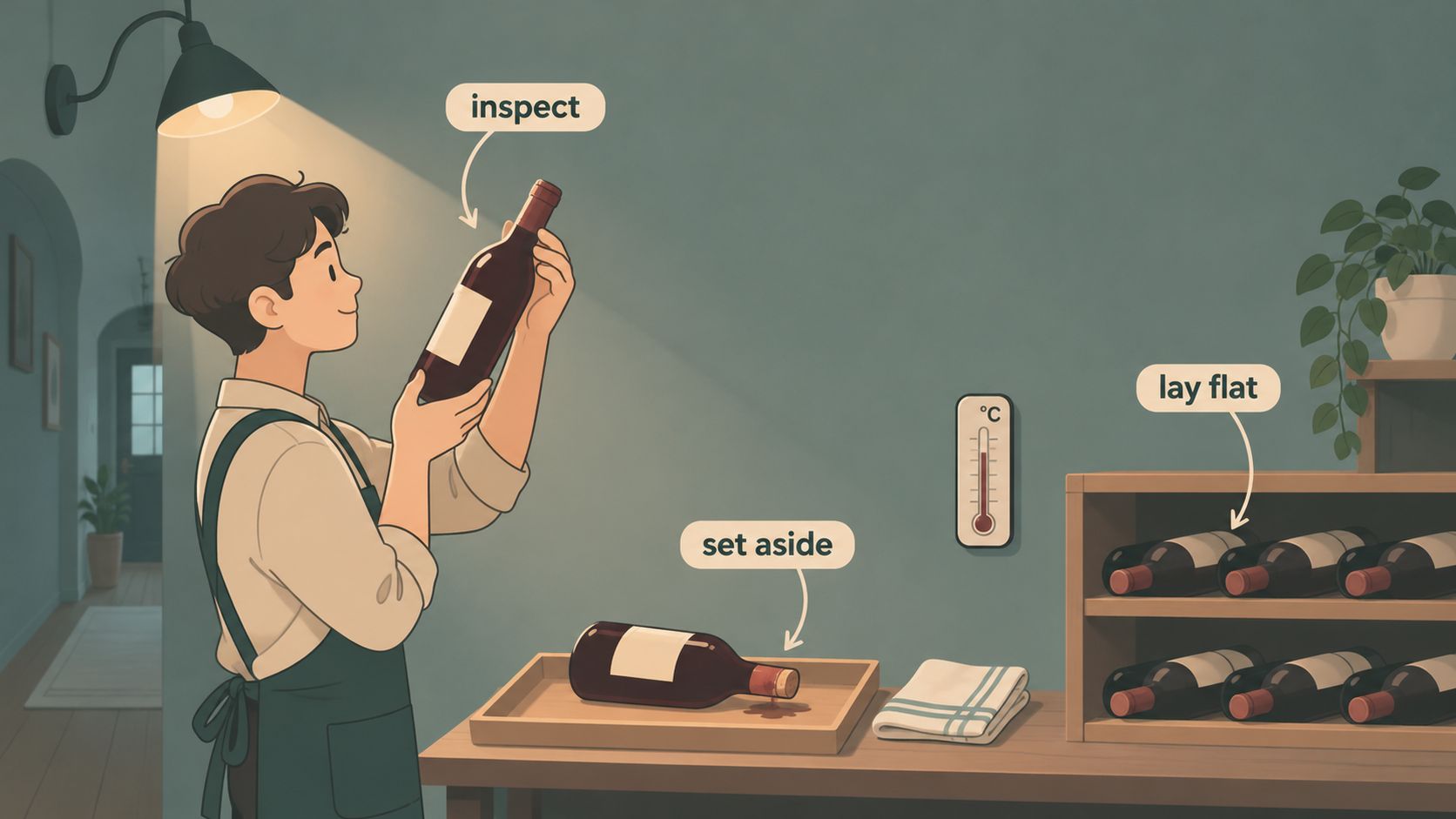
Follow a practical setup routine
The WinesExpert storage guide supports inspecting bottles, separating them from heat and odours, and logging conditions before long-term cellaring. Turn those principles into a routine you can maintain:
- Inspect every arrival. Look around the capsule, closure and neck for sticky residue, fresh seepage or damaged packaging. Set suspect bottles aside and photograph their condition before shelving them.
- Remove direct light. Move bottles into a dark cupboard or sound carton rather than leaving them on a bench while you decide where they belong. Keep labels readable so you can identify bottles without repeatedly unpacking everything.
- Match the shelf to the closure. Use a stable horizontal rack for natural cork, and secure upright positions for screwcaps where convenient. Follow the producer's advice for synthetic closures and sparkling wines, and avoid balancing bottles where retrieving one could dislodge another.
- Separate wine from household hazards. Keep it away from cleaning chemicals, paint, strong odours, boilers and vibrating appliances. A utility cupboard may be dark but still be unsuitable because of what else it contains.
- Put the logger beside the bottles. Measure temperature and relative humidity on the intended shelf, not in a cooler neighbouring room. Let it record through ordinary household use and changing weather before moving valuable stock in.
- Reduce unnecessary handling. Keep drinking stock accessible so retrieving a bottle doesn't disturb the collection. Chill the bottle you plan to serve rather than repeatedly cooling and warming the rest.
- Review the record weekly. Check the maximum, minimum and the shape of the temperature trace, not just the current display. If the cupboard warms substantially during hot weather, relocate the wine instead of waiting for visible damage.
Don't deliberately wet corks or add open water containers to a cupboard. That's an uncontrolled response to a humidity concern and can leave cartons and labels damp without solving the underlying storage problem.
For a visual companion to the setup routine, use the video below.
Make the storage match your buying
We let customers build their own mix of wines, find their favourites and buy those favourites in bulk later. That approach also lets you establish a workable storage space before filling it with a larger purchase.
Inspect deliveries before breaking seals if you have concerns. Opened bottles and bottles with broken seals are non-returnable and non-refundable, so document any apparent arrival damage first.
A tidy rack isn't proof of good storage. The logger tells you whether the location is suitable.
Before committing the collection, check:
- Recorded conditions: The space has been logged for several weeks.
- Controlled peaks: The trace doesn't show sustained warm periods or repeated sharp rises.
- Dark surroundings: Bottles remain protected when the room is in normal use.
- Correct positioning: Each closure has an appropriate, secure place.
Spotting Harmed Bottles Before You Cellar Them
Inspect the closure first, then compare the bottle with its storage history. Seepage, a cork pushed noticeably upwards or a sticky neck warrants attention before the bottle joins your long-term collection.
Damp labels and mouldy cartons tell you the surrounding conditions need attention, but they don't prove the sealed wine is faulty. Equally, an immaculate label doesn't establish that a bottle escaped prolonged warmth.
Separate symptoms from a diagnosis
A raised cork or leakage can be consistent with heat exposure or a closure problem. Neither tells you exactly how long the bottle was warm, and cooling it afterwards won't restore quality already lost.
Flat fruit, faulty flavours or an unexpectedly tired character may become apparent only after opening. Our Australian guide to identifying wine faults helps distinguish different problems instead of treating every disappointing bottle as heat-damaged.
Compare the suspect bottle with the logger trace and its delivery history. A prolonged warm period is more informative than today's cool reading, while missing records mean you should acknowledge uncertainty rather than declare the batch sound.
Decide what to do next
- Separate leaking or displaced closures. Keep suspect bottles identifiable and away from clean cartons. Photograph the condition if you need to raise a delivery concern.
- Check a representative bottle when appropriate. If the batch is yours to assess and no return enquiry is pending, open a sample and evaluate its aromas and flavours. Don't use a visibly compromised bottle as the sole test of the whole batch.
- Relocate the remaining stock. Move it to a cooler, monitored location without unnecessary cycles through different environments.
- Reassess the cellaring plan. Wine with uncertain heat exposure may be a poor candidate for further ageing, even if it's still enjoyable now.
A sample is a guide, not proof: Bottles from the same case can differ, particularly when their closures or exposure differ.
Set up a logged shelf this week, record its conditions across the coming month and inspect your existing bottles while it runs. Move the collection only when the trace supports the location, not because the shelf is ready.
At McLaren Vale Cellars, you can build your own mix of regional wines, discover your favourites and buy them in bulk later. Explore the range with your storage capacity and drinking plans in mind, so you're buying bottles you can keep well and enjoy at the right time.
Comments (0)
There are no comments for this article. Be the first one to leave a message!