
So, you want to become a sommelier? It’s an amazing path, but it’s not just about swirling fancy wines. The real journey blends serious study with the hands-on grit of hospitality. Think of it as part art, part science, and a whole lot of hard work. You'll need formal education from world-renowned institutions like the Court of Master Sommeliers, but that's only half the story. The rest is learned through rigorous tasting and long hours on the restaurant floor.
What It Really Takes to Become a Sommelier

Before you even think about exams and textbooks, let’s get real about what this job entails. Being a sommelier in Australia is so much more than recommending a great bottle of Shiraz. It’s a dynamic role that pulls together deep expertise, sharp business sense, and a genuine love for making people happy.
This career is all about constant learning. One minute you're an educator, the next you're an inventory manager, and then you're a salesperson. Your responsibilities stretch far beyond what guests see in the dining room.
A Look Beyond the Wine List
A truly great sommelier doesn't just know about wine; they understand the entire ecosystem of a restaurant’s beverage program. It’s a massive undertaking, and you’ll be building a diverse set of skills over many years.
You’ll find yourself juggling quite a few roles:
- Cellar Management: You're the guardian of the cellar. That means buying, organising, and maintaining inventory, all while keeping a close eye on profitability.
- Staff Training: You’ll be the go-to wine expert for the entire team, training servers so they can speak confidently about the list and help create a better experience for guests.
- Guest Experience: This is the heart of it all. You’ll be listening to diners, helping them navigate the wine list without feeling intimidated, and creating those magic moments with the perfect pairing.
- Financial Acumen: It's a business, after all. You need to understand margins, set pricing, and build a wine list that excites guests and hits the restaurant's financial targets.
This path is tough but incredibly rewarding. It demands serious dedication, a huge time commitment, and the humility to start from the bottom to master both the theory and the art of service.
Understanding the Australian Certification Landscape
Formal education gives you the structure and theory you need to build on. In Australia, the two big international names are the Court of Master Sommeliers (CMS) and the Wine & Spirit Education Trust (WSET). Both are hugely respected, but they come at the wine world from slightly different angles.
And make no mistake, reaching the top is a monumental challenge. Since the Court of Master Sommeliers started offering its program here in 2008, thousands have tried, but as of 2019, only six people in Australia had earned the coveted Master Sommelier title. The pass rates for the top levels are often in the single digits, reflecting years of intense study and tasting. You can read more about these demanding exams to really grasp the level of commitment required.
Choosing Your Path to Wine Certification
Passion might be the engine that drives your sommelier dream, but formal education is the framework you'll build your entire career on. Getting certified gives you a structured, internationally recognised way to prove your knowledge and skills. It’s the map you need.
Think of it like learning a language. You can pick up phrases here and there on your own, but formal study teaches you the grammar, structure, and cultural context you need to become truly fluent. In Australia, two global titans dominate the wine education scene, and they each offer a very different path to becoming a sommelier.
Court of Master Sommeliers vs WSET
The first question almost every aspiring sommelier asks is, "Should I do CMS or WSET?" Honestly, the answer depends entirely on your end goal. Both are incredibly prestigious, but they are not interchangeable.
The Court of Master Sommeliers (CMS) is laser-focused on one thing: service. The whole curriculum is built for the on-floor sommelier working in a high-end restaurant. It’s heavy on practical skills—think deductive blind tasting under pressure, flawless tableside service, and knowing the classic wine regions you’d find on a top-tier wine list inside and out.
On the other hand, the Wine & Spirit Education Trust (WSET) takes a much broader, more academic approach. Its curriculum is designed for anyone in the drinks trade—importers, retailers, marketers, writers, and educators, as well as sommeliers. WSET dives deep into viticulture, winemaking theory, and the global business of wine, with much less emphasis on the practical service side of things.
Key Takeaway: If your dream is to wear the pin and work the floor of a top restaurant, CMS is your most direct route. If you see yourself in a wider role within the wine industry, maybe in buying or education, WSET provides an incredibly solid theoretical foundation.
Comparing Major Sommelier Certifications in Australia
Let’s get into the nuts and bolts. A side-by-side look at the Court of Master Sommeliers (CMS) and Wine & Spirit Education Trust (WSET) can help you figure out which path lines up best with your ambitions and budget.
| Feature | Court of Master Sommeliers (CMS) | Wine & Spirit Education Trust (WSET) |
|---|---|---|
| Primary Focus | Practical service, blind tasting, restaurant operations | Comprehensive theory, global wine knowledge, business acumen |
| Career Path | Ideal for restaurant sommeliers, beverage directors | Suited for wine retail, distribution, marketing, education |
| Exam Style | Multi-part exams including theory, tasting, and live service | Multiple-choice questions, short-answer essays, blind tasting notes |
| Typical Cost (AU) | Introductory: ~$1,200 AUD; Certified: ~$1,500 AUD | Level 2: ~$1,000 AUD; Level 3: ~$1,800 AUD |
Remember, these costs are just for the initial levels. The price tag for advanced certifications in both programs goes up significantly. That’s before you even factor in the personal investment of buying countless bottles of wine for your study group.
Exploring Local Australian Options
While CMS and WSET are the global heavyweights, don't overlook the excellent local courses available right here. TAFE institutions across Australia offer fantastic hospitality and wine studies programs that can be a brilliant and often more affordable starting point.
Local programs often deliver big advantages:
- Hands-On Training: Many TAFE courses are linked to training restaurants, throwing you straight into practical, real-world experience.
- Australian Focus: You'll gain a deep understanding of our local wine regions, laws, and industry quirks—invaluable knowledge for working here.
- Networking Opportunities: These courses are a great way to connect with local industry pros and other aspiring sommeliers who will become your peers.
While you're zeroing in on wine credentials, it’s smart to look at how other hospitality industry certifications can round out your skill set. A certificate in hospitality management, for instance, can be the perfect partner to your deep wine knowledge.
The Power of Tasting Groups
I can't stress this enough: no matter which path you choose, you can't pass these exams alone. Reading books and memorising flashcards will only get you so far. The practical tasting exam is notoriously tough and requires disciplined, consistent practice.
Joining or forming a tasting group is non-negotiable. It’s where the theory from the textbook slams into the reality in the glass. A good group provides structure, accountability, and a range of different palates to help you calibrate your own. You’ll pool your money to afford a wider array of classic wines and drill each other in blind tasting scenarios that mimic the pressure of the real exam.
This is how you build the sensory memory you need to identify grape varieties, regions, and quality levels with speed and accuracy. If you’re just getting started and want to build a solid foundation, check out the beginner's roadmap to wine to gain some confidence before diving in. Your journey to becoming a sommelier is a marathon, not a sprint, and your study group will be your most important training partner.
Developing a World-Class Palate
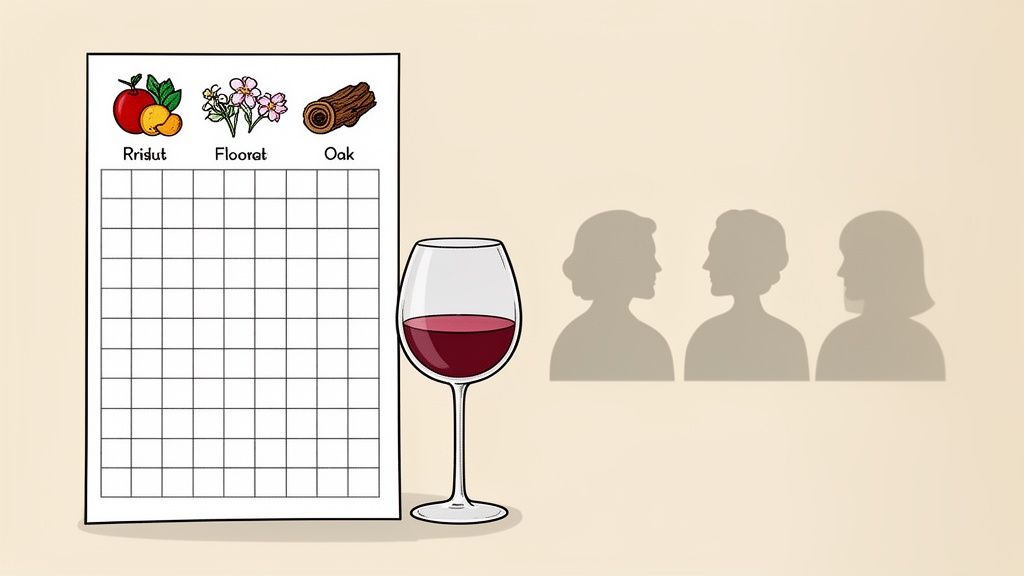
While certifications get you in the door, it’s your palate that will truly define your career as a sommelier. The ability to taste, analyse, and talk about what’s in the glass is the absolute core skill that separates an enthusiast from a professional. This isn't just about enjoying wine; it’s about deconstructing it with discipline.
Think of building a world-class palate like building muscle. It takes consistent, structured training to build sensory memory. You're training your brain to recognise the patterns in aroma, structure, and flavour that point to a specific grape, region, and winemaking style.
The Art of Deductive Tasting
The first real step is moving beyond "I like this" to "This is why it tastes this way." That’s the entire point of deductive tasting—using a systematic grid to break down a wine and come to a logical conclusion about what it is and where it's from.
This disciplined approach forces you to evaluate every single component, from the intensity of its colour right down to the length of its finish. You’ll learn to pick out individual aromas and flavours, assess things like acid and tannin, and connect all those clues to a final verdict.
At its core, deductive tasting is a problem-solving exercise. You are a detective gathering evidence from the glass. Each observation—the hue of the wine, the presence of black pepper, the level of alcohol—is a clue leading you closer to the truth.
To get started, find a deductive tasting grid online—the Court of Master Sommeliers provides a classic template. Use it for every single wine you taste. It will feel slow and clinical at first, but with repetition, the process becomes second nature, letting you analyse wines with impressive speed and precision.
Mastering the Blind Tasting Group
Here's the thing: you can't build a formidable palate on your own. Reading that Northern Rhône Syrah has notes of olive and bacon is one thing; actually identifying it in a blind lineup is a whole different ball game. This is where a dedicated tasting group becomes your most valuable asset.
And organising an effective group is about more than just chipping in for a few bottles. It needs structure and a shared commitment to serious study.
Here’s how to set one up for success:
- Keep it Small: Aim for a group of 4-6 people. This is big enough to split the cost of several wines but small enough to make sure everyone gets a voice and ample tasting time.
- Set Clear Goals: Are you all studying for the CMS Certified exam? Or just exploring Italian reds? Define the purpose of each session beforehand so everyone is on the same page.
- Taste Blind, Always: This is the cornerstone of effective practice. Tasting blind strips away all your preconceived ideas and forces you to rely only on what your senses are telling you. Have one person "bag" the wines so no one else knows their identity until the big reveal.
- Enforce the Grid: Everyone in the group should use the same tasting grid and verbally walk through their analysis. This builds a shared vocabulary and helps you calibrate your palate against others'.
Sourcing Wine Smartly
Building a deep sensory library means tasting a huge variety of wines, and that can get expensive fast. The key is to be strategic with your buying. You don't need to be splashing out on Grand Cru Burgundy every week.
Instead, focus on benchmark examples. These are wines that perfectly represent the "typicity" of their grape and region. Think of a Sancerre for Sauvignon Blanc, or a Barossa Shiraz for Australian Shiraz. Start with these classics to build your foundation.
Another brilliant strategy, especially for getting your head around regional character, is using curated tasting packs. For those wanting to truly understand Australian wine, exploring sample packs from iconic regions like McLaren Vale offers an incredibly efficient way to compare different expressions of Shiraz or Grenache side-by-side. Our guide on how to train your palate has even more tips on this.
By investing in these curated selections, you get exposure to a region's diversity without having to research and buy a dozen individual bottles yourself. It's a focused approach that accelerates your learning and is far more cost-effective. It’s all about tasting smarter, not just tasting more.
Gaining Essential Hands-on Experience
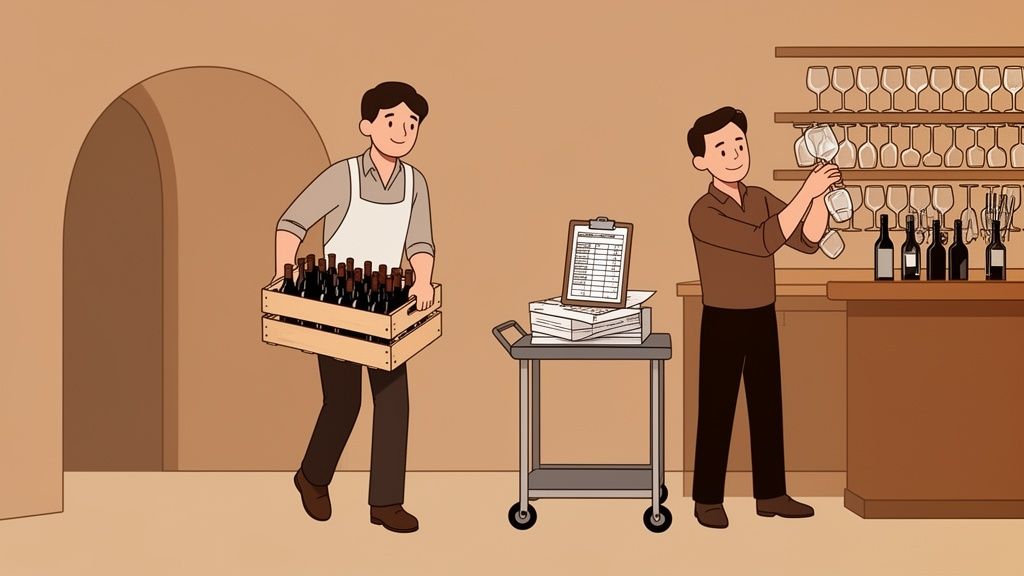
Theory and tasting practice are your foundation, but no certificate can replace the lessons you learn on the floor. Hands-on experience is where knowledge meets reality. It’s the crucible where you learn to navigate a chaotic service, handle a curveball from a guest, and build the muscle memory a career in wine demands.
This is where you stop just studying and start doing. The real shift from enthusiast to professional happens when you're facing real-world challenges, not just memorising flashcards. It’s about picking up the practical, often unglamorous, skills that truly define a great sommelier.
Finding Your Foot in the Door
Trying to break into the world of fine dining can feel intimidating, especially when you’re just starting out. The secret? Be humble, be hungry, and be willing to start from the bottom. Top restaurants value attitude and a genuine fire to learn just as much as a stacked résumé.
Don't be afraid to take a role that might feel like a step below your ultimate goal. These positions are your backstage pass to understanding the mechanics of a truly successful hospitality operation.
Consider these powerful entry points:
- Barback or Cellar Hand: These jobs put you right in the thick of the wine program. You’ll be stocking, organising, and learning the inventory inside out—skills that are completely non-negotiable for a sommelier.
- Fine Wine Retail: Working in a quality wine shop is basically a paid education. You'll taste an incredible variety of wines, see how supplier relationships work, and get daily practice talking to customers about what they like.
- Restaurant Support Staff: Roles like food runner or busser immerse you in the rhythm and culture of a high-end dining room. You'll see the flow of service, hear how senior staff talk to guests, and prove you have the work ethic to hang.
When you approach that top restaurant or wine bar, let your passion show. Mention the certification you're studying for, talk about your tasting group, and make it crystal clear you want to learn from their team. That proactive attitude is exactly what managers are looking for.
Mastering On-the-Job Competencies
Once you're in, every single shift is a classroom. Your mission is to soak it all up and master the practical skills that separate the pros from the amateurs. It’s not just about pouring wine; it’s about managing a complex, living part of the business.
Beyond the wine list itself, you need to develop a sharp sense of how the cellar actually operates. This is what turns you from a wine expert into an indispensable part of the restaurant's team.
Focus on developing these key skills:
- Inventory Control: Get to know the system for receiving, tracking, and doing stocktakes. A well-managed cellar is a profitable one, and accuracy is everything. Pay attention to bin numbers, vintage changes, and stock levels.
- Supplier Relations: Watch how the head sommelier or beverage manager interacts with sales reps. Understanding how to build those relationships, negotiate pricing, and find out about new allocations is a crucial business skill.
- Tableside Service Finesse: This is your stage. Perfecting service involves much more than just opening a bottle without spilling. It’s about moving with grace and confidence, handling a decanter smoothly, presenting the bottle correctly, and keeping your cool when things get hectic.
Pro Tip: Ask to help with the end-of-month inventory. It can be a tedious job that others avoid, but it’s the single best way to familiarise yourself with the entire cellar, understand what’s selling, and see the financial side of the wine program up close.
Turning Every Shift into a Learning Opportunity
Your growth will skyrocket when you actively seek out knowledge. Don’t just wait to be taught; be curious. The people you work with are your most valuable resource.
Find a senior sommelier or manager you admire. Watch how they handle tricky guests, how they describe a wine, and how they organise their section. A good mentor can give you guidance that you’ll never find in a textbook.
Just be respectful of their time. Instead of asking vague questions, be specific. For example, "I noticed you suggested that Grüner Veltliner with the scallop dish. Could you walk me through why that pairing works so well?"
It shows you're paying attention and thinking critically. Every interaction is a chance to deepen your understanding. Being the person who is always asking smart questions, offering to help, and staying late to polish glasses is how you get noticed. It’s how you earn more responsibility. Your journey is built one shift at a time.
Building Your Sommelier Career and Landing the Job
Alright, you've put in the hours, your palate is sharp, and you've got the knowledge to back it up. Now it's time to turn all that hard work into a career. This is where you shift from student to professional, building a brand that opens doors and convinces a hiring manager you’re the right person for their team.
It’s about crafting a narrative. Your résumé shouldn't just be a list of qualifications; it should tell the story of your passion and your deliberate journey towards becoming a sommelier.
Crafting a Résumé That Stands Out
A sommelier's CV needs to be a potent mix of formal qualifications and real-world experience. It must instantly show you understand wine theory, have hands-on service skills, and grasp the business side of a beverage program. Generic résumés just won't cut it.
To make your application pop, get specific with your achievements:
- Quantify Your Impact: Did you help reduce cellar variance by 5%? Mention it. Did you help boost sales of a featured wine by 10%? Put it in. Numbers are hard evidence of your value.
- Showcase Tasting Experience: Add a section detailing your involvement in tasting groups, competitions, or deep dives into specific regions. This proves you’re proactive and passionate beyond the job description.
- Detail Your Service Skills: Don't just say you have "service skills." List specifics like decanting aged wines, handling large-format bottles, and using cellar management software. This shows you're ready to hit the floor running.
The path to the top is paved with persistence. To give you some perspective, by 2017 in Australia, 982 candidates had attempted the Court of Master Sommeliers exams. Only 273 achieved Certified status, 28 Advanced, and a mere trio reached the Master level. The journey demands serious dedication, as those numbers show. Check out more on the rigorous sommelier certification journey to truly grasp the commitment involved.
The Power of Networking and Industry Connections
The Australian hospitality scene is a tight-knit community. Who you know is often just as important as what you know. Landing the best gigs often comes down to your reputation and the connections you've made.
Forget just collecting business cards. Networking is about building genuine relationships. Get yourself to industry tastings, trade shows, and supplier events. Don't just sip the wine—introduce yourself to the winemakers, distributors, and other sommeliers. Ask good questions, and more importantly, listen.
These people become your champions, your mentors, and your source for jobs that never even get advertised.
Nailing the Sommelier Job Interview
The sommelier interview is a different beast entirely. It’s a multi-stage test of your knowledge, practical skills, and personality, all under pressure. You’ll almost always face a practical component alongside the usual chat.
Here’s what you can generally expect:
- The Theoretical Test: You might get quizzed on classic regions, grape varieties, vintages, or even the principles of beverage cost control.
- The Blind Tasting: They'll pour you a glass or two and ask you to break it down. They’re looking at your process and how you communicate just as much as your final guess.
- The Service Practical: This is a role-playing scenario. You might be asked to recommend a wine for a tricky food pairing, open a bottle of sparkling wine tableside, or handle a decanting request. They’re watching for your grace, confidence, and technique.
Remember, your ability to connect with a guest is everything. If you need a refresher on guiding diners, our piece on how to navigate restaurant wine lists has some handy tips.
At the end of the day, they're hiring a person, not just a palate. Let your enthusiasm, humility, and unwavering commitment to hospitality shine through.
Got Questions About a Sommelier Career?
Thinking about diving into the world of wine? You probably have a lot of questions. From what the day-to-day grind really looks like to the all-important salary question, getting straight answers is key to figuring out if this path is right for you.
Let's tackle some of the most common queries we hear from people just starting their journey. This isn't just a job; it's a lifestyle that demands both passion and serious discipline.
What Does a Sommelier Actually Do All Day?
The image of a somm gracefully gliding through a dining room to recommend the perfect bottle? That's definitely part of it, but it’s just the tip of the iceberg. A huge chunk of the work is behind the scenes and, frankly, not very glamorous.
A typical day is a whirlwind of physical labour, admin, and, finally, guest service.
You might be:
- Hauling heavy cases of wine from a delivery truck down to the cellar.
- Updating the wine list and inventory in the restaurant’s POS system.
- Polishing what feels like a mountain of glassware until it’s spotless.
- Running a quick training session for the floor staff on a new wine you've just added.
- Tasting with suppliers to decide which wines will make the cut for your list.
The best sommeliers are masters of juggling. They have to balance the back-breaking cellar work with the mental focus needed for study and the charm required on the floor—all during long, demanding shifts.
How Much Can I Realistically Expect to Earn?
This is the big one, and the honest answer is: it varies wildly. Your salary depends on your experience, certifications, where you live, and the type of venue you work in. In Australia, someone just starting out as a junior sommelier might earn around $55,000 to $65,000 a year.
As you build your skills and get more qualifications under your belt, that number starts to climb. A Head Sommelier at a top restaurant in Sydney or Melbourne could be looking at $80,000 to $100,000+, not including tips or bonuses. The top earners are usually the Master Sommeliers or the Beverage Directors who manage the wine programs for entire restaurant groups.
How Long Does It Take to Become a Sommelier?
There’s no set timeline; everyone’s journey is different. You could probably get the knowledge for an introductory certification in a few months if you really hit the books. But to reach the level of a Certified Sommelier with the Court of Master Sommeliers, you're realistically looking at two to four years of intense study combined with real-world restaurant experience.
Going for the Advanced or Master Sommelier diplomas? That’s a whole different ball game. It’s a monumental commitment that can easily take a decade or more of your life. This career is a marathon, not a sprint. It’s all about continuous learning in a world of wine that never stops changing.
Here at McLaren Vale Cellars, we know that every great wine journey starts with education. Whether you're studying for your next big exam or just want to get to know one of Australia’s most iconic wine regions, our tasting packs are the perfect way to train your palate. Start your tasting adventure with us today!


Comments (0)
There are no comments for this article. Be the first one to leave a message!