
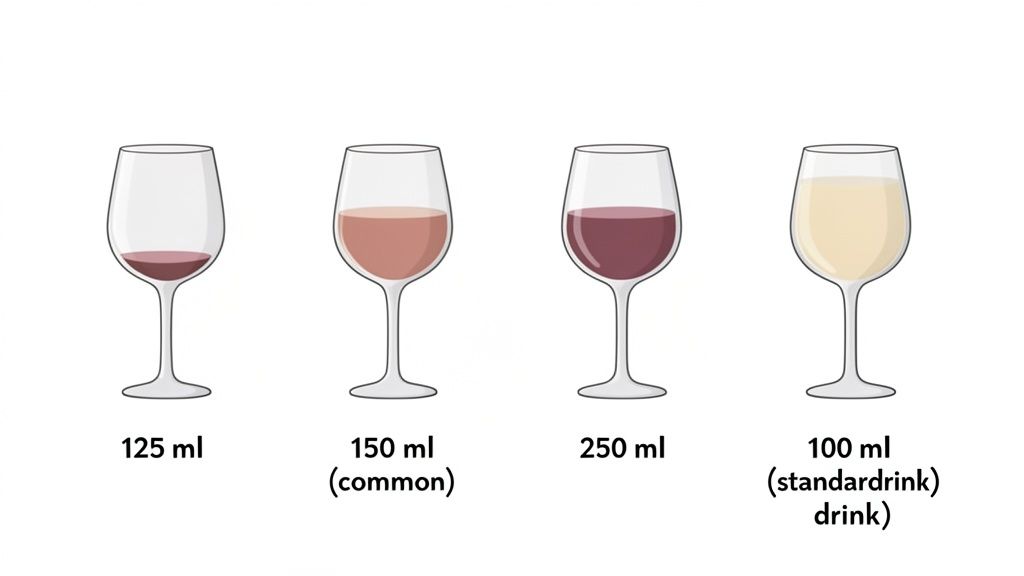
Ever wondered exactly how much wine is in that glass the waiter just brought over? When you ask, "how many ml is a glass of wine?", there isn't one single answer. That said, the closest thing to a standard pour in most Australian pubs and restaurants is 150 ml.
This has become the go-to size for a glass of wine when you're out, though you'll often see other options on the menu, like a smaller 125 ml serve or a more generous 250 ml glass.
Your Quick Guide to Australian Wine Pours
Getting your head around wine volume is much easier when you break it down by where you are and what you're doing. A 150 ml restaurant glass is one thing, but it’s a world away from the official Australian health guideline for a 'standard drink', which is just 100 ml of wine (assuming an average alcohol strength).
Knowing the difference is the key to enjoying wine mindfully and keeping track of your intake.
All these pours, of course, come from the classic 750 ml bottle. It's the global standard for good reason, with a surprisingly interesting backstory. If you're curious, you can dive into the history behind the 750ml wine bottle to learn more. This universal size is what dictates how many glasses you'll get, whether you're pouring at home or ordering at a bar.
Common Australian Wine Serving Sizes at a Glance
To make it even clearer, here’s a quick summary of the different wine pour sizes you’ll likely run into across Australia.
| Pour Type | Volume (mL) | Common Setting |
|---|---|---|
| Standard Drink | 100 mL | Australian Government health guideline |
| Small Pour | 125 mL | Fine dining, wine tasting flights |
| Restaurant Pour | 150 mL | Most pubs, bars, and restaurants |
| Large Pour | 250 mL | Offered as a large option in some pubs |
This little table gives you a great snapshot of what to expect. Once you can spot these different volumes, you're in a much better position to understand what you’re being served. It puts you in the driver's seat of your own tasting experience and is the first real step to becoming a more savvy wine lover.
The Standard Drink Versus the Restaurant Pour
When you order a glass of wine at a bar or restaurant, what arrives in your glass is almost certainly not a single ‘standard drink’. This is one of the most important things for any wine lover to get their head around, because it directly affects how you track your intake.
Think of an official Australian standard drink as a unit of measurement, almost like a nutritional serving size on a food label. It’s purely a health and safety guideline, not a serving suggestion. The Australian Department of Health and Aged Care defines one standard drink as containing 10 grams of pure alcohol, which for a typical table wine, works out to be just 100 ml.
Why Restaurants Pour More
So, what's with the difference? Well, the most common pour you'll find in Australian pubs, bars, and restaurants is 150 ml, a full 50% larger than the official standard. It’s become the unofficial industry benchmark, offering a better experience for the customer while still being practical to serve. You can find out more about how these serving sizes became the norm at boozebarrels.com.au.
This bigger pour isn’t just about being generous; it’s also about flavour and aroma. A 150 ml serve in a decent-sized glass gives the wine room to breathe. That little bit of extra space is crucial for swirling, which releases all the complex aromatic compounds that make a rich McLaren Vale Shiraz so incredible.
The key takeaway is simple: ordering one glass of wine usually means you are consuming at least 1.5 standard drinks. Being aware of this empowers you to enjoy your wine mindfully.
Understanding this isn't about drinking less, it's about drinking smarter. It helps you accurately gauge your intake and make informed choices. Of course, the wine’s alcohol content also plays a huge role. A higher-alcohol wine means even more standard drinks are packed into that same 150 ml pour. You can learn more about how to interpret the alcohol content of wine in our detailed guide. This knowledge puts you in control, letting you fully savour every sip.
Navigating Pours from Pubs to Fine Dining
Ordering 'a glass of wine' isn't a one-size-fits-all request. The amount you get in your glass can change quite a bit depending on where you are, shifting from the familiar feel of a local pub to the refined atmosphere of an upscale restaurant. Getting your head around this variety is the key to understanding what you're actually drinking.
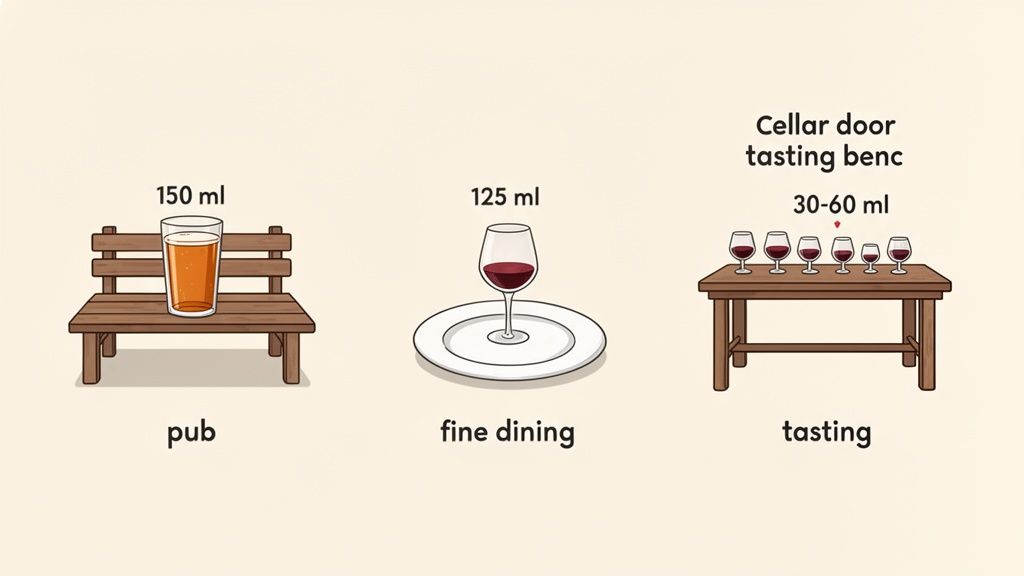
Pop down to your local, and you’ll likely be handed a straightforward 150 ml glass. This has become the unofficial industry standard across Australia. It’s a generous pour that feels substantial and is easy for pubs and bars to manage.
But the moment you step into a fine dining environment, the rules change.
Different Venues Different Volumes
In a more formal setting, especially one with a curated wine pairing menu, a smaller 125 ml pour is the norm. It’s a deliberate choice. This smaller serve allows the sommelier to carefully balance the wine with each course without overwhelming your palate or you.
On the other end of the spectrum, some venues offer a large 250 ml pour, which is a hefty third of an entire bottle. Knowing the difference between these sizes is essential for mindful drinking, a topic we explore in our guide on how many glasses are in a wine bottle.
A cellar door experience, like the ones we love in McLaren Vale, introduces another measurement entirely: the tasting pour. These are typically just 30-60 ml, designed purely for you to sample the wine's character without committing to a full glass.
Ultimately, knowing what to expect puts you in control. Whether you're enjoying a casual drink with mates or diving into a sophisticated tasting flight, understanding the pour helps you manage your enjoyment and consumption with complete confidence.
How to Pour the Perfect Glass at Home
Let's bring the conversation home. It's where we relax the rules, and it’s all too easy to be a bit more generous with our pours. While a restaurant is meticulous about hitting that 150 ml mark, our measures at home can be a little more... free-flowing.
Interestingly, research into Aussie habits found that our home pours often land somewhere in the middle. The average self-poured glass was 129.4 ml for white wine and 131.7 ml for red wine. That shows we naturally pour about 30% more than the official 100 ml standard drink. It’s a fascinating insight, and you can dive deeper into these real world pouring patterns in the full research study.
Mastering the At-Home Pour
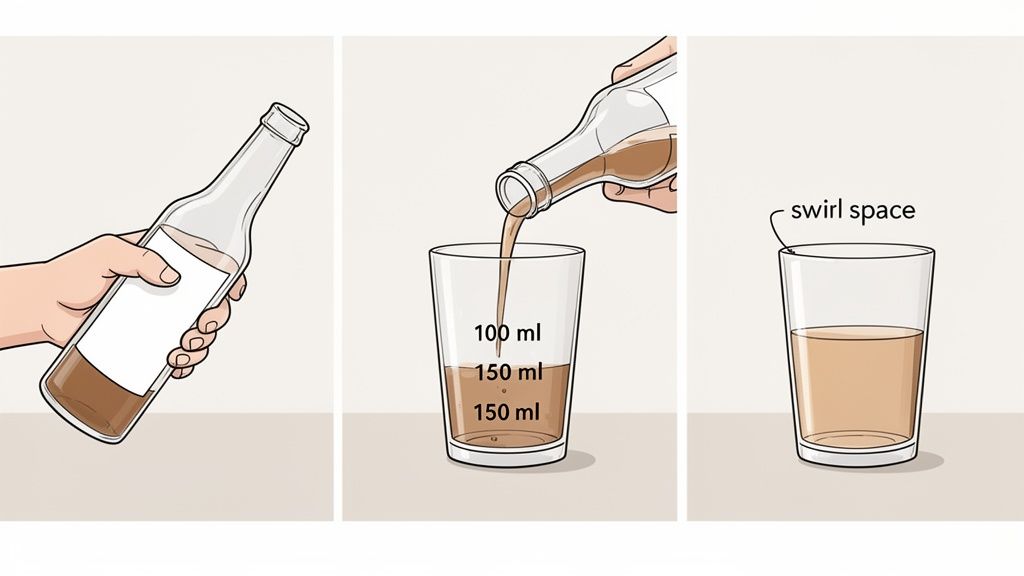
You don't need a measuring cup to get it right. The secret is already in your hand: the wine glass itself.
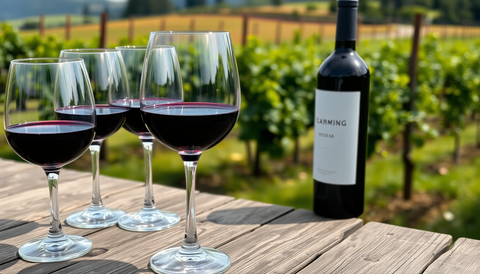
For most standard red or white wine glasses, the widest part of the bowl is your target. Fill to this point, and you'll be pretty close to a 150 ml serve every time.
This technique does more than just measure your pour, it fundamentally improves how you experience the wine. That empty space you leave at the top, known as the 'ullage', is essential for swirling.
And swirling isn't just for show; it’s all about aeration. As you gently move the liquid, you expose more of its surface to oxygen, which helps release all those delicate, complex aromas. This simple action allows the full bouquet of the wine to collect in the bowl, delivering a much richer flavour and scent when you take that first sip.
Adjusting for Different Wine Styles
Now, this "pour to the widest point" rule works beautifully for most still wines, but some styles demand a different approach. Heavier, high-alcohol wines, for instance, call for smaller serves.
- Fortified Wines: Think Port or Sherry. These are much higher in alcohol, often around 17-20% ABV. A standard serve is consequently much smaller, typically just 60 ml.
- Dessert Wines: Sweet and luscious dessert wines are also served in smaller quantities. Their richness and intensity mean a little goes a long way.
By pouring with a bit of purpose, you not only keep an eye on your consumption but also unlock the full potential of every bottle. It's about ensuring each glass is as delicious as the winemaker intended.
Calculating Standard Drinks in Your Favourite Wine
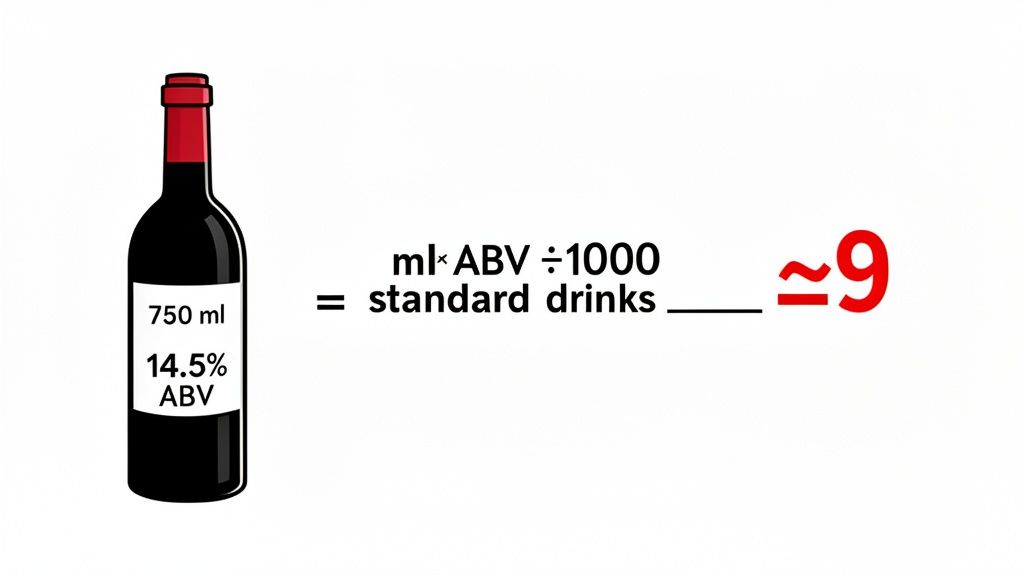
Now that we’ve got a handle on pour sizes, let’s connect the dots between millilitres, alcohol percentage, and the all-important standard drink. It’s a classic mistake to think one glass automatically equals one standard drink, but the reality is a little more complex. The key is remembering that not all wines are created equal.
The alcohol by volume (ABV) on the label is your best guide. A light-bodied Sauvignon Blanc at 11.5% ABV has a lot less alcohol than a bold McLaren Vale Shiraz clocking in at 14.5% ABV. This means that in the same 150 ml restaurant pour, that Shiraz is delivering a much bigger punch.
Making the Calculation Simple
You don’t need to be a mathematician to figure this out. Thankfully, most wine bottles in Australia state the number of standard drinks right on the label, taking all the guesswork out of it for you.
For instance, a standard 750 ml bottle of wine at 13.5% ABV contains roughly 8 standard drinks. But a more robust bottle at 14.5% ABV can easily have closer to 9 standard drinks. Knowing this is empowering, as it lets you track what you’re drinking much more accurately.
Understanding the relationship between volume (mL) and ABV is crucial. It transforms you from a passive consumer into a mindful enthusiast who can make informed choices about every glass poured.
This is especially handy when you’re out and about. According to the Alcohol and Drug Foundation, a 100 ml glass of 13% red wine is one standard drink. But an average restaurant serve of 150 ml red wine at 13.5% alcohol is actually 1.6 standard drinks. You can discover more insights about these official guidelines and how they apply to different drinks.
It just goes to show how quickly standard drinks can add up, even with a single glass. By simply checking the label, you get a crystal clear picture of your intake, helping you enjoy the wines you love responsibly.
Answering Your Wine Pour Questions
We've covered a lot of ground, from what makes a standard drink to getting that perfect pour at home. But a few practical questions always seem to pop up. Let's tackle them head-on to clear up any confusion and get you pouring like a pro.
This is where we get into the real-world stuff that every Aussie wine lover wants to know.
How Many 150 ml Glasses Are in a Standard 750 ml Bottle?
This is the classic wine maths question, and it's an essential one. A standard 750 ml bottle of wine will give you exactly five 150 ml glasses.
It’s the go-to number for restaurants and what you should aim for when pouring generous serves at home. Remembering this simple fact makes planning for a dinner party or any get-together a breeze, so you always know if you’ve got enough to go around.
Does the Shape of the Wine Glass Change How Much I Should Pour?
Absolutely. The shape and size of your glass have a huge impact on how a pour looks and, more importantly, how the wine actually tastes and smells.
A 150 ml pour can look almost lost in a big, wide bowled glass designed for a bold Shiraz, but it might look like you've overfilled a slender, narrow glass for a crisp Riesling. That visual trickery is why pouring perfectly by eye takes a bit of practice.
The golden rule is to pour to the widest part of the bowl, never anywhere near the rim. This simple trick gives the wine room to breathe, allowing all those beautiful aromas to gather. That space is crucial for the tasting experience.
Is a Standard Drink of Beer the Same as a Standard Drink of Wine?
This is a common point of confusion, and the answer is no. While any standard drink contains the same amount of pure alcohol (10 grams in Australia), the volume of liquid is completely different for each beverage type.
Here’s how a single standard drink measures up in Australia:
- 100 ml of wine (at 13% ABV)
- 285 ml (a pot or middy) of full-strength beer
- 425 ml (a schooner) of light beer
This is exactly why just "counting your drinks" can be so misleading. To track your intake responsibly, you need to know the specific standard drink measurement for whatever you’ve got in your glass.


Comments (0)
There are no comments for this article. Be the first one to leave a message!