
Ever wondered exactly how much wine is in your glass when you order at a bar or restaurant? It’s a great question, and the answer can change depending on where you are and what you’re drinking.
Your Quick Answer to Wine Pour Sizes
Here in Australia, the go-to pour for a standard glass of wine is 150 ml. Think of this as the benchmark – it’s what you’ll almost always be served in pubs, bars, and restaurants across the country.
Of course, not all pours are created equal. A little taste at a cellar door will be just that—a small splash to give you an idea of the wine. On the other hand, a rich, fortified wine is always served in a smaller glass due to its intensity and higher alcohol content.
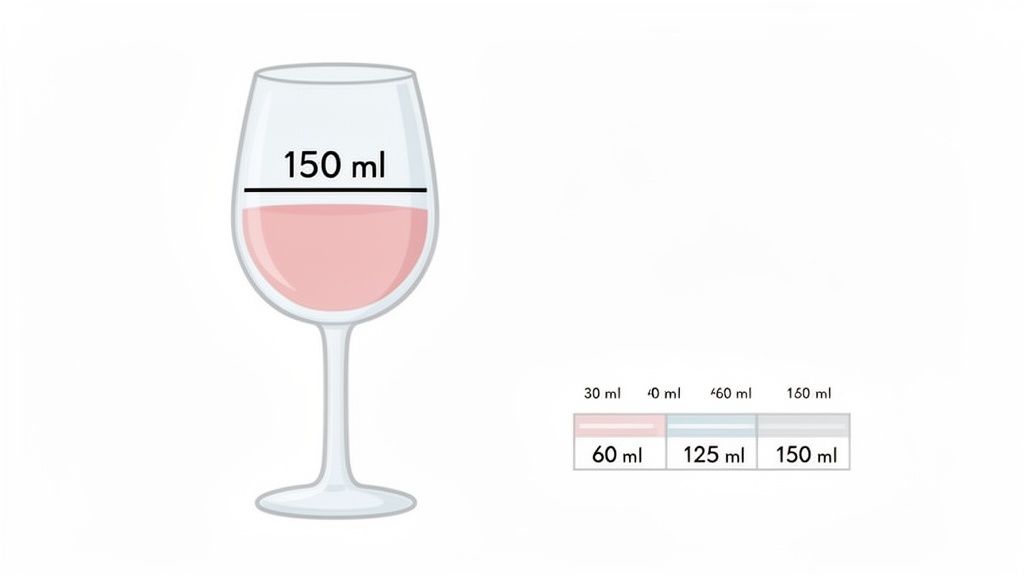
To get you up to speed, we've put together a handy guide on the most common wine pour sizes you’re likely to come across.
Common Wine Pour Sizes at a Glance
This little table breaks down the typical volumes for different wine servings, from a tiny sample to a more generous serve.
| Pour Type | Typical Volume (ml) | Common Use |
|---|---|---|
| Tasting Pour | 30-60 ml | Just a splash, perfect for sampling at a cellar door. |
| Small Glass | 100-125 ml | Often found on menus as a lighter option. |
| Standard Glass | 150 ml | The classic restaurant and bar pour here in Australia. |
| Large Glass | 200-250 ml | A generous serve for when you’ve found a wine you love. |
| Fortified Wine | 60-90 ml | A smaller pour designed for high-alcohol dessert wines. |
Understanding that 150 ml is the standard is a great starting point. It gives you a consistent measure, whether you’re a wine lover wanting to know what you’re getting or a venue aiming for consistency. From here, we can dive a bit deeper into how these servings differ around the world and what they mean for you.
Why 150 ML Is the Australian Standard
When you order a glass of wine in an Australian pub or restaurant, the amount you get isn't just a random guess. The 150 ml serving has become the unofficial industry standard, and for good reason. It strikes a neat balance between offering good value for the customer and making practical sense for the business.
This pour size feels satisfying in the glass, and it allows a venue to get exactly five servings from a standard 750 ml bottle. Simple. But this is also where a common point of confusion comes in: a 'standard serve' of 150 ml is definitely not the same as an official 'standard drink'.
Serving Size Versus Standard Drinks
Think of a 'standard drink' as a public health measure, not a hospitality one. In Australia, one standard drink officially contains 10 grams of pure alcohol. For a typical wine, this works out to be only about 100 ml—quite a bit less than the 150 ml you’re usually poured.
This distinction is crucial if you're keeping an eye on your alcohol intake. The alcohol-by-volume (ABV) percentage, which you'll find on the label, directly changes how many standard drinks are in your glass. If you need a hand decoding the label, check out our guide on understanding Australian wine labels.
The key takeaway is simple: a single 150 ml glass of wine almost always contains more than one standard drink. For many popular wine styles, it's closer to one and a half.
This is exactly why knowing "how many ml are in a glass of wine" matters. To put it in perspective, the Australian Department of Health points out that an average restaurant serve of red wine is often around 1.6 standard drinks. The same 150 ml pour of a lighter white wine might be closer to 1.4 standard drinks.
Comparing Wine Pours Around the World
While we’ve settled on a generous 150 ml standard here in Australia, the answer to "how many ml in a glass of wine?" changes the moment you step on a plane. Ordering a glass abroad can be a surprisingly different experience, with serving sizes shaped by local laws, customs, and dining culture.

Take the United Kingdom, for example. It’s common to see a few different sizes on offer. Venues are legally required to provide a smaller 125 ml pour, though most people tend to go for the more common 175 ml "medium" or even a hefty 250 ml glass.
Global Pour Size Variations
Hop across the Atlantic to the United States, and you'll find the standard pour is typically 5 fluid ounces, which works out to about 148 ml. This makes the American standard almost identical to ours, so you can expect a very familiar serving size in your glass.
In contrast, many parts of Europe lean towards more modest pours. While it varies a lot from country to country, a 125 ml glass is a frequent starting point in places like France and Italy. It's a reflection of a culture where wine is a companion to every meal, not the main event.
Getting your head around these regional differences makes you a more savvy wine drinker, no matter where your travels take you. You'll know what to expect and can better appreciate how local culture shapes the whole wine experience.
To make it even clearer, here’s a simple table breaking down what to expect when you order a glass of wine in different parts of the world.
Standard Wine Pours by Region
This quick guide shows the typical small, standard, and large restaurant servings you'll encounter in millilitres (ml).
| Region | Small Pour | Standard Pour | Large Pour |
|---|---|---|---|
| Australia | 100 ml | 150 ml | 250 ml |
| United Kingdom | 125 ml | 175 ml | 250 ml |
| United States | - | 148 ml (5 oz) | - |
| Europe | 125 ml | 150 ml | 200 ml |
As you can see, while there are similarities, that "standard" glass of wine isn't quite so standard after all. Knowing the local pour helps you order with confidence and manage your consumption, whether you're after a small taste or a generous glass.
Understanding Pours for Tastings and Fortified Wines
Not every glass of wine is meant to be a full 150 ml serve. For special occasions like cellar door tastings or for more potent wine styles, the pour size is adjusted to match the wine's intensity and purpose.
If you’ve ever visited a cellar door in McLaren Vale, you’ll know the tasting pours are much smaller. These are usually just 30-60 ml—and for good reason. It’s the perfect amount to let you properly sample a few different wines, exploring their unique aromas and flavours without feeling overwhelmed.
Servings for Richer Styles
Then you have the big guns: dessert and fortified wines. These richer, more intense styles pack a serious punch with their higher alcohol and sugar content. A standard 150 ml glass would be far too much.
Instead, these powerful wines are served in smaller portions, typically between 60 ml and 90 ml. This smaller serve allows you to truly savour their concentrated complexity and sweetness without tiring out your palate. It’s all about finding the right balance between the wine's intensity and the serving size.
As a rule of thumb, the more potent and flavourful the wine, the smaller the pour. This ensures every sip is enjoyed just as the winemaker intended, from a light tasting sample to a rich, lingering fortified wine.
Getting a handle on these smaller measures helps you appreciate each style in the right context. If you're curious about these richer styles, our complete guide to fortified wines is a great place to start exploring their unique character. Ready to taste one? Shop our Tawny and fortified wine range. With this knowledge, you can serve and enjoy every type of wine with confidence, ensuring the perfect experience every time.
How to Pour the Perfect Glass at Home

When you’re relaxing at home, it's easy to be a little more generous than your local restaurant. Without any lines or measurements to guide you, that “standard” glass of wine can quickly become a lot larger, often creeping well past the typical 150 ml serve.
And you're not alone. Research from Australia and abroad has found that our home pours are consistently larger than the official 100 ml standard drink. One study actually measured them, finding the average pour was 129.4 ml for white wine and 131.7 ml for red.
While there's nothing wrong with a healthy pour, consistently overdoing it means you'll get fewer glasses out of a bottle and might be drinking more than you realise. The good news is, mastering an accurate pour at home is incredibly simple.
Simple Tricks for Accurate Pours
You don’t need any fancy bar tools to get it right. The easiest way to train your eye is with something you almost certainly have in your kitchen already: a measuring cup.
- The Calibration Trick: Start by pouring 150 ml of water into one of your favourite wine glasses. Take a good look at where the water line sits. This is your new visual marker for a perfect pour.
- The Two-Finger Rule: As a quick guide, a 150 ml serve in most standard wine glasses comes up to the widest part of the bowl. This is often about two fingers' width above the stem.
It's worth remembering that the shape of your glass makes a huge difference. A 150 ml pour can look tiny in a big, wide Burgundy glass, tempting you to top it up, while the same amount might look quite full in a slender Riesling glass.
If you’re keen to really nail your technique, checking out some professional tips for achieving the perfect pour can be a great help. These simple tricks build consistency, helping you manage what you drink and get the most enjoyment out of every single bottle.
How Many Glasses Are in a Bottle of Wine?
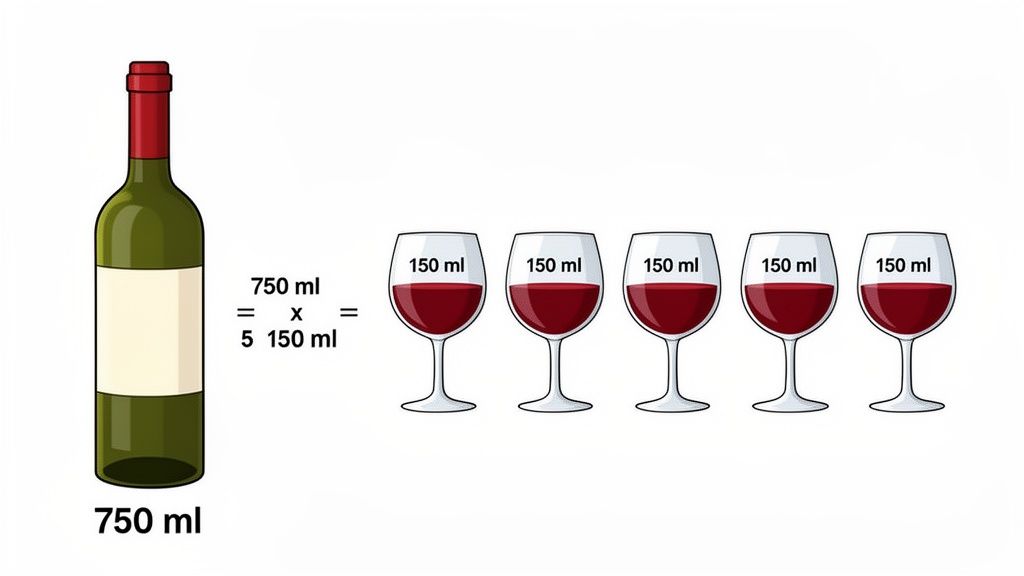
Let's put all the pieces together and see how a single pour relates to the entire bottle. It’s actually beautifully simple: a standard 750 ml bottle of wine holds exactly five 150 ml glasses.
This is the rule of thumb you'll want to remember. It’s a lifesaver when you're planning a dinner party or just trying to keep track of your consumption over the week. Suddenly, abstract numbers become tangible value, and a case of wine isn’t just a box; it's a specific number of serves, making it much easier to stock up.
From the Bottle to the Nation
Putting this into a bigger picture gives us a fascinating snapshot of our national wine habits. According to the Australian Bureau of Statistics, there was enough wine available in one year to pour roughly 190 standard 150 ml glasses for every single adult in Australia.
That breaks down to about 3.65 glasses per week, a figure that helps frame where our own habits might fit in. You can find more of these insights over on the ABS website.
Knowing the simple 5-glasses-per-bottle rule empowers you to make smarter buying decisions and serve wine with confidence, whether you're hosting a crowd or enjoying a quiet night in.
Armed with these numbers, planning becomes a breeze. If you're curious about different bottle sizes and how many glasses they yield, check out our complete guide to wine measurements for a more detailed breakdown.
Common Questions About Wine Servings
Even with the standards sorted, a few questions always seem to pop up. Getting simple, clear answers is the key to pouring and enjoying your wine with confidence. Let's tackle some of the most common queries.
How Many 150ml Glasses Are in a 750ml Bottle?
This is probably the handiest rule of thumb to remember. A standard 750 ml bottle of wine will give you exactly five 150 ml glasses. It’s the perfect bit of maths for planning a dinner party or just knowing how many serves you have left in the bottle. Simple.
Does the Shape of the Glass Change the Serving Size?
While the volume in millilitres should always stay the same, the shape of the glass can definitely play tricks on your eyes.
A 150 ml pour might look a bit lost and lonely in a big, wide-bowled Burgundy glass, tempting you to top it up. Pour that same amount into a tall, slender Riesling glass, however, and it suddenly looks quite generous.
This is exactly why it’s always best to measure your pour by volume, not just by how it looks in the glass.
Why Is a Standard Drink Only 100 ML?
Here in Australia, the term ‘standard drink’ is an official public health measurement that contains 10 grams of pure alcohol. For your average bottle of wine, this works out to be about 100 ml. It's important to remember this is a government guideline and is different from what a bar or restaurant would call a 'standard serve', which is typically 150 ml.
Ready to put your newfound knowledge to the test? Explore perfectly crafted McLaren Vale wines ideal for any pour size at McLaren Vale Cellars — browse our crisp whites and bold reds, and enjoy free delivery on orders over $100.


Comments (0)
There are no comments for this article. Be the first one to leave a message!