
You've poured a McLaren Vale Shiraz on a quiet weeknight, taken a sip, and thought, I like this, but I couldn't tell you why. That's the normal starting point. This guide to wine tasting gives you a calm, repeatable routine you can run at the kitchen bench, using Australian wines as your examples instead of memorised scores or fancy language.
Setting Up Your First Tasting at Home
You don't need a cellar door, a spittoon, or a vocabulary list to start. You need one wine, a clean glass, good light, and a notebook. Pour less than you'd pour for dinner so you can swirl safely, then slow down before that first sip.
Think of tasting as four checkpoints you visit in the same order each time. First you look, then you smell, then you taste for structure, then you notice what lingers after you swallow or spit. Repeating the order is what builds skill, because your brain starts comparing like with like.
Professional tasters work the same way, just with stricter controls. The Australian Grape and Wine sensory evaluation procedure recommends panels of 8 to 12 assessors, trained judges, blind presentation, and blind duplicates to check reliability. You're not running a panel at home, but you can borrow the principle. Separate the wine from the label, and judge what is in the glass.
What to Put on the Bench
Keep the setup boring on purpose. Boring means consistent, and consistent means your notes mean something next week.
- One glass shape: Use the same clean, plain glass for every wine so shape doesn't change the aroma.
- White background: A sheet of paper or a white napkin helps you read colour accurately.
- Water and plain crackers: These reset your palate without adding flavour.
- Notebook or phone notes: Write before you discuss, so price and label talk don't rewrite your first impression.
Practical rule: If you can't describe a wine yet, describe what you'd change. More freshness, less oak, softer tannin. That's already a useful buying note.
By the end of one glass, you should have four short lines, not an essay. Appearance, aroma, palate, and finish. That's enough to remember the wine, compare it next time, and choose better at the shop without guessing.
Reading a Wine Through Appearance
Your first read of a wine happens before your nose goes anywhere near the glass. Tilt the glass away from you over something white, in natural light if you can find it. Look from the deep centre, called the core, out to the thin edge, called the rim. That gradient between the two is the useful part.
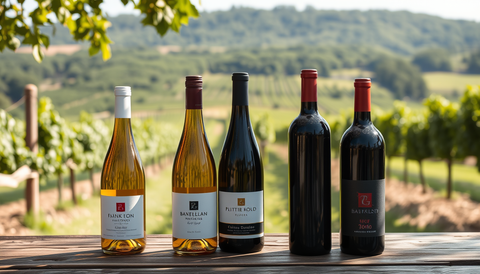
This golden white gives you a clean reference for clarity and brightness before you compare reds or sparkling styles.
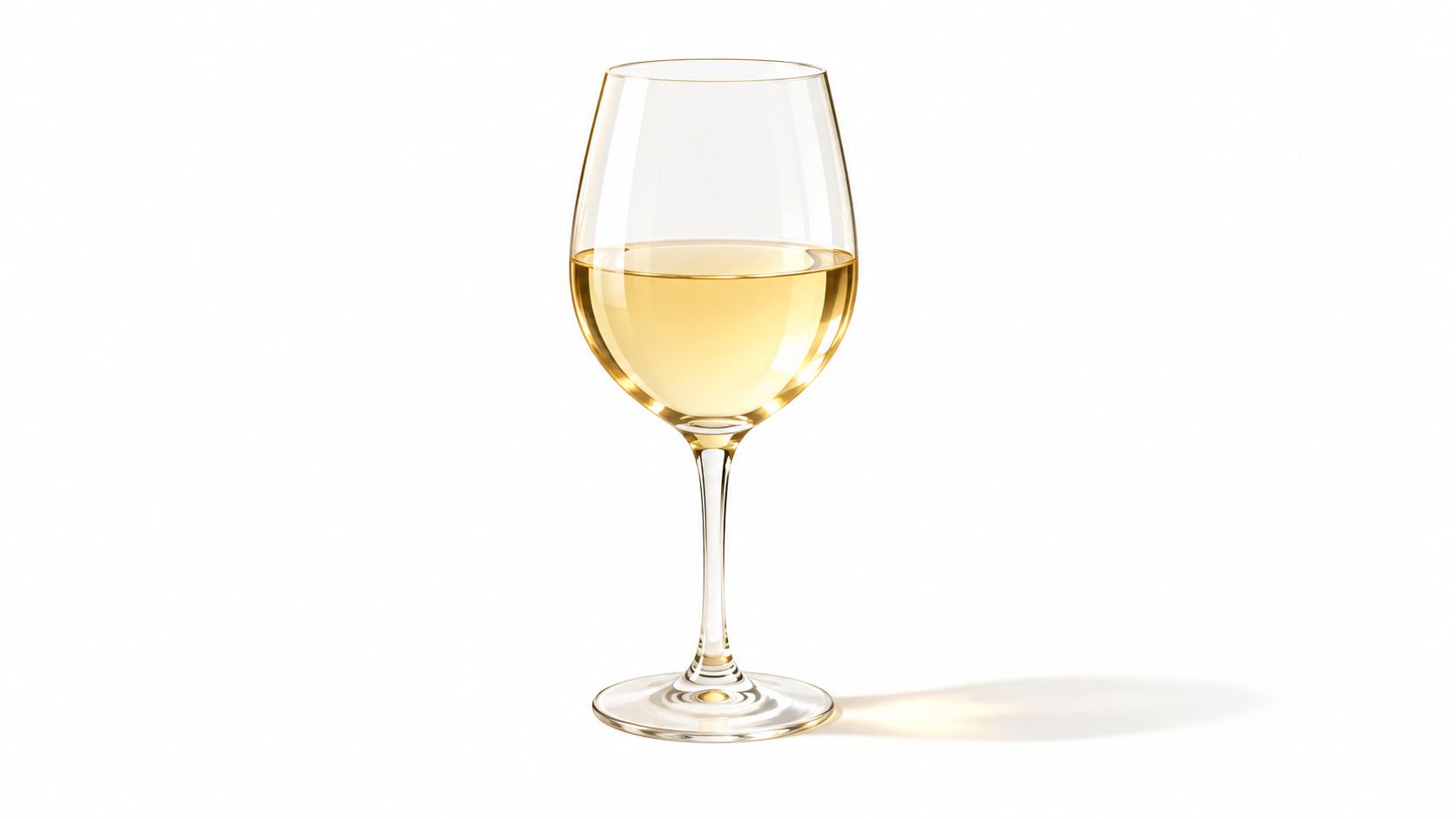
Colour gives clues you verify later on the palate. A young McLaren Vale Shiraz often looks deep purple-red, while a Cabernet Sauvignon can sit darker and shift toward garnet as it ages. A pale rosé should look fresh and bright rather than orange or dull. A Blanc de Blancs sparkling is usually pale straw with fine, steady bubbles when it is well made and properly chilled.
Three checks cover everything appearance can tell you. Write one short line for each.
| Check | What to write |
|---|---|
| Dominant colour | Straw, gold, salmon pink, ruby, purple or garnet covers most wines you will meet |
| Depth | Whether you can see your fingers through the core, or whether it sits opaque |
| Clarity | Clear and bright versus hazy or dull |
Depth hints at variety, ripeness and skin contact. It says nothing about quality on its own. The same applies to haze: most commercial wines pour clear and bright, though some unfiltered styles carry a harmless cloudiness. Haze paired with a dull, flat aroma is the combination that should make you taste cautiously.
One more thing appears after a swirl. Slow drips slide down the inside of the glass, often called legs or tears, and they mostly reflect alcohol, sugar and temperature along with how the wine coats the surface. Thick, slow legs get credited with quality at dinner parties. They do not show it.
Age writes itself at the rim first. Young reds keep a purple or bright ruby edge, older reds drift toward brick and tawny, and whites deepen from pale straw toward gold. Record the rim colour on its own line. When you try the next vintage in six months, that small detail shows you change before your palate can name it.
The Swirl and Sniff Method for Aroma
Smell the wine twice, and treat the two sniffs as different jobs. First, hold the glass still and take one short sniff for the brightest, most volatile aromas. Then swirl for a few seconds, let the wine coat the glass, and sniff again more thoroughly for the fuller picture underneath.
The diagram below breaks aroma into families, which is easier than hunting for one perfect descriptor.
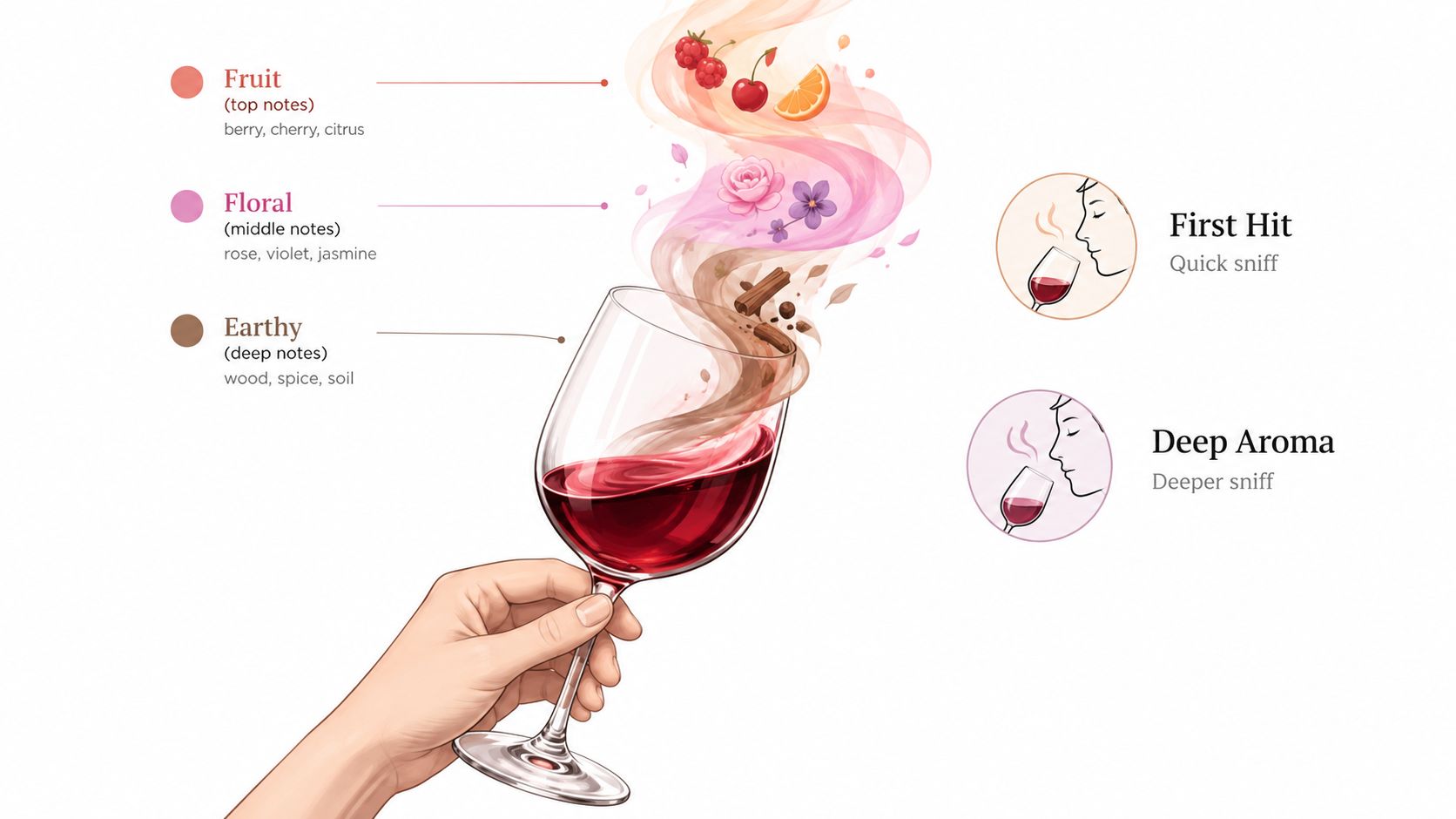
Swirling does real work. It releases aroma compounds into the bowl of the glass and mixes in a little oxygen, so muted wines open up. If you're nervous about splashing, keep the base of the glass flat on the bench and move it in small circles. You'll get the same effect without redecorating your shirt.
Sorting Aromas Into Three Layers
Primary aromas come from the grape and fermentation. Think blackberry, plum, and dark cherry in McLaren Vale Shiraz, citrus and passionfruit in Sauvignon Blanc, or strawberry in a fresh rosé. These usually hit first and smell like fruit, flowers, or herbs.
Secondary aromas come from winemaking choices. Vanilla, toast, and cedar suggest oak, while brioche, biscuit, and toasted nut in a méthode traditionnelle sparkling point to time on lees. Tertiary aromas develop with bottle age, such as dried fruit, leather, tobacco, or forest floor in an older red. You don't need to find all three layers. Young wines may only show the first, and that's fine.
Watch this short demonstration, then try the two-sniff routine on your next glass without pausing to name everything at once.
If you get stuck, choose a family before a specific word. Is it fruit, floral, spice, earth, or oak. Then narrow it by one step, red fruit or dark fruit, fresh or dried. That habit stops every note becoming just fruity, and it makes your next comparison far clearer.
Mapping Palate, Tannin, Acidity and Finish
At the kitchen bench, taste one sip of McLaren Vale Shiraz, then pause before taking another. Notice how it feels across your mouth: that physical framework, alongside flavour, helps explain why a wine seems fresh, weighty, grippy or soft. A repeatable check makes it easier to compare wines without relying on memory alone.
The tongue diagram can be a useful prompt, though texture and acidity are felt across the mouth rather than in separate zones.
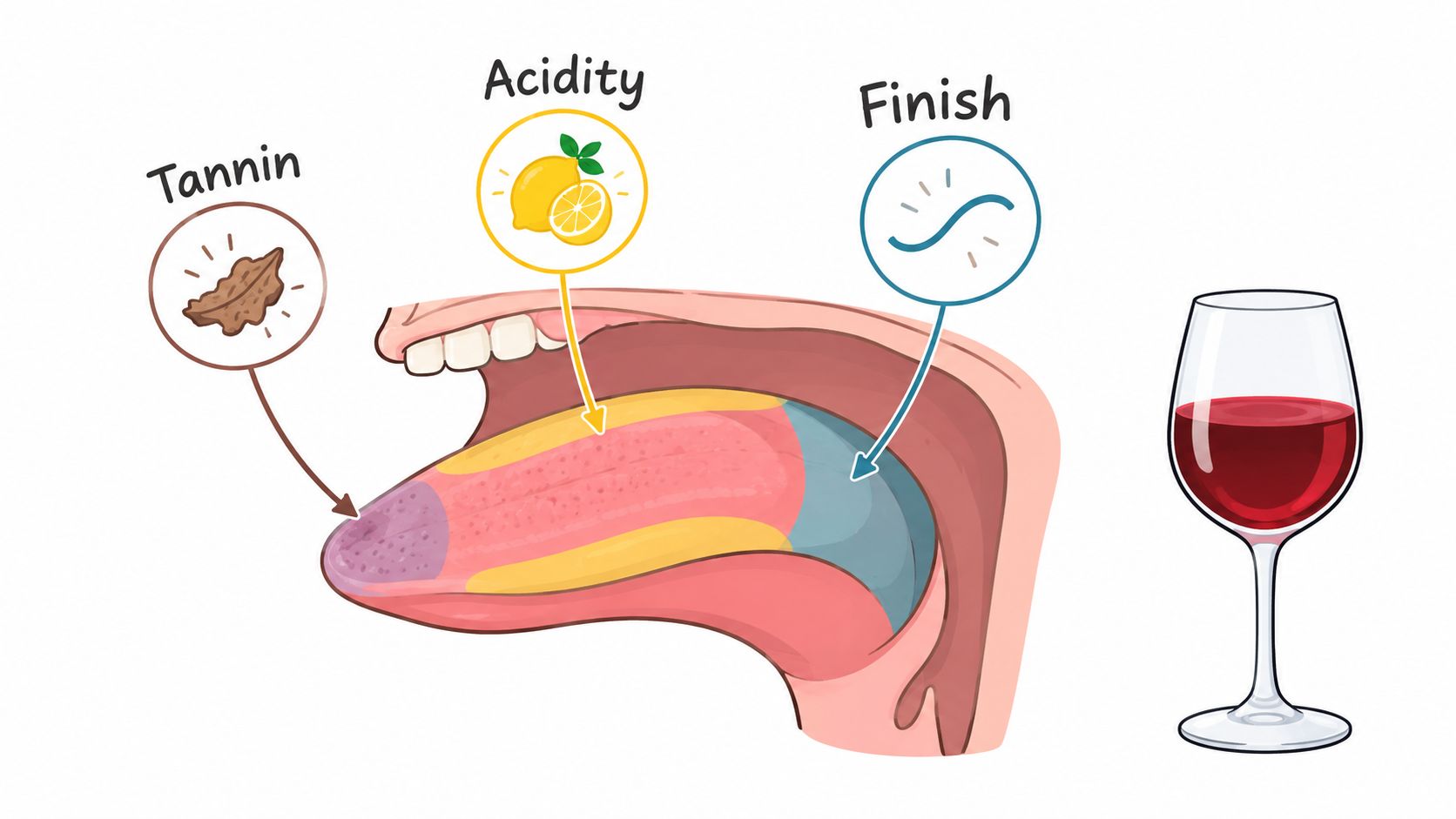
Tannin creates a drying, puckering sensation, much like strong black tea. It comes largely from grape skins and seeds, and can also come from oak. Australian sensory research on Cabernet Sauvignon and Shiraz mouthfeel treats astringency as distinct from bitterness, linking it to tannin and other phenolic substances. Check its strength, texture and duration: is the grip light or strong, fine and powdery or coarse, brief or lingering?
Record five quick observations. A word or two is enough. Use low, medium or high, adding a texture word where it helps.
| Checkpoint | What to notice |
|---|---|
| Acidity | Mouth-watering freshness, like the sharp bite of a crisp apple. Too little can leave a warm-climate red feeling flat; too much can make it seem sharp. |
| Alcohol | Warmth at the back of the throat. Keep it separate from body: a lighter wine can still feel hot if the alcohol stands apart from the fruit. |
| Body | The wine's weight on your palate, a little like the difference between skim and full-cream milk. McLaren Vale Shiraz often feels fuller than Pinot Noir, even when both have plenty of flavour. |
| Tannin | The drying sensation on your gums. Record its texture separately from the intensity of dark fruit. |
| Finish | What remains after you swallow or spit: fruit, spice, drying grip or warmth. Note how long it lasts and whether the flavours stay clear. |
For comparison, a Napa Cabernet tasting experience can offer another warm-region reference for firm tannin and dark fruit. Use that contrast to notice how an Australian Cabernet may pair ripe fruit with freshness.
A high-tannin wine can still feel balanced when its fruit, acidity and lingering flavours support the grip. If drying sensation dominates everything else, the wine may feel harsh.
Leave “smooth” out of your first notes. Once you've recorded medium acidity, fine tannin and medium body, for example, you have a clearer guide for choosing another bottle than a general memory of liking the wine.
Adapting the Method for Lighter Australian Styles
Big reds don't own serious tasting. A chilled rosé, a Pinot Grigio, a sparkling wine, and a Shiraz all reward the same four checkpoints, but you change what you lead with. For lighter styles, refreshment, temperature, bubbles, and delicate fruit often matter more than tannin and oak.
Australian off-premise reporting covered in the Endeavour Group insights report on the Australia off-trade market identifies growth in sparkling, rosé, spritzers, and other convenient formats, with Pinot Noir, Pinot Grigio or Gris, and Prosecco gaining share. Your tasting method should match how you drink on a warm afternoon, not just how you'd judge a cellar red in winter.
A Small Flight You Can Run at Home
Serve four small pours in this order, sparkling first, then chilled white, then rosé, then Shiraz last. Taste each one at its proper serving temperature, write your notes, and only then go back for a second sip if you want to check the finish.
| Wine Style | Lead With | Watch For |
|---|---|---|
| Sparkling Blanc de Blanc | Bubble fineness and freshness | Brioche or citrus, clean dry finish |
| Pinot Grigio or Sauvignon Blanc | Acidity and aroma lift | Fruit clarity without heaviness |
| Rosé | Refreshment and texture | Dryness, red fruit, food friendliness |
| Pinot Noir | Delicate tannin and perfume | Silky texture versus thinness |
| McLaren Vale Shiraz | Fruit depth and structure | Tannin grip balanced by freshness |
If Pinot Noir is your bridge between whites and fuller reds, this overview of Australian Pinot Noir styles and regions gives you a lighter red to slot into the flight before Shiraz. Notice how your questions shift as you move down the table. With sparkling you're asking how fine and persistent the bubbles feel, with rosé you're asking whether it's dry and refreshing, and only with Shiraz does tannin become a lead question.
Don't award points across styles that are trying to do different jobs. Ask instead, would I pour a second glass, what food would suit it, and did it stay interesting as it warmed slightly in the glass. A lighter wine that refreshes cleanly and finishes with flavour isn't simpler in a lesser sense. It's succeeding at a different occasion.
Running a Controlled Home Tasting
Two Shiraz pours can seem worlds apart if one is warmer, served in a different glass, or introduced with its price. A controlled tasting keeps those influences steady, so you can focus on what's in the wine. Use the same glasses, pour size and serving conditions, and write your first impressions before discussing labels.
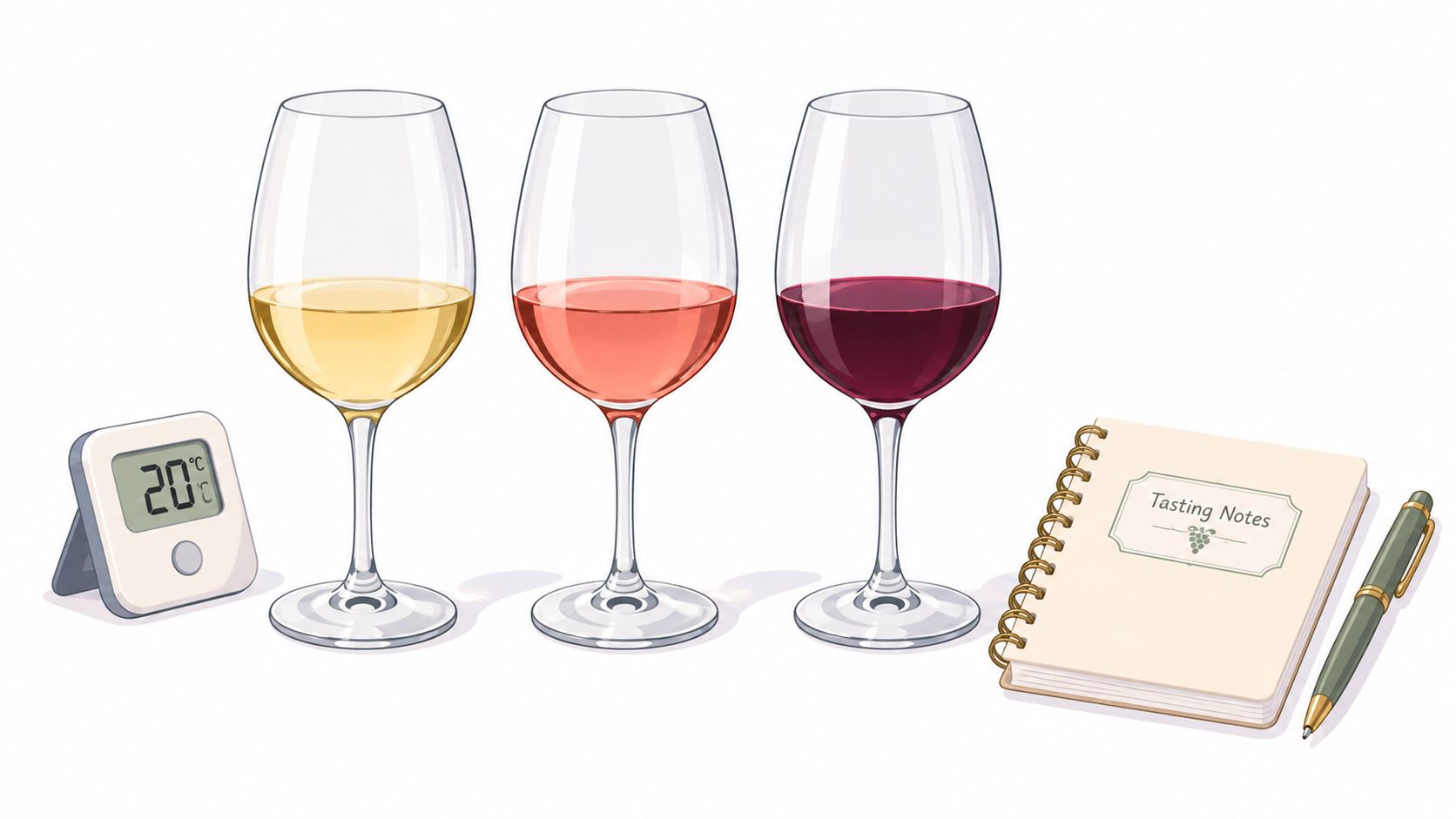
The Australian Wine Research Institute's sensory assessment guidance recommends pouring approximately 30 mL per sample and serving samples at a consistent temperature near 20°C for sensory assessment. Treat that temperature as a comparison benchmark, particularly for reds, rather than a serving instruction for every style. For example, keep two McLaren Vale Shiraz samples at the same temperature; serve whites, rosé and sparkling at a consistently chosen cooler temperature.
A thermometer can help, though matching conditions matters more than buying extra equipment. A few small pours, identical glasses and a notebook are enough to begin.
Keep Your Notes Blind
Ask someone else to assign each wine a three-digit code and pour it out of sight. If you're tasting alone, cover the labels and number the glasses before pouring. Set a time limit, such as an hour, so the final sample doesn't sit much longer than the first.
For each wine, jot down a few observations rather than trying to name every aroma:
- Appearance: note colour, depth and clarity.
- Aroma: record one fruit scent and, if you notice one, a non-fruit scent.
- Structure: rate acidity, tannin, alcohol and body as low, medium or high.
- Finish and verdict: write what lingers and whether you'd choose the wine again.
Keep cooking smells, scented candles and perfume out of the room. Garlic on the stove can blur the aromas you're trying to assess. If you're sampling several wines, spit or keep each pour small, and stop when your palate feels tired. Control makes the comparison clearer; it doesn't need to make the evening formal.
Tasting Etiquette for Hosts and Guests
At a kitchen-table tasting, one guest may reach for the Shiraz while another is still writing about the rosé. A calm pace gives everyone room to notice their own response before the group's opinions take over. Offer water and plain crackers between wines, and leave a pause for people to collect their thoughts.
Serve from lighter to fuller styles: sparkling, whites and rosé, then lighter reds, followed by McLaren Vale Shiraz or Cabernet Sauvignon. A fuller red can leave your palate feeling coated, making a delicate Pinot Grigio seem faint by comparison.
Keep the Conversation Easy
Ask questions that invite observation, not a perfect answer. “What fruit do you notice?” or “Would you choose another glass?” gives guests a way in. A comment such as “The tannin feels drying to me” is useful feedback, even if someone else enjoys that same quality.
Let guests taste in their own way. A spit cup should be available without comment, and a small pour leaves room to revisit a wine. Hold back the labels until people have shared their first impressions, so the name or price doesn't steer the discussion.
For more ideas on relaxed pouring and cellar door manners, see this guide to wine etiquette without pretension. Good hosting makes curiosity feel welcome.
Building Confidence as a McLaren Vale Taster
Confidence doesn't come from naming fifteen aromas in one sniff. It comes from tasting the same variety twice, writing honest notes, and noticing that your second note is sharper than your first. Calibration through repeated comparison is how professional assessors improve, and it's how home tasters improve too.
Region and vintage belong in every note because McLaren Vale isn't one flavour. Grapevines were planted there in 1838, and the South Australian Winegrape Crush Survey 2023 regional summary for McLaren Vale recorded a crush of 26,467 tonnes, the lowest since that survey began in 1993. Weather shifts like that can change ripeness, acidity, and concentration, so comparing two vintages of the same Shiraz teaches you more than chasing a new label every week.
Try three simple exercises over the next month. Taste a McLaren Vale Shiraz beside a Barossa Shiraz and write only about tannin, acidity, and fruit ripeness. Revisit a favourite wine after food and note what changed. Run one blind flight of three reds using codes, then check whether your favourite was the one you expected.
Keep sustainability claims separate from flavour judgement. Wine Australia reporting on consumer opinions research on certified sustainable production found certified sustainable production was very or somewhat important to 56% of surveyed consumers in 2025, but a credential doesn't guarantee you'll love what's in the glass. Ask what evidence sits behind a claim, taste the wine blind where you can, and let both answers inform the purchase.
When you're ready to go deeper on local examples, work through this step-by-step sensory guide to tasting McLaren Vale wines with a notebook beside you. McLaren Vale Cellars sells mixed dozens and sample packs that suit this kind of side-by-side practice, which is one practical way to build a flight without buying full cases of one wine. Keep your notes, trust the pattern that emerges, and buy more of what your own palate keeps choosing.
Put this routine to work with a small mixed flight of Shiraz, Cabernet, rosé, and sparkling from McLaren Vale Cellars, where you'll find curated sample packs, value dozens, and tasting resources built for home practice. Pour small, write your five lines before you check the label, and use your own notes to choose your next case with confidence.
Comments (0)
There are no comments for this article. Be the first one to leave a message!